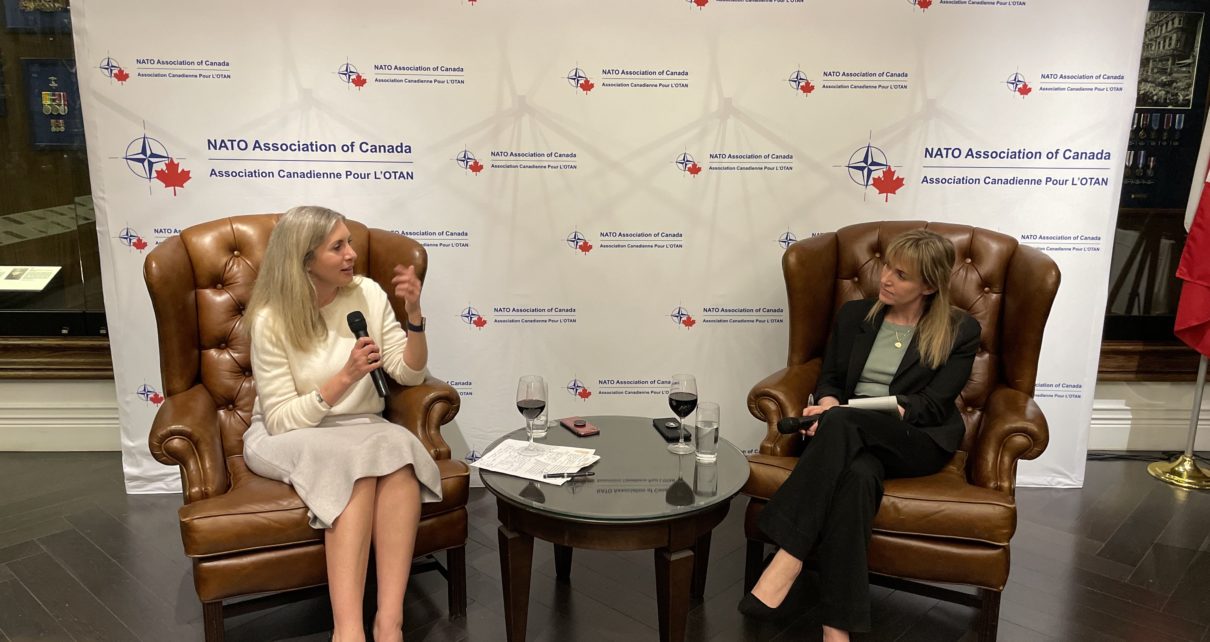
Jean Chrétien, Canada’s twentieth prime minister, had his audience in an effervescent mood on March 15th at the Globe and Mail Centre. As the guest of honour at an event organized by the NATO Association of Canada to recognize Mr. Chrétien’s legacy in Canadian foreign affairs and his contributions to the evolution of NATO, he Read More…
Tag: NATO
The Role of the Transatlantic Bond and Democratic values as a Prerequisite for the Relevance of NATO: Ukraine and the Pandora Box Dilemma
There is an ongoing debate whether there is a linkage between the importance of transatlantic values and the level of effective commitment that might contribute to the enduring success of the North Atlantic Treaty Organization (NATO). In my strongest opinion, there is a precondition to how our alliance can achieve success in the future. And Read More…
A Decade of Engagement: Jean Chrétien and NATO
Significant international events—the breakup of Yugoslavia, NATO enlargement, the invasions of Afghanistan and Iraq, to name a few—occurred during Jean Chrétien’s decade as prime minister. This retrospective examines Chrétien’s foreign policy with a specific emphasis on his government’s engagement with NATO.
Germany’s Tornado Gap: Nuclear-Sharing and the F-35
Germany’s underfunding in the development of a new fighter-bomber leaves a capability gap in NATO’s nuclear sharing agreement when the Tornado retires in 2030. Germany must now turn to the F-35 to fill the gap.
Deciphering the Russia-Ukraine War – A Discussion with Professor Marta Dyczok
In this article, Arash Toupchinejad interviews Professor Marta Dyczok from Western University about the socio-cultural and economic implications of the conflict between Russia and Ukraine and the heightened tensions to better assess the status of the situation in Eastern Europe.
Special Report: NATO’s Forgotten Western Flank
In this special report, Research Analyst Andrew Erskine poses the case for why NATO needs to acknowledge its western flank as a legitimate geo-security periphery. Demonstrating the periphery’s history, geo-security gravity, and opportunity to amplify intra-alliance unity and cohesion, Andrew presents a timely insight for why the time is ripe for including a new geopolitical flank to NATO’s security and defence mandate.
What Should be the Maximum Extent of NATO Expansion?
The NATO Association of Canada’s editors share their thoughts this week on what NATO’s expansion (or lack thereof) could look like based on today’s international relations. Olivia Cretella Strategic partnership is a concept that allows for two or more countries to improve or enhance relations in order to maximize their abilities to achieve positive international Read More…
NATO, AUKUS & the Indo-Pacific: Further Proof of Intra-Alliance Friction
In this article, Research Analyst Andrew Erskine assesses the implications of the AUKUS security pact on NATO’s unity and cohesion towards a collective Indo-Pacific strategy and the need for the Alliance to develop an Indo-Pacific Council to avoid further debacles of intra-alliance friction.
Trouble in the Caucasus – The Roots of Iran’s Tensions with Azerbaijan
One year after the Nagorno-Karabakh war, regional security in the South Caucasus is once again at risk. This time, Iran and Azerbaijan are at odds as the countries exchange words and flex their military might in drills across their shared border. In this article, Arash Toupchinejad highlights the root causes of the increasingly sociopolitical dispute and how it could have significant implications for NATO.
Zero Trust Networks: A New Normal for Cybersecurity?
What is Zero Trust in cybersecurity, and what are the reasons for the Biden administration’s push towards a Zero Trust architecture? In this article, Bryan Roh explains some of the reasons why the Zero Trust security model is gaining momentum in both the public and private sectors.