The 2025 Science and Technology Organization (STO) Highlights Report is a stark reminder that in an environment characterized by compressed decision cycles and rapid response requirements, technological military advantage depends less on possessing advanced systems than on how seamlessly they operate across domains, nations, and architectures. Progress in integrated platforms and autonomous sensing and countermeasure systems point to a consistent challenge: while data infrastructure, AI-driven autonomy, and multi-domain operations (MDO) are advancing rapidly, they are not evolving in a coherent or integrated manner both within and among Allied nations. Because MDO effectiveness depends on synchronizing digital and physical frameworks so that air, land, sea, cyber, and space systems may function simultaneously, this lack of integration becomes a growing operational risk. The challenge becomes all the more acute as NATO expands its autonomous capabilities to cover an expanded security purview.
Such tension is already visible in NATO’s own policy architecture. The 2022 Autonomy Implementation Plan stresses that autonomous systems only function reliably when Allies share testing frameworks and interoperable command and control (C2) architectures, while traceability and auditability depend on consistent, high‑quality data. Those foundations currently remain patchworked, creating modernization gaps that risk slowing NATO’s ability to convert innovation into practical advantage.
Pillar One: Data
As the STO report underscores, data is the substrate of modern warfare and thus the raw material from which decisive breakthroughs in autonomy and multidomain operations are built. The clearest example of NATO’s evolving data needs is Mainsail, described as a “cutting‑edge data platform” that fuses underwater acoustics and satellite information into a single operational picture. As one of the most mature demonstrations of multidomain fusion in the Alliance, the project demonstrates the practical value of data that is both cross‑domain and machine‑interpretable.
However, Mainsail currently remains the exception rather than the norm. The STO report also highlights the Data and Sharing Hub (DASH), which exists precisely because data sharing across the Collaborative Programme of Work remains “largely limited to individual Research Task Groups”, with “no standardized mechanism” for sharing across groups or nations. Recent NATO-level analyses reinforce this picture: the Alliance’s Data Strategy acknowledges that national systems still operate in isolated ways that hinder seamless exchange, while the Data-Centric Reference Architecture describes a landscape shaped by divergent national practices that complicate interoperability. European Allies continue to rely heavily on US-driven data infrastructures, underscoring how uneven development across the Alliance shapes who can access, contribute to, and benefit from shared information.
Taken together, the STO report situates itself squarely within NATO’s broader effort to transform data from a scattered technical resource into a coherent strategic asset. What the STO makes clear is that NATO’s operational ambitions in autonomy and multidomain integration will only be realized when data governance, sharing, and quality are treated as core elements of collective defence.
Pillar Two: Autonomy
Autonomous systems are one of the notable areas of progress in the STO report. The Anti‑Submarine Warfare Programme now deploys autonomous underwater networks using collaborative sensing incorporated into machine learning‑enabled detection, while the Maritime Unmanned Systems Enablers Programme integrates live data, mission planning, optimization algorithms, and simulations to investigate uses for unmanned assets at sea. These indicate concrete steps toward NATO’s interoperability aims, which necessitates more involvement across a greater strategic purview.
However, in contested environments where data is prone to being jammed or compromised, autonomous systems can misclassify and misinterpret, ultimately failing to coordinate proper response in critical moments. This applies particularly to the AI and algorithms that power these systems, and bottlenecks in common processes for data provenance, metadata standards, and model documentation complicate the cross‑national verification needed to ensure models behave predictably outside their original training environment. Divergent security classifications and proprietary constraints further prevent Allies from pooling datasets or conducting joint audits, limiting the Alliance’s ability to diffuse these technologies across borders.
The result, as reflected in the STO report, is an Alliance fielding autonomy faster than it is securing the foundational pipelines that make it dependable. Without stronger data frameworks and more interoperable C2 architectures, autonomous systems risk becoming isolated “islands of excellence” that are technically sophisticated, but unable to integrate into a wider operational ecosystem.
Pillar Three: Multi-Domain Operations
MDO is the conceptual backbone of NATO’s future warfighting model, and the STO report showcases both the impressive progress and the constraints that still shape this transformation. The Seabed‑to‑Space Situational Awareness (S3A) project is a case in point: it represents one of NATO’s most advanced fusion efforts, combining satellite imagery, AI-enabled detection, and deep learning methods to monitor activity around critical undersea infrastructure.
Yet even at this level of sophistication, its architecture is not easily transferable across NATO commands or integrated into many national systems. These limits are intensified by disparities among NATO members, particularly smaller states who often rely on legacy systems and repositories, making it difficult to align with projects like S3A or participate in real‑time information exchange. As a result, NATO’s sophisticated multidomain tools risk becoming unevenly adopted, reinforcing existing gaps and dependencies, and ultimately complicating the Alliance’s ability to operationalize MDO as a truly collective capacity.
The Risk of Siloed Progress
The strategic risk is not as much a lack of innovation – the STO report makes clear that NATO is advancing rapidly – but the deeper challenge of integration. Without shared data frameworks across all NATO members and interoperable systems in service of broader MDO aspirations, NATO risks creating pockets of advanced capability that cannot be synchronized at speed. This fragmentation is most acute for smaller Allies, who face disproportionate barriers to adoption with the result of eroding collective cohesion. Left unaddressed, these structural asymmetries could stall NATO’s modernization trajectory, as technological progress outpaces the institutional capacity to integrate it holistically.
Conclusion: Alignment as Strategic Imperative
The 2025 STO Highlights Report is a catalogue of scientific and technological achievement, but also a blueprint of the dependencies between them. It underscores a central strategic reality that future advantage will hinge less on the sophistication of individual systems than on the Alliance’s ability to integrate information and adapt across domains at both scale and speed.
What remains uncertain, and strategically consequential for NATO, is whether these components can be aligned into an architecture that moves as quickly as the technologies it is beginning to field. The report shows an Alliance capable of extraordinary innovation; the next test is whether it can convert that innovation into coherent operational advantage.
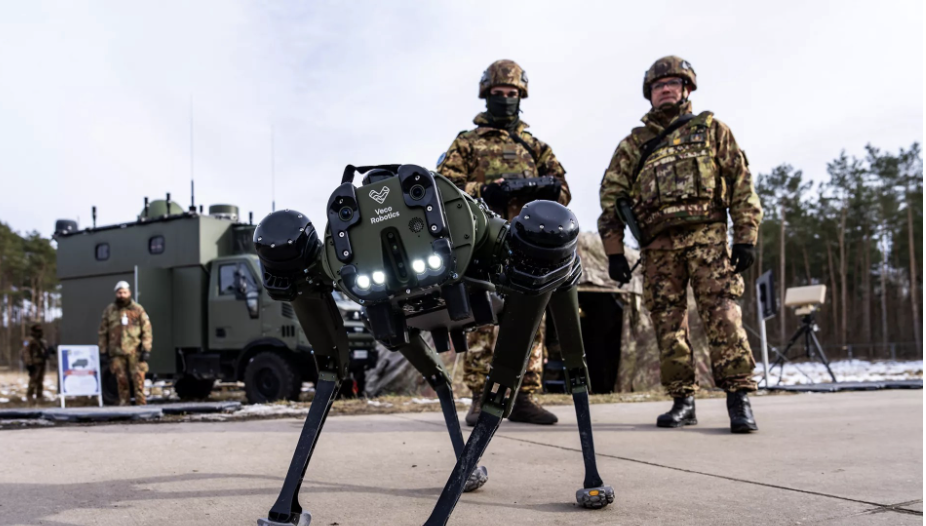
Image Citation: “Exercise Steadfast Dart 26 showcases NATO’s rapid reinforcement and the Allied Reaction Force” (2026), by NATO via NATO Multimedia Portal.
Disclaimer: Any views or opinions expressed in articles are solely those of the authors and do not necessarily represent the views of the NATO Association of Canada.