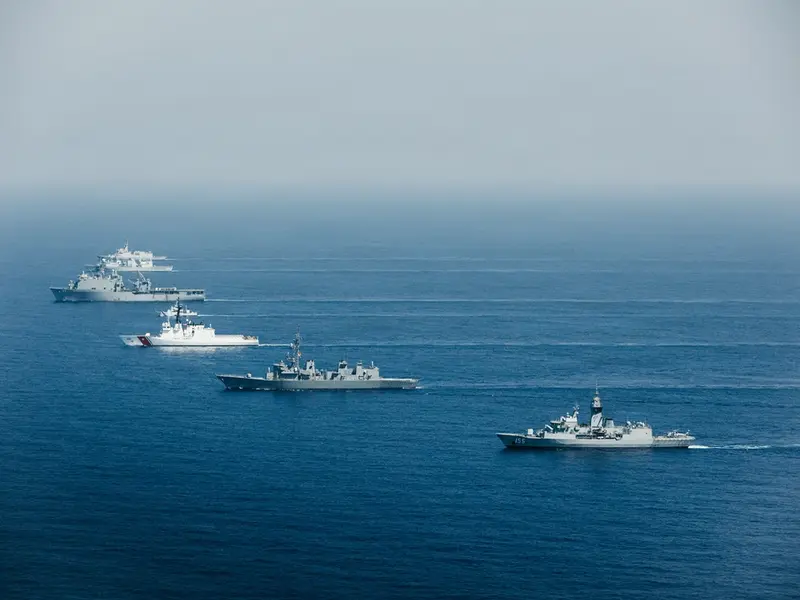
Between April 20 and May 8, 2026, Canadian warship HMCS Charlottetown and combat support ship MV Asterix sailed shoulder-to-shoulder with American, Australian, Japanese, and French forces in the waters off the Philippines, participating in Exercise BALIKATAN 2026. The Exercise marked its 41st iteration in 2026 and Canada’s transition from observer status to active training participant, made possible by the signing of the Status of Visiting Forces Agreement (SOVFA) the previous year. Canada’s newly active role marks a diplomatic milestone and a clear statement of collaborative intent in the region. BALIKATAN, Tagalog for ‘shoulder-to-shoulder’, also captures the spirit in which Indo-Pacific middle powers are increasingly choosing to act together.
Exercise BALIKATAN operates under Operation HORIZON, part of Canada’s Indo-Pacific Strategy that launched in 2023, and is authorized to run until 2028. Its operational goal is for Canada to support peace, security, and the rules-based international order in the Indo-Pacific region. With the Indo-Pacific at the centre of a rapidly evolving international order, nations in the region are increasingly turning to regional frameworks as global institutions weaken. Building a persistent and meaningful presence in the Indo-Pacific will serve Canada’s long-term strategic interests well; understanding why that presence matters now requires looking at the forces reshaping the region itself.
Since WWII, Asia’s maritime security has been largely anchored by U.S. primacy, and Washington continues to view the region as strategically vital. The 2026 U.S. National Defense Strategy announced its military’s foremost priority lies in defending the U.S. homeland, followed by deterring China in the Indo-Pacific. Amid intensifying competition with China, ongoing involvement in European and Middle Eastern conflicts, and growing domestic political pressures, Washington’s strategic attention is stretched. As a result, many Indo-Pacific nations are seeking to diversify their security cooperation beyond the United States. In contrast, China has presented a more exclusive vision for what Asian regional security should look like. In 2014, President Xi Jinping called for a New Asian Security Concept, calling on Asia to “run the affairs of Asia, solve the problems of Asia, and uphold the security of Asia”; in other words, a departure of Western military capable of checking Chinese hard power from the region. A decade later, this vision carries more weight under China’s growing global influence. Yet China’s hegemony-building efforts remain constrained by credibility deficits and regional skepticism, producing a “fragmented and contested security landscape“.
With the U.S. preoccupied, and China’s vision of ‘Asian security for Asians’ still uncertain, Canada is at a strategic time to deepen its relationships with the region. This contested landscape allows for global middle powers to play a larger role in defence. Japan, Australia, and South Korea are already strengthening their own intraregional defence partnerships, while expanding engagement to other middle powers beyond the Indo-Pacific. For Canada, this realignment among middle powers is an opening.
Over the past four decades, Canada’s engagement in the Indo-Pacific has been deemed “erratic”, marked by reactive disaster relief instead of long-term strategy. The RCN’s force posture has historically been concentrated in the Atlantic as well. With the majority of its fleet based on the East Coast, despite the West Coast serving as Canada’s geographical gateway to the Indo-Pacific. Due to fleet-size limitations, deployment costs, and a strategic emphasis on homeland defence, the RCN does not permanently station warships in the Indo-Pacific. Compare that to the United States, which maintains key naval assets in Japan, Guam, and Singapore. For Canada, operations and exercises that strengthen middle power defence relationships are the most practical tools for maintaining a presence in a region it cannot yet permanently base forces in.
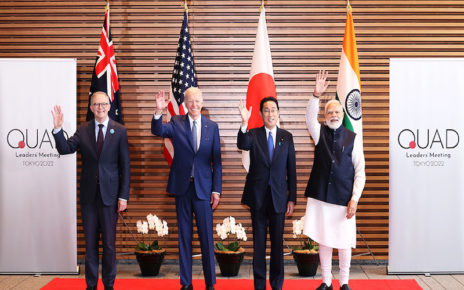
Canadian defence outreach to the Asia-Pacific has been on an upward trajectory. Since PM Mark Carney’s election in 2025, diversifying Canadian partnerships in the Indo-Pacific has become a main foreign policy effort. At the 2025 G7 Leaders’ Summit, Carney invited the Prime Ministers of India and Australia, and the President of South Korea, as guests. India, Australia, and South Korea are Indo-Pacific middle powers with expanding naval and defence cooperation networks. Their presence at the Summit can be interpreted as part of Carney’s broader Indo-Pacific alignment strategy: to strengthen ties with democratic partners, and build security and defence-industrial relationships across the region. Though the most consequential bilateral development may be with Japan.
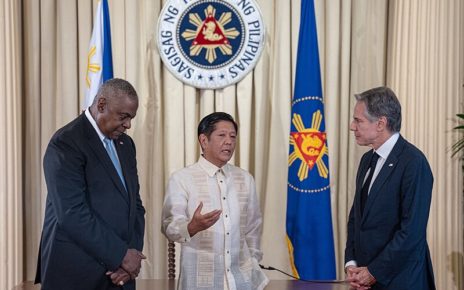
Japan, already a G7 member, hosts major U.S. naval assets and plays a leading role in maintaining the region’s stability, making it among the most strategically significant partners Canada can cultivate in the Indo-Pacific. Following a meeting between Carney and Japanese PM Ishiba Shigeru in March 2026, a new Comprehensive Strategic Partnership across defence was announced. The partnership emphasises bilateral exercises, interoperability, and strategic planning, reflecting a shared commitment to strengthening defence coordination. The agreement includes three bilateral Memoranda of Cooperation, joint naval sails and Coast Guard exercises, and the potential for Japan to participate in Operation NANOOK.
Maintaining partnerships and strengthening interoperability with allies is Canada’s most effective path to strategic relevance and trust in a region it cannot sway by fleet size alone. By demonstrating that Canada is a reliable Pacific security actor, political trust can be built with Indo-Pacific partners, keeping the rules-based international maritime order part of the conversation. Whether Xi’s “Asian security for Asians” regains traction, U.S. strategic uncertainty persists, or China-U.S. tensions escalate further, Canada with a mid-sized naval capacity cannot afford to wait. New partnerships that bring Canada into regional security conversations are also urgent before Indo-Pacific defence architecture becomes more formalized, and potentially exclusionary under an increasingly uncertain political climate.
Canada’s most credible role is not that of a military heavyweight, but of a diplomatic bridge-builder: a consistent, rules-based partner that Indo-Pacific middle powers can rely on because it carries none of the baggage associated with the great powers. The shoulder-to-shoulder spirit of BALIKATAN is an open invitation. Canada’s task now is to show up alongside its middle power allies before the door closes.
By Anastasia Crook
Any views or opinions expressed in articles are solely those of the authors and do not necessarily represent the views of the NATO Association of Canada.
Image Credit: Balikatan 2026: Task Force Ashland participates in Group Sail [Image 3 of 12], by Gunnery Sgt. Manuel Serrano. Accessed via DVIDS. Public Domain.