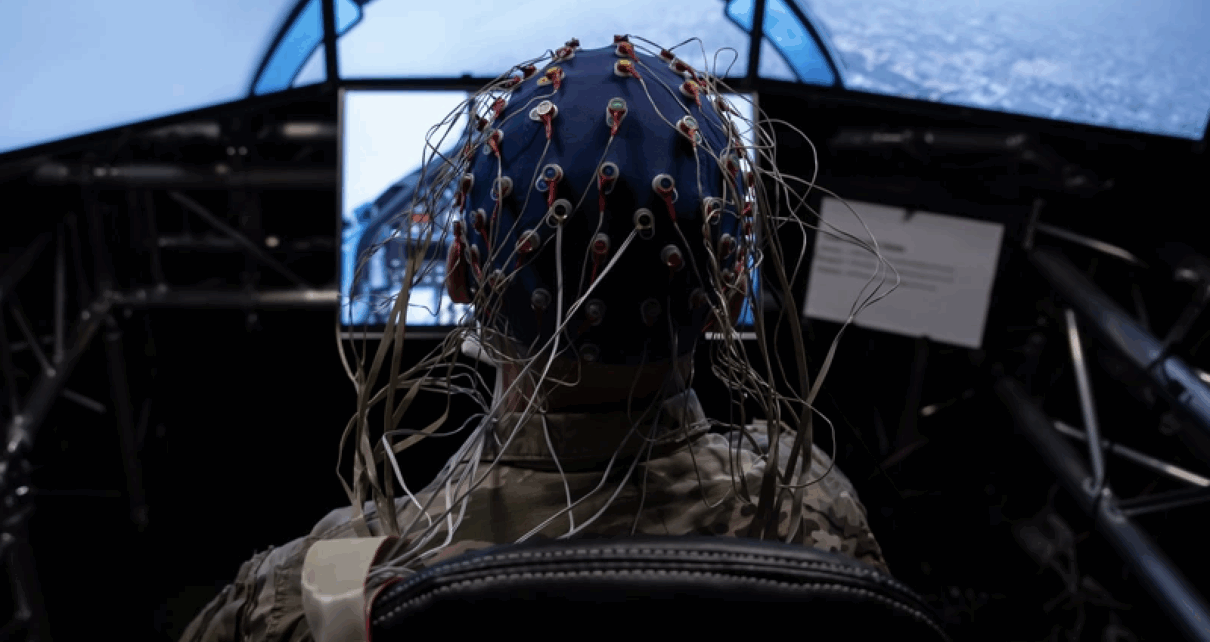
The 2025 announcement of NATO’s Defence Innovation Accelerator for the North Atlantic (DIANA) funding cohort was dominated by high-profile artificial intelligence (AI) and energy projects. Among those selected, however, was a company whose work carries significant strategic implications: Neuroverse, a startup developing wearable brain interfaces that can detect cognitive and emotional states.
Neurotechnology is advancing rapidly from medical origins to an inherently dual-use field shaped by military investment. Use cases range from translating neural signals into commands, to monitoring cognitive load, to altering neural activity entirely; in operational contexts, this could include interfaces that support interrogation, improve information processing, or enable personnel to control unmanned weapons systems. More speculative research explores constraining pain or fear responses, or even enabling direct brain-to-brain communication. These possibilities underscore both the promise and the risks of neurotechnology, highlighting the need for NATO to anticipate vulnerabilities before they become embedded in operational systems.
Neuroverse’s selection signals NATO’s recognition that, even amid rapid advances in AI, the human remains central to defence and deterrence. Neurotechnology is emerging as an integration mechanism linking human cognition with increasingly autonomous systems, using tools that detect, translate, or modulate brain signals to enable more efficient and precise operational capabilities. Some view this as a step toward the “super soldier”, while others describe the brain itself as a new combat space. As neurotechnology increasingly intersects with a broader human enhancement agenda stretching from biological modification to AI, the pace and diversity of development risks outstripping existing governance frameworks.
This trajectory leaves NATO with a narrowing governance window exacerbated by a series of overlapping deficits – conceptual, institutional, regulatory, operational, and normative – that crystallize as neurotechnology advances. Intervening too early risks constraining innovation, while intervening too late risks dependence on technologies whose norms and safeguards have been set by others. As neurotechnology progresses from passive external sensors to invasive interfaces capable of affecting brain activity, the Alliance requires a governance strategy that protects the integrity of human cognition while enabling responsible technological progress.
NATO’s current approach, reflected in DIANA’s human health and performance portfolio as well as the 2024 Neuroenhancement in Military Personnel special report, is internally oriented and performance centric. Neuro‑related tools are framed primarily as supports for well-being and operational effectiveness, emphasizing technologies that monitor or enhance physical, cognitive, and sensory capabilities so personnel can operateeffectively alongside advanced machines.
The narrowed scope of this posture becomes evident when examining NATO’s treatment of cognitive threats. The Chief Scientist’s Report on cognitive warfare focuses overwhelmingly on information-centric threats such as deepfakes, disinformation, and AI-enabled influence campaigns. The result is a subtle but important asymmetry: technologies that target cognition are treated as urgent threats requiring coordinated defence, while those that interface with cognition are largely cast as tools for improving performance. This leaves NATO at a conceptual disadvantage: the Alliance is well-positioned to counter influence operations but less prepared forvulnerabilities that will intensify with deeper human-machine integration.
This conceptual narrowing is occurring just as adversaries are expanding neurotechnology into outward‑facing military strategy. China’s “one body two wings” model, for example, links brain science research to military human-machine teaming and cognitive replication. Codified in the China National Defense University’s Science of Military Strategy 2020, this intelligentized warfare framework emphasizes shaping and disrupting enemy cognition as a means of achieving strategic advantage, creating openings for the malicious co‑opting of brain‑computer interfaces. Chinese military thinkers have gone further, anticipating that “mental confrontation” will become a defining feature of future conflict, involving the attack and defence of the brain using cognition-focused weaponry.
Together, these approaches reveal a growing threat‑recognition lag: while adversaries are extending neurotechnology into direct military operations, NATO’s current framing leaves these vectors largely outside its threat taxonomy. The implications for NATO’s own forces are significant; neurotechnology could recast service members as components of weapon systems or even as biological platforms for warfare, raising concerns around ambiguous agency, intrusive monitoring, neural manipulation, and the exploitation of highly sensitive neural data. Without an anticipatory structure, NATO may find itself adapting to norms set by actors who view neurotechnology not as an adjunct to human performance, but as a system-level capability that reconfigures all military operations.
To avoid ceding initiative, NATO needs mechanisms that evolve in step with the technology and directly address the vulnerabilities at each successive stage. Each phase of governance must therefore correspond to a specific class of risk, from early ethical boundaries to neural data protection and deterring cognitive interference.
- Early Guardrails
Establish baseline ethical principles, map applications beyond existing NATO documents, and embed secure-by-design expectations into procurement, drawing on NATO Science and Technology Organization (STO) guidance and implemented through bodies such as the NATO Support and Procurement Agency (NSPA). This phase mitigates the risk of early operational dependence on systems whose ethical and security parameters have not yet been defined; it also requires NATO to articulate a clear normative stance on neurotechnology, defining acceptable uses and prohibiting coercive or manipulative applications.
- Institutionalization
Develop Alliance-wide neurosecurity guidelines, such as mental privacy protections and neural data governance practices, through bodies such as the NATO STO or the Office of the Chief Scientist. More generally, the Alliance could advocate for the integration of neurotechnology into export-control discussions, including preferential regulatory approval or establishing certifications with humanitarian-aligned benchmarks.This step responds to the growing risks around neural data sensitivity and concerns around militaristic innovation harming civilians.
- International Coordination
The North Atlantic Council could seek to codify NATO’s normative posture on neurotechnology by advocating for updates to UN conventions, including the Biological and Chemical Weapons Conventions, to address electrophysiological concerns such as neural manipulation and cognitive interference. In tangent, conversations can begin shaping norms around cognitive sovereignty, or the right of individuals and states to maintain autonomy over neural processes and resist unwanted interference. This phase tackles the strategic asymmetry created by adversaries who are already pursuing neurotechnology for cognitive influence and neural manipulation.
- Operational Integration
NATO’s Joint Intelligence and Security Division could address readiness oversights by including neurotech‑specific threat detection into resilience planning, thereby integrating a new pillar into the operational environment. This would also include developing training and accountability mechanisms to ensure ethical codes translate into practice as neurotechnology becomes embedded into operational workflows.
- Adaptive Governance
As an overarching best practice, NATO should aim to maintain a posture of continuous revision as capabilities evolve, ensuring deterrence practices and ethical frameworks remain fit for purpose. This final phase acknowledges that neurotechnology will not stabilize for years to come, and governance must remain iterative to avoid obsolescence.
NATO’s task is to ensure that as neurotechnology advances, it strengthens rather than erodes the values the Alliance was built to defend. The brain may be the last frontier of warfare, but it is also the first frontier of human identity.
Disclaimer: Any views or opinions expressed in articles are solely those of the authors and do not necessarily represent the views of the NATO Association of Canada.
Photo Credit: dvids