NATO is known primarily for collective defence and operational missions. Yet, one of its most vital and perhaps least visible roles lies in protecting health and delivering medical support during armed conflict — to soldiers and citizens alike. Canada has played a central role in shaping this system. Its contributions extend from command leadership and field hospital management to aeromedical evacuation and medical training. However, as NATO’s strength on the ground remains well established, the next challenge lies in matching that capability in cyberspace. The future of medical planning in warfare will depend not only on readiness in physical conflict zones but also on building strong cyber defences that protect the digital systems sustaining military healthcare.
NATO’s medical operations are grounded in International Humanitarian Law (IHL), specifically the Geneva Conventions of 1949 which protect wounded civilians and soldiers, medical personnel, and healthcare facilities in armed conflict. These frameworks are reinforced by the UN Security Council Resolution 2286 (2016) which condemns attacks on medical services, and urges all states to ensure accountability for any violations.
NATO operationalizes these principles through the Allied Joint Doctrine for Medical Support (AJP-4.10). This doctrine mandates how medical units should be structured and lays out an evacuation chain to inform how multinational forces are to coordinate treatment. Translating these legal mandates into action is difficult, considering the international coordination efforts required. Canada is a leader in providing resources and training in this sphere, helping NATO fulfill its humanitarian duties, specifically in providing standardized care for all soldiers.
Within NATO, Canadian Forces Health Services Group (CFHSG) are deployed to provide command and expertise in multinational medical operations, with care extending from preventative medicine to emergency surgery. One of Canada’s most significant contributions to a NATO operation was in Afghanistan where it led the Role 3 Multinational Medical Unit at the Kandahar Airfield from 2006-2009. The hospital was protected and commanded by majority Canadian officers and was a fully equipped surgical facility. It was staffed by medical personnel from the United States, Denmark, the Netherlands, New Zealand, and the United Kingdom. The unit treated thousands of patients, including Afghan civilians and enemy combatants – operating under the Geneva principle of impartial care. Canadian specialists spearheaded the introduction of advanced trauma practices including damage control surgery which inspired future NATO standards.
In an area critical to NATO’s evolving approach to casualty care, Canada has been recognized for its excellence in aeromedical evacuation (AE). Of note, the Royal Canadian Air Force’s 8 Wing Trenton has served as a specialized aircraft with personnel capable of transporting injured soldiers across continents. Canadian AE units have supported NATO missions in Libya during the 2011 Operation MOBILE, in Iraq, and across Eastern Europe to ensure that wounded personnel receive critical care within the ‘golden hour’ – which is the critical hour after a severe injury where treatment significantly increases survival chances. Canada collaborates with NATO’s Centre of Excellence for Military Medicine in Budapest, which develops international training programs and simulations to strengthen medical interoperability among allies. Canadian officers have led working groups abroad on mass casualty response, infectious disease management, and mental health plans to shape NATO’s preparedness for both combat and peacetime needs. In its ongoing participation in NATO’s Medical Evaluation (MEDEVAL) and Vigorous Warrior exercises, Canada excels in its deployable medical capabilities. Altogether, Canada’s expertise in military medical care ensures interoperability across 32 member states so that regardless of nationality, a wounded soldier receives standardized care.
Domestically, during the COVID-19 pandemic, the Canadian Armed Forces (CAF) launched Operation LASER and deployed military medical personnel to assist overburdened civilian healthcare systems. While this was not a NATO-specific mission, it applied the same doctrines of rapid deployment, triage, and infectious disease control that are hallmarks of NATO’s medical operations. A large portion of these deployments occurred in underdeveloped and high-risk communities, including remote northern and Indigenous areas across Canada, as their healthcare infrastructure was severely strained. These revealed two key components of CAF’s medical capacity. First, it demonstrated how NATO-level readiness and standards-for-care can strengthen domestic resilience during public health crises. Second, it highlighted the CAF’s ability to adapt under times of pressure to provide military medical doctrine to ensure continuity of care where local systems were under strain.
Despite strong legal frameworks, NATO’s ability to protect healthcare in contemporary conflict is increasingly under threat. Cyberattacks on healthcare systems such as ransomware targeting hospital networks are a new frontier in warfare that must be addressed quickly and effectively. In Syria and Ukraine, hospitals have been subjected to both physical and cyberattacks, which undermines the principle of medical neutrality under international law. For NATO, this has forced a reconsideration of what it means to “protect care” in the anticipation of further technological warfare developments. The battlefield extends into data systems and cyber-networks that are harder to protect, since attacks are no longer geographically confined.
Canada has been at the forefront of this adaptation. The Canadian Forces Health Information System (CFHIS), operational since 2005, was one of the first electronic health records (EHR) systems designed for military use. Recognizing the evolving needs of modern warfare, Canada is transitioning to a next generation Electronic Health Records Platform (EHRP). This upgrade is designed to promote and enhance interoperability amongst NATO allies to allow Canadian medical personnel to securely share patient data and coordinate care with other nations in joint operations. Integrating artificial intelligence for clinical decision support and protection of data, this system ensures that Canadian forces can operate at a higher level during crucial missions. The platform is expected to be fully operational by 2031 and aligns with international standards and NATO medical doctrine, serving as an example for other countries to follow suit.
Looking ahead, NATO’s ability to protect medical care in conflict zones will depend on how well it adapts its medical doctrine to counter novel forms of cyber warfare. Recent developments in digital attacks raise questions about whether the Geneva Conventions and existing resolutions are still strong enough to safeguard medical services in the new era of technological warfare. Cyberattacks and disinformation campaigns threaten neutrality and safety once limited to physical battlefields. To address this, NATO could create a permanent working group to develop a new doctrine focused on protecting digital health systems, including telemedicine and medical data security. The recent EHRP upgrade demonstrates Canada’s strength in developing innovative systems that could help institutionalize a new standard of medical protection to account for both digital and physical care. Canada, with its expertise in digital health innovation and secure electronic medical systems, is well positioned to lead this new era in military medical care.
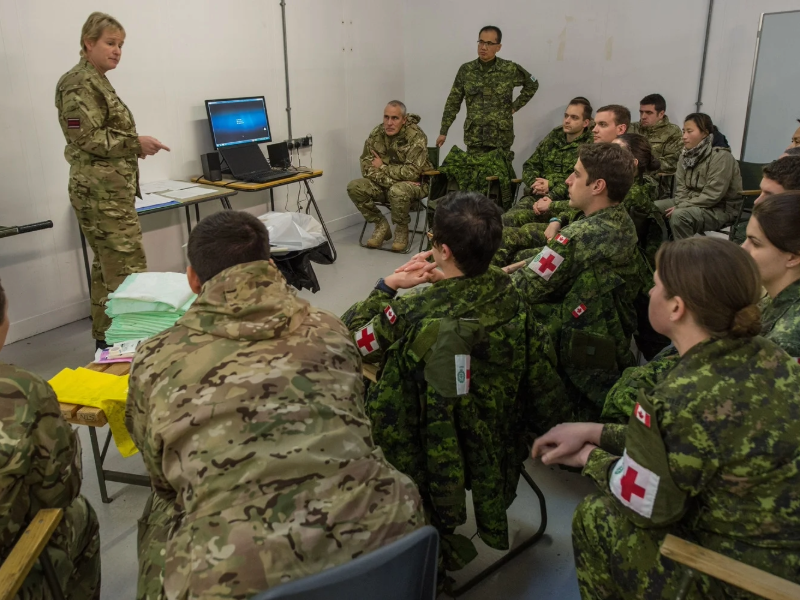
Photo: Canadian and British Armed Forces medical personnel engage in a debriefing during Operation SIRONA pre-deployment training at the Army Medical Services Training Centre in Strensall, UK, in 2014. Source: Esprit de Corps Magazine / Tarzan Kay (2015).
Disclaimer: Any views or opinions expressed in articles are solely those of the authors and do not necessarily represent the views of the NATO Association of Canada.