For eight years, the Canadian Armed Forces has contributed hundreds of soldiers to serve as the core of a NATO multinational formation in Latvia, made up of service members from 14 countries. They are deployed under Operation Reassurance, which encompasses Canada’s contributions to NATO in Central and Eastern Europe. In 2017, as concerns over Russia’s aggressive foreign policy grew following the 2014 annexation of Crimea and direct Russia support to separatists in Eastern Ukraine, NATO developed an ‘enhanced forward presence’ posture, organizing multinational battlegroups along its borders with Russia.
Canada took up leadership of the formation in Latvia, deploying an infantry company and supporting assets. In 2022, NATO countries agreed to increase the size of formations from battlegroups to brigades, effectively tripling the number of deployed troops. Since then, Canada has extended its mission and its contribution has grown up to an expected 2200 troops in 2026, including an armour and a helicopter contingent. Canada’s contribution to the Multinational Brigade-Latvia will continue through to at least 2029, as announced by Prime Minister Carney during his visit to the country in August 2025.
Years after this commitment began, it is important to remember why it is more important than ever given the increased threats caused by Russia’s belligerent behaviour. Canada’s leadership and participation in NATO’s enhanced forward presence in Latvia is a key component of its foreign policy, and perhaps the most important part of its defence policy beyond the North American continent. Thanks to the Canadian and other battlegroups deployed on the alliance’s border with Russia, there is a greater deterrent against Russian aggression. This is fundamental to the security and prosperity of Europe, which is crucial to Canadian interests. Further, the deployment shows Canada’s resolve and commitment to its allies, reinforcing its standing and reassuring Eastern European states who live closest to the Russian threat.
Deterrence and Tripwire
The enhanced forward presence formations, located along the alliance’s eastern flank from Estonia to Bulgaria, serve as a deterrent against Russian aggression. Thus, they have a strategic purpose for Canada, as it is in its interest that Europe remain independent and secure. Deterrence is based on the threat that an adversary would be incapable of achieving its military objectives or would suffer unacceptable costs in the event of an attack. It is especially important to convince potential attackers that a quick victory cannot be achieved. Deterring potential Russian aggression by convincing Moscow that an attack would cost more than they could gain is a core purpose of the NATO alliance. The forward presence brigades increase the military force present in the states neighbouring Russia, making the costs of a potential invasion higher. Further, deterrence relies on the credibility of the threat of consequences resulting from an attack. The multinational formations contribute to this by signaling the resolve of member states to defend the alliance.
There are valid concerns about the ability of the NATO formation in Latvia and elsewhere to stop Russian aggression, which were especially relevant before the size of the force was increased in 2022. The increase of the enhanced forward presence from battlegroups to brigades partly alleviates this concern, as a larger force combined with the host nation’s own military would stand a better chance against a Russian invasion. Nonetheless, these forces are not intended as an independent defensive force capable of succeeding alone, but as an initial force meant to be reinforced and as a tripwire that would involve the whole alliance in the event of aggression against one state. Indeed, the intent of the enhanced forward presence is not to stop a Russian aggression, but rather to put all alliance members at risk in the event of one, bringing them into the conflict and motivating them to deploy reinforcements. In service of this, Canada will increasingly be able to reinforce the troops deployed in Europe in the event of war thanks to an uptick in defence spending, the upcoming defence industrial strategy, and efforts to increase the size of the Canadian Armed Forces.
Showing Canada’s Commitment to its Allies
Beyond promoting European security by deterring Russia, Canada’s military deployment to Latvia also serves political purposes. Canada is one of six states to have taken on the role of leading a multinational brigade, with all others such as Germany and the United States having much larger militaries. Canada’s contribution to NATO’s deterrence posture is thus an overachievement. This display of leadership was particularly useful in the past, as it could be used to placate partners who complained about Canada not meeting targets for defence spending. But even as Ottawa is taking genuine steps to increase its defence spending to NATO expectations, such a display of effort remains useful. Indeed, the goodwill and influence it garners on both sides of the Atlantic by being a contributing ally is key for Canada’s diplomacy.
Further, the presence of Canadian troops in the Baltics, along with troops from the majority of NATO states in other forward presence brigades, promotes the cohesion of the alliance. Just as the creation and maintenance of multinational units signals to Russia the resolve of the alliance to defend itself, it also reassures NATO’s eastmost members that they will be defended. Given their small size and proximity to Russia, the Baltic states fear that they could become targets of Russian aggression. Other Eastern European states share these concerns. By deploying forces close to Russia and training with other NATO states, alliance members are showing their commitments to defending their allies in the event of a conflict. The resulting unity is crucial to ensure that all member states continue to believe in the usefulness of NATO and for the effective functioning of the alliance.
The Future of Task Force Latvia
Undoubtedly, the 2022 Russian invasion of Ukraine vindicated the establishment of enhanced forward presence, and their relevance will endure as the war drags on and Russia does not seem willing to abandon its aims over its neighbours. Recent Russian drone and aircraft incursions in Polish, Romanian, and Estonian airspaces confirm the need for a strong deterrence posture and its constant improvement to address evolving challenges. Efforts are ongoing to maintain and strengthen NATO’s foreign posture. In 2023, it was agreed that a new enhanced forward presence brigade would be created in Finland under Swedish leadership. Germany has committed to deploying 3000 to 5000 troops to Lithuania by 2026.
Canada also has an important role to play. First, it should ensure that the forces already deployed are combat ready and able to participate in training exercises, which has not been the case amidst recent vehicle parts shortages. Further, it must ensure that it can meet its commitments to deploy 2200 troops by 2026, ensuring that the brigade it leads is adequately staffed. Finally, it should work to improve the capabilities of the forces deployed to Latvia so that they can face the challenges of modern conventional warfare. This effort is already underway, with the deployment of armoured forces and helicopters, and the procurement of anti-tank, anti-air, and anti-drone systems. This is an essential effort to Canadian foreign policy, as European security and Ottawa’s interests rest in the balance.
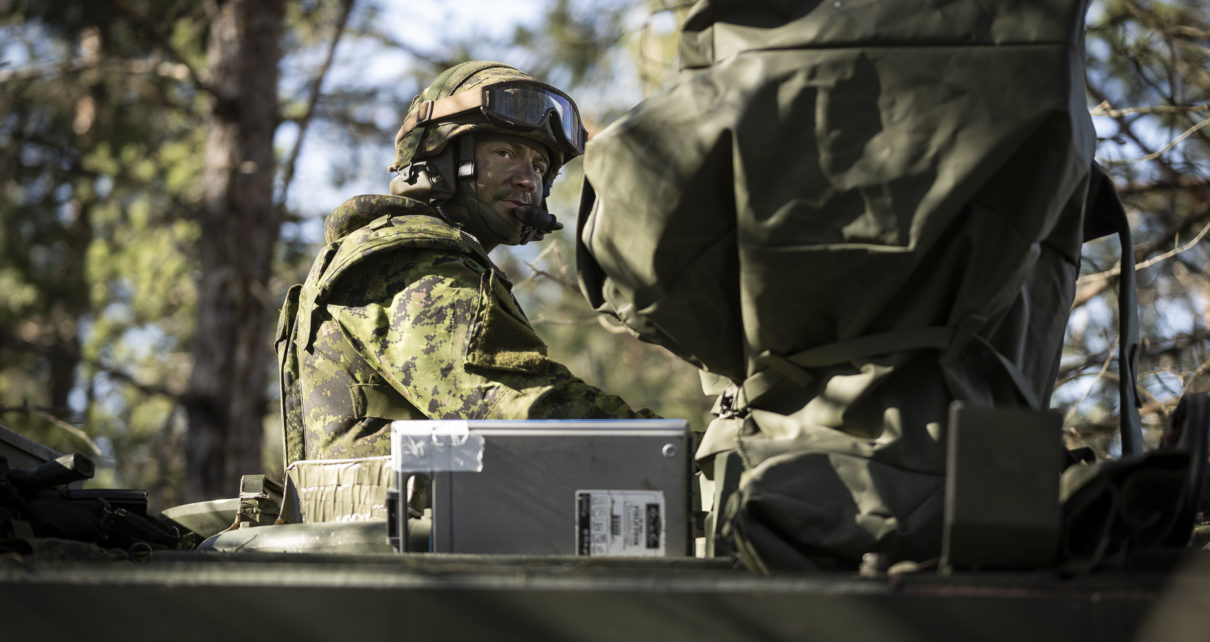
Photo: Canadian Armed Forces members of NATO enhanced Forward Presence Battle Group Latvia participate in Exercise CRYSTAL ARROW at Camp Ādaži, Latvia, on 10 March 2024. Canadian Forces Combat Camera photo by MCpl Genevieve Lapointe, Canadian Armed Forces (Photo ID: 20240310ISA0001D016).
Disclaimer: Any views or opinions expressed in articles are solely those of the authors and do not necessarily represent the views of the NATO Association of Canada.