As the Russo-Ukrainian War enters its fifth summer, victory remains nowhere in sight. What Russian officials expected to be a week-long blitzkrieg has evolved into a brutal war of attrition, with gridlocked frontlines and a soaring casualty-count. The return of overt kinetic warfare in Europe has tested NATO’s ability to deter expanded Russian aggression while also providing critical military support to a non-ally. Despite its tactical success, NATO allies have been unable to envision an off-ramp to the conflict that is inherently victorious for Ukraine and simultaneously acceptable to Moscow. For Canada, whose support for Ukraine represents both a strategic and moral commitment, the continuation of war without a viable end-state increases the friction between its values and interests, making the achievement of peace a foreign policy necessity.
The elusive nature of peace has been amplified by Russia’s lack of immediate success in the “special military operation” of 2022. The invasion of Ukraine had, in many ways, an opposite strategic effect for Russia. What was conceptualized as a “smash-and-grab” assertion of Russian dominance quickly morphed into a struggle against a world rejecting Moscow’s influence. Putin’s attempt at blitzkrieg was styled to halt perceived Western intrusion, and demonstrate his willingness to wield hard power to re-establish Russia’s reputation. Consequently, the failure of this gambit has intensified the fight to preserve any such reputation, spurring the Kremlin to double down on its revisionist arguments that NATO expansion is a core threat to Russian security, and that the establishment of a sphere of influence is its strategic right.
Simultaneously, Ukrainians have considered the war a struggle for their own identity from the outset. This difference in perception between Moscow and Kyiv has created a victory paradox, whereby neither side is likely to cease fighting without a perceived win, and the terms of this win are mutually unacceptable. This stalemate is unfolding against a backdrop of shifting priorities amongst NATO members, which may see increased skepticism among voters over aid to Kyiv with no progress towards peace. The war’s increasingly attritional nature coupled with a looming fifth winter makes this summer a possible catalyst for peace, as Russia, Ukraine, and NATO have a common interest in stopping the bloodshed. .
Even after the establishment of a cease fire, the length and violence of the conflict have left both parties in a position to require some semblance of victory. However, the strategic concessions required by one is similarly a red-line for the other. The peace proposal presented by the United States in 2025, for example, outlines that Russia would gain de jure control over the entire Donbas region, despite its current lack of complete occupation. This would force Ukraine to cede territory to its aggressor and legitimize Putin’s onslaught against its sovereignty, which is predictably unacceptable.
President Volodymyr Zelensky has framed the American peace proposal as a choice between “losing our dignity or losing the U.S.” The premise of Moscow dictating Ukraine’s defensive capacity is a major sticking point for Ukrainians, who fear that Putin will wait some years and then invade again. This is the inherent issue when dealing with an overtly hostile neighbour such as Russia, which has flagrantly disregarded international law and refuses to back down from its maximalist demands. As a result, Ukrainian negotiators will require significant security guarantees to deter future hostility. Conversely, from the perspective of the Kremlin, the limitation of Ukraine’s defensive capacity and restrictions on its NATO membership represent key components of a perceived win. For a democracy with genuine ambitions to join the EU and NATO, the imposition of Moscow’s desires over those of its people is irreconcilable.
At the same time, geopolitical developments elsewhere actively distract Western attention from Ukraine. For example, Zelensky’s determination to relaunch negotiations has been overshadowed by the U.S. airstrike campaign in Iran. In Canada, rising economic costs associated with this conflict has become a key issue. Despite Prime Minister Carney’s recent commitment of additional aid to Ukraine, public support amongst Canadians over the long term becomes unclear. Canada is home to a significant Ukrainian diaspora and has been a staunch ally of its war effort by welcoming refugees, training soldiers, and providing aid. However, with peace talks on the back burner and no Canadian seat at the table, Ottawa finds itself invested in a war with a political end-state that remains frustratingly unclear.
Current tensions with the United States has led Canada to make a strategic pivot towards Europe, joining the European Union’s SAFE Program, providing access to a significant loan apparatus for defence spending. Perhaps symptomatic of this strategy, however, is a need to appear unequivocally devoted to Ukraine despite Canada’s geographic removal from the conflict. While war in Europe presents a direct security interest for European actors, the threat to Canadians is more theoretical, and could likely be overlooked if domestic conditions worsen. While the threat of Russian aggression in the Arctic remains a concern, North American defence is duly reinforced through NORAD, a line that Moscow is unwise to cross. In this sense, while support for Ukraine upholds Canadian values, the extent to which it constitutes a key security interest is less clear. If the war continues into a fifth year and demand for aid increases, this question becomes even more opaque. In a fast-moving and increasingly expensive world, the moral argument for supporting Ukraine only goes so far with voters. As costs of living continue to rise at home, and a new trade deal with the United States remains unstruck, Ottawa will find that the priorities of Canadians shift towards the issues that immediately impact them.
This is not to say that Ukraine should accept defeat and acquiesce to the revisionist ambitions of Putin. NATO has proven itself a worthwhile ally and an effective guarantor of military might, despite its members’ difficulties in forcing an end to the war. If NATO’s adaptability has been a key factor in its 77-year survival, ending Russia’s war requires an emphasis on the alliance’s political ability. In order to achieve peace, allies must recognize that NATO provides the forum to coordinate the diplomatic positions of the West, and collaborate to find terms that are mutually digestible for Russia and Ukraine. All NATO allies have both military and political counsellors who can pool their respective expertise to coordinate a consensus-backed, and coherent plan for peace. It is important to note that this coordination does not immediately translate to compromise – Russia has been extremely hostile towards NATO and would likely be skeptical to any terms negotiated by its members. However, an alliance backed effort would give all allies, including Canada, the ability to weigh-in on ending a conflict they have so staunchly supported. This effort is also likely to illuminate an uncomfortable truth: the necessary terms of peace may appear very similar to defeat for one side or the other.
Canada is deeply committed to Ukraine and yet geographically distant. This creates a paradox of its own: Canada has less to fear from Russia directly, yet much to lose from a fractured alliance or settlements that reward revisionism. While victory in Ukraine may remain difficult to define, allowing it to become politically impossible risks consequences far beyond the battlefield.
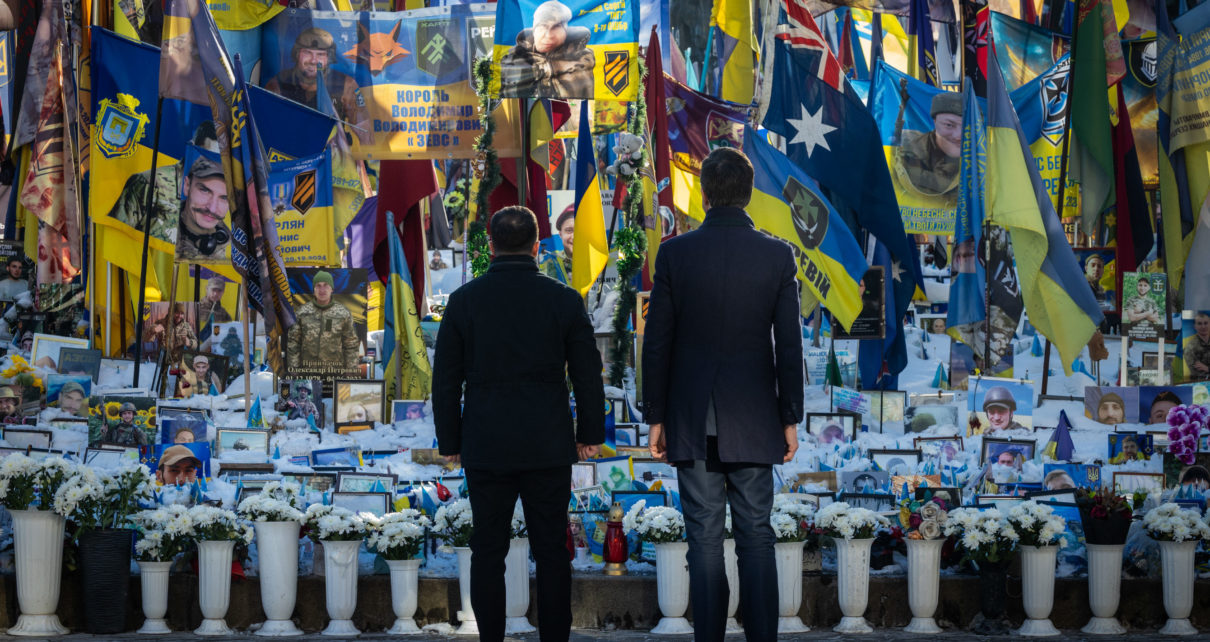
Photo: https://www.flickr.com/photos/nato/55076061391/in/album-72177720331815271
Disclaimer: Any views or opinions expressed in articles are solely those of the authors and do not necessarily represent the views of the NATO Association of Canada.