Military AI technologies have the potential to replicate gender bias due to the ways AI machine learning encodes patterns in data. In this article, Tessa McDermid argues that as NATO expands its investment in military AI technologies, it must equally commit to monitoring how these systems risk reproducing gender bias. By adopting corrective frameworks that align its AI Strategy with core Alliance values, NATO can meet its goals in advancing the Women, Peace and Security Agenda.
Tag: NATO
AI and Warfare: When Machines Make Decisions – Event Report
On Monday, May 25, 2026, the NATO Association of Canada hosted a panel discussion titled “AI and Warfare: When Machines Make Decisions”. The discussion brought together experts from defence, academia, policy, and industry to examine the growing role of artificial intelligence in modern warfare. This report provides a detailed overview of the event’s discussions.
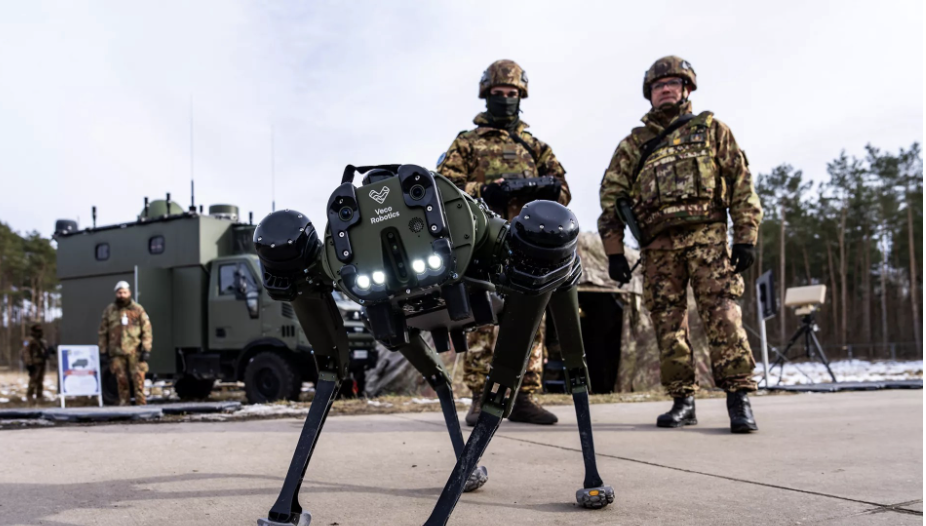
Delegating Destruction: AI and the Ethics of Warfare
As artificial intelligence becomes embedded in modern warfare, it is reshaping how states conduct war and raising urgent questions of ethics and accountability regarding the potential absence of human judgment in lethal decisions. If machines can decide when force is used, who ultimately remains accountable for the decision to take a human life in war?
Trade Law and the Coordination of Security-Based Trade Measures
As economic security becomes increasingly central to international policymaking, trade law is being reshaped by sanctions, export controls, and other security-based economic measures. In this article, Hassan Ahmed examines how the WTO’s national security exception has evolved from a narrow safeguard into a more routine justification for strategic economic action, and how allied states increasingly coordinate such measures through informal alignment rather than unified legal frameworks. Using examples ranging from semiconductor export controls to sanctions coordination following Russia’s invasion of Ukraine, the article explores the growing intersection of trade law, strategic competition, and alliance politics, including the implications for middle powers such as Canada.
Special Report: Iran, Russia, & Hybrid Warfare Influence Operations
In this special report, Soha Sarfraz examines how Iran and Russia use influence operations and information warfare to weaken democratic cohesion across NATO societies. Particularly by targeting key institutions through digital disruption, narrative manipulation, and the covert exploitation of grassroots mobilization. She argues that these campaigns threaten not only institutions themselves, but also the social trust, political consensus, and informational resilience that sustain collective defence, underscoring the need for stronger democratic resilience and alliance-wide responses to hybrid threats.
How AI-Generated Misinformation Creates Friendly-Fire Confusion Among NATO Allies
How can allied democracies inadvertently amplify each other’s friendly-fire of confusion and panic? What existential threat does this pose to content creators, journalists, or news anchors? Ji Young Kim examines how AI-generated misinformation shapes interpretation in the context of recent geopolitics and modern media culture.
Copyright as Security: Lessons from Denmark’s Approach to Deepfakes
In this article, Soha Sarfraz explores how the rise of deepfakes is placing new strains on democratic resilience, using Denmark’s developing legal and policy response as a case study of how states may preserve trust and political legitimacy in the age of fake media, Soha examines what lessons Canada might draw from that model. She argues that deepfakes increasingly threaten not only individual reputations, but also electoral integrity and the broader information environment, contending that the challenge is no longer merely a technological, but fundamentally political and strategic.
Event Report – Baltic and Ukrainian Youth on Security and Solidarity
On May 13, 2026, the NATO Association of Canada (NAOC), the Canadian Lithuanian Youth Association, and the Embassy of Lithuania to Canada co-hosted a panel discussion titled “Baltic and Ukrainian Youth on Security and Solidarity.” The event explored the role of youth in supporting Ukraine’s resistance against Russia’s full-scale invasion, countering Russian disinformation, and maintaining transatlantic solidarity with Ukraine. The discussion also examined what NATO countries can learn from Ukraine’s resilience, including lessons on informational resilience, civic mobilization, and rapid innovation in defence technologies. Read the full event report for a detailed overview of the discussion and key takeaways.
Complement or Challenge to Transatlantic Security? Reassessing Europe’s Role in NATO
As Europe advances its pursuit of strategic autonomy, questions are emerging about the future of NATO and transatlantic security. Can a more independent Europe strengthen collective defence, or risk fragmentation? This article explores how alignment and coordination will shape the future of Western security.
Event Report – NATO Climate Change and Security Centre of Excellence Toronto Introductory Event
On May 5, 2026, NATO Association of Canada hosted the Toronto introductory event for the NATO Climate Change and Security Centre of Excellence (CCASCOE). The event brought together military, academic, and civilian experts to examine how climate change is reshaping security, defence planning, and strategic risk. This report provides a detailed overview of the event’s discussions.