In yet another step towards broader escalation, Russia is reportedly weighing an armed provocation against NATO through an attack on Poland or a Baltic state. The United States has warned Polish officials of Russian plans to conduct an attack on Polish soil. Satellite imagery shows that Russia is amassing troops along its border with Finland. This buildup, oriented not toward Ukraine but toward NATO, shows that a once-theoretical threat is becoming real.
To many, it may seem like an odd time for Russia to open a new front. Russia has been suffering increasing losses on the battlefield: Ukrainian drones are now penetrating as far as Moscow, and nearly 500,000 Russian troops have been killed since 2022. While Ukraine is still incurring great costs, it is becoming increasingly clear that Russia is in over its head.
For these reasons, Russia is looking toward NATO. Domestically, as the once-distant war arrives at Russia’s doorstep, Russian support for the war is waning. The initial rally-around-the-flag effect has dissipated, prompting the Kremlin to look for what George Quester calls a “palliative” — a psychological mechanism that helps populations tolerate suffering — since wartime behaviour depends on public morale, not just pure military capacity. Therefore, Putin — wary of his precarious position — can confront the proverbial boogeyman, NATO, to reignite domestic backing through Russian nationalism.
Strategically, Russia is trying to deter countries from supporting Ukraine with military aid by threatening to attack them as well. A window also appears to be open: the war in Iran has triggered internal strife within NATO over what constitutes a triggering of Article 5. A multilateral defence alliance with divergent interests undermines its core goal, making a coordinated, alliance-wide military response difficult. This, combined with Trump’s perceived animosity toward the alliance, gives Putin the impression that now is the optimal time to act against it.
Unlike its full-scale invasion of Ukraine in 2022, Russia’s current approach appears to be more reserved. Russia’s plans resemble the pattern that Thomas Schelling termed “salami tactics,” activities calculated to threaten an adversary without crossing the threshold that would justify a full-scale retaliation. Each “slice” — whether it be an errant drone, a cyber attack, or border skirmishes — is designed to push the limits of Article 5, which, over time, will both normalize Russian action and erode NATO’s coherence. Moreover, each successful slice serves as a palliative for Putin’s domestic audience. This is not a new approach; the 2014 annexation of Crimea followed this playbook. Russia used unmarked soldiers to seize Crimean infrastructure to maintain plausible deniability, so as to undermine a coherent response from Ukraine and the West, only admitting after the annexation was a fait accompli. The effect on the domestic audience was profound; after the annexation of Crimea, Putin’s popular support surged 20 points.
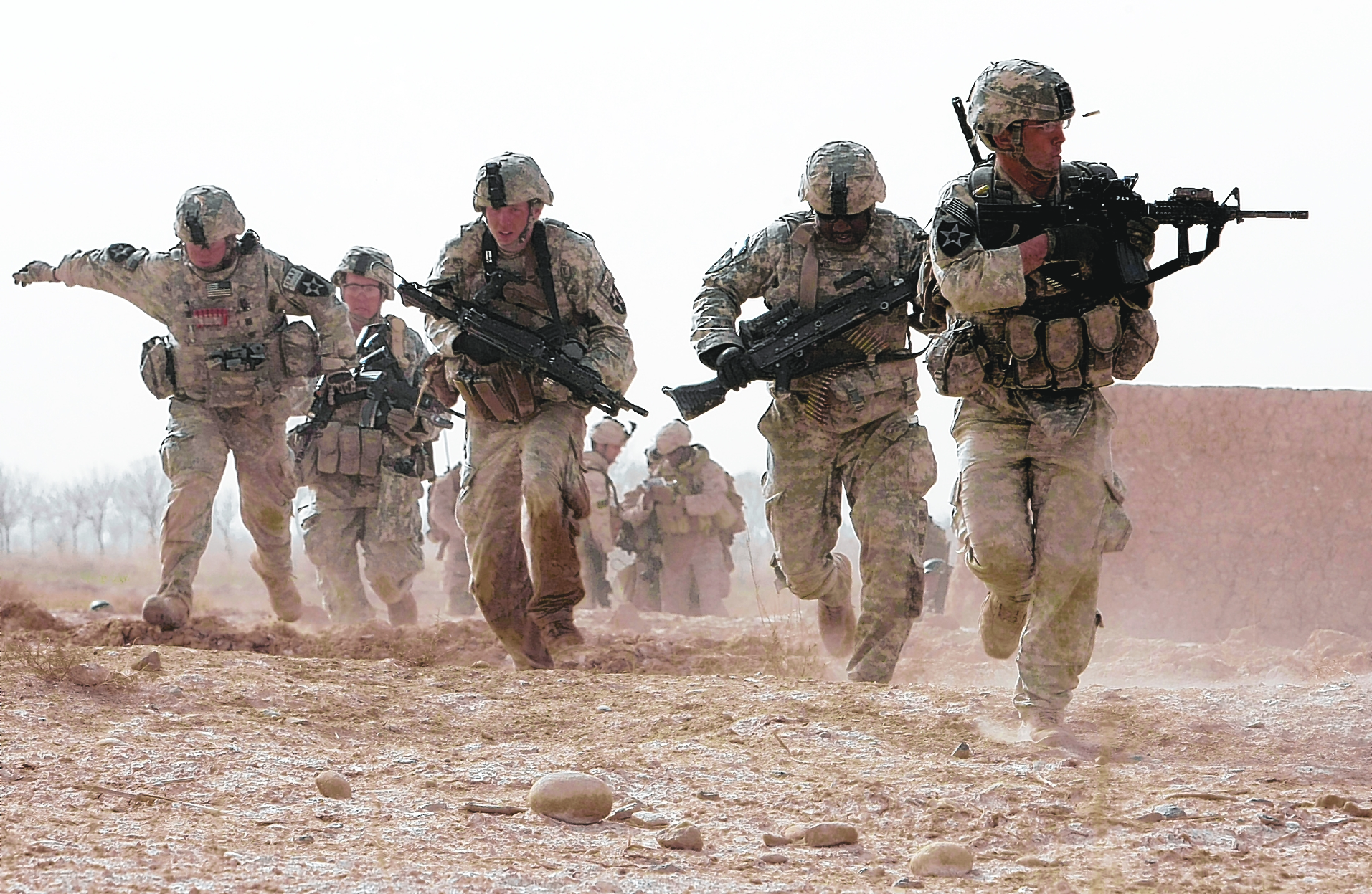
Russia’s strategy presents a strategic dilemma for its neighbours and their NATO allies. The reflexive response is to increase deterrence through military capacity, which is already in action: Poland, the Nordic and Baltic states are investing in defence and capacity buildup along their borders with Russia. NATO has also been increasing its deterrence posture on the eastern flank, working to ensure greater combat readiness. Canada should continue to invest in this NATO-wide endeavour, both financially and by maintaining its military presence in Latvia under Operation REASSURANCE.
While Russia’s plans are currently limited to the European arena, it should nonetheless raise eyebrows in Ottawa as the same salami tactics could plausibly be extended to the Arctic. Canada’s role in the Arctic is more direct. Ottawa should continue to reinforce its sovereignty in the Arctic, ensuring there is no NATO-like ambiguity that Russia could exploit. These measures matter because they raise the expected costs of Russian aggression. However, they must be paired with alliance unity. Canada and its allies must work to reinforce NATO’s political cohesion. Salami tactics are most successful when ambiguity and tension exist within an alliance; a unified alliance with established red lines would signal to Russia that such tactics would not succeed in dividing NATO.
Yet a deterrence-focused strategy could have adverse implications, creating a security dilemma. As NATO officials have noted, moving NATO forces to the border of Kaliningrad — Russia’s heavily militarized enclave between Lithuania and Poland — could provide Putin a pretext for escalation. As Patrick Morgan notes, deterrence works insofar as it signals that the costs of war outweigh the potential benefits. Putin’s calculations are informed by more than just the potential costs of action; he is also shaped by the costs of backing down. Even within an autocratic regime, research finds that Putin remains vulnerable to audience costs—the domestic political blowback associated with backing down from a conflict. Thus, if Putin perceives his regime’s survival to be in danger if he backs down in the face of deterrence, that deterrence may actually cause him to rationally escalate further. This echoes what Hein Goemans terms “gambling for resurrection,” as the small likelihood the escalation will end in military victory is viewed as preferable to the cost of backing down.
This is dangerous for NATO. A strategy focused on increasing Russia’s military costs could paradoxically endanger Europe. If escalation is Putin’s rational option, he could resort to extreme measures to avoid the humiliation of backing down. The danger is compounded by Russia’s possession of nuclear weapons. The solution, therefore, should be to combine deterrence with a reasonable avenue for de-escalation.
Canada, alongside its NATO allies, should pursue this multipronged approach of combining military deterrence with what Sun Tzu calls a “golden bridge” for Putin to take. This means providing an off-ramp that lets Putin believe he can escape humiliation, helping eliminate the aforementioned escalation trap. This off-ramp must be carefully designed so it is not seen as rewarding Russian aggression, while also being palatable to Putin, as he has repeatedly shown he is an immovable obstacle in peace talks. This could look like proposing agreed-upon exclusion zones or troop limits in sensitive areas such as Kaliningrad, the Suwalki Gap, and the Finnish border. These measures are not without precedent; they closely mirror those outlined in the 1990 CFE Treaty, meant to reduce the risk of hostilities in Europe. Despite Russia’s abrogation of the CFE Treaty in 2023, NATO’s willingness to pursue such a route could be spun as Putin extracting concessions from the West, and thus be a domestic victory for him. If NATO balances continued deterrence with a clear off-ramp, rather than moving toward brinkmanship, it can squeeze Putin from both sides and push him toward the proposed off-ramp.
Combining these two elements would increase the cost of action through deterrence while reducing the cost of inaction, quelling the threat on the Eastern flank without ending in all-out war or perhaps worse.
Canada should continue to support NATO’s defence posture while also advocating for sustained diplomatic channels through NATO and other intermediaries. Canada’s involvement is unlikely to shift the deterrence needle alone; however, it can strengthen alliance unity, help ensure red lines are communicated, and encourage a middle-ground path to minimize the potential for escalation. In the face of a revisionist nuclear power, staving off existential threats hinges on convincing Russia that aggression will backfire, while simultaneously ensuring that the alternative is not perceived as worse.
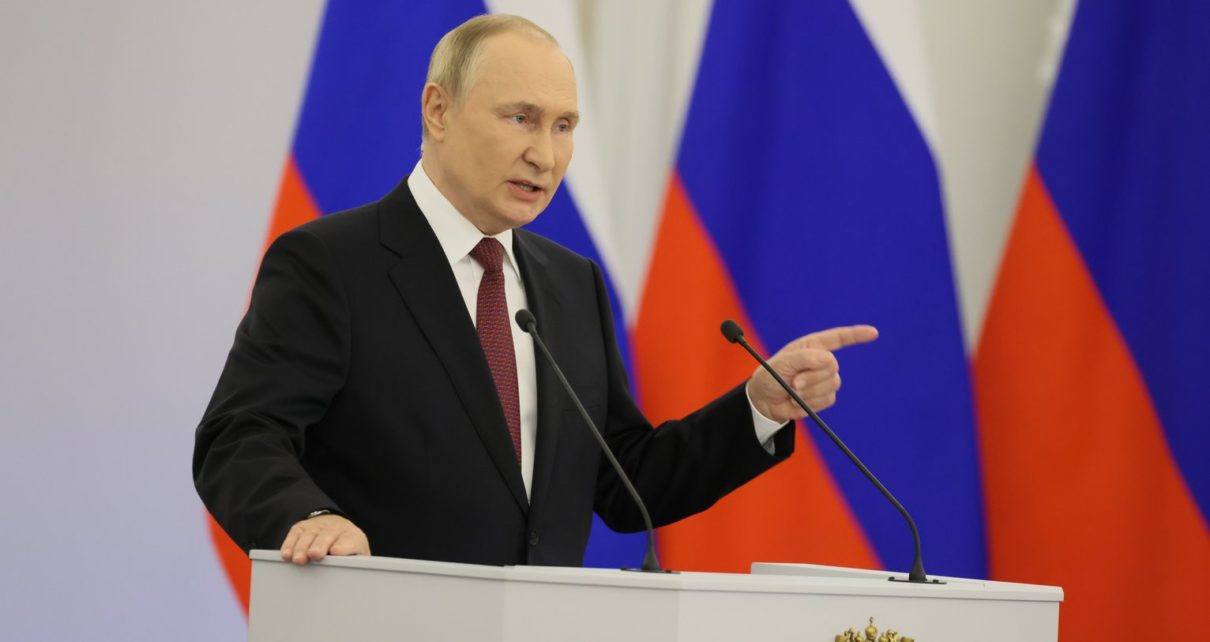
Photo: “Vladimir Putin 2022 Annexation Speech” is licensed under Creative Commons Attribution 4.0 International (CC BY 4.0). https://commons.wikimedia.org/wiki/File:Vladimir_Putin_2022_Annexation_Speech.jpg
Disclaimer: Any views or opinions expressed in articles are solely those of the authors and do not necessarily represent the views of the NATO Association of Canada.