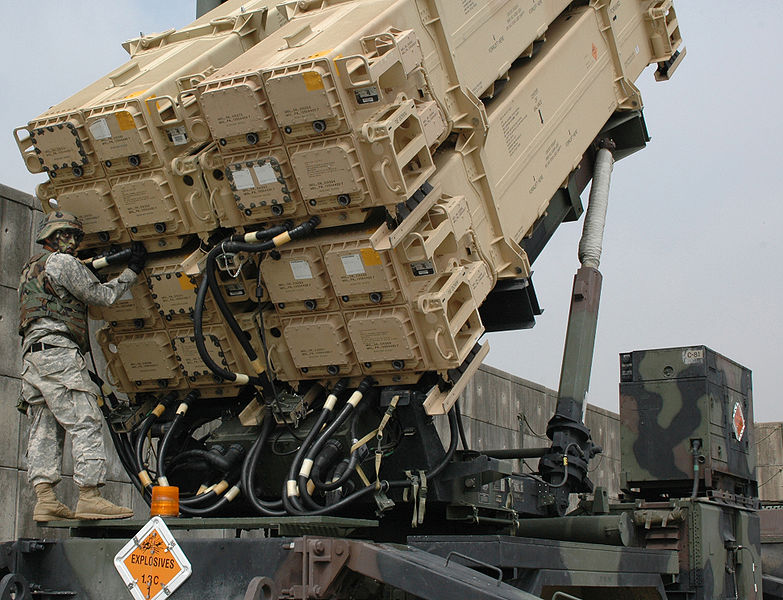
Extended nuclear deterrence (END) is a security guarantee offered by nuclear-armed states to non-nuclear-armed states in which the nuclear- armed state pledges to use its nuclear arsenal in response to nuclear or major attacks against its allies. States that do not possess nuclear weapons are able to reap deterrence benefits by sitting under a ‘nuclear umbrella’ of protection. As such, the United States extends nuclear protections to NATO states, but the U.S. President maintains exclusive authority over their deployment. END relies on a premise that is, at times, doubtful: American commitment to risk its own security to defend allies is legitimate. The commitment’s credibility depends on American military capability, but also on political willingness and trust between the U.S. and its allies. If confidence declines in the credibility of the U.S., or the strength of its relationships with allies, confidence in END also declines. Trump’s presidency has been marked by an “America First” approach: unilateral action, NATO skepticism, extensive tariffs, withdrawal from international agreements, and provocation and pressuring of allies. As these actions reduce states’ confidence in END, nuclear-latent states – possessing the capability of relatively quick nuclear armament – are prompted to consider independent or alternative nuclear deterrence arrangements.
Multiple European states are reassessing their nuclear arrangements as France and potentially the U.K. strengthen their nuclear cooperation and extended deterrence commitments. Trump’s public denigration of the NATO alliance and security concerns from Russia-Ukraine have led Poland to consider developing nuclear weapons and bid to participate in NATO nuclear sharing. Denmark and Germany have also indicated interest in France’s END offer. As Europe coordinates amongst itself, Canada is left to reassess its options as a nuclear- latent state, both currently under the U.S. nuclear umbrella and with reason to doubt its reliability. This article discusses and evaluates Canadian nuclear latency, ultimately concluding Canada should not pursue independent nuclear armament because END may stabilize, it is currently unnecessary, and it would undermine Canada’s international political interests.
First, does Canada have legitimate reason to doubt the reliability of American END? Political tensions with, and behaviour by, the U.S. would indicate yes. Trump openly stated ambitions to annex Canada, saying he doesn’t believe in the legitimacy of the U.S.-/Canadian border and that he wishes to bring Canada to its knees with economic force. The hostile, disrespectful comments occurred alongside the sudden imposition of unprecedented and wildly disruptive tariffs that sparked a pseudo trade war. Canada was also amongst the NATO states pressured to increase its defencse fund contributions to 5% of its GDP, 3.5% to core defencse requirements and 1.5% to related security projects – which is notably a greater GDP share than what the U.S. currently spends. This hostility indicated America’s perception of current collective defencse arrangements as being unfairly burdensome and potential unwillingness to defend NATO members that do not meet expectations. This unwillingness was reiterated in a 2025 discussion regarding America’s provision of extended deterrence to Japan.
While Carney hit Canada’s 2% NATO defence contribution goal and committed to 5%, Trump still critiqued NATO states for their lack of participation in recent American strikes on Iran. Trump’s strikes on Iran were unilateral, did not invoke NATO’s Article 5 of collective defencse, and were justified with claims of Iranian nuclear abilities ranging from questionable to contradicted by U.S. intelligence assessments. Simultaneously, the strikes evoked mixed responses from allies which have evolved overtime. Canada’s Prime Minister Carney was initially supportive of Trump’s strikes but came to regret his stance as they appeared inconsistent with international law. France’s President Macron has consistently expressed disapproval with Trump’s approach to the war. The U.K.’s Prime Minister Starmer initially rejected involvement with U.S. strikes but has moved to permit American usage of British bases for limited defensive purposes. German President Steinmeier called the war a “politically fateful mistake… a truly avoidable, unnecessary war” and contradictory to international law. Still, the conduct of the 2026 campaign, the one-sided expectation for allied states to join it, and Trump’s anger upon their unwillingness to, may suggests an asymmetric understanding of the alliance’s defencse arrangements and an increasingly demanding, unpredictable, and increasingly unpredictable American foreign policy characteristic of an actor declining in reliability. Such a characterization may prompt a disinclination to rely on America for END.
However, the U.S.-Canadian military alliance, NORAD – the North American Aerospace Defence Command – adds another layer of mutual defence commitments and operationalizes END promises. Canadian-US geography also means the U.S. is incentivized to prevent and intercept strikes to North America as it may be unclear which side of the border a missile is headed for, and the fallout of a nuclear strike on Canada may pose immediate security and health risks to American neighbours. Last, the political behaviours prompting declined confidence in END may primarily be associated with Trump as opposed to the United States of America. Trump is, according to the U.S. Constitution, temporary. While “America First” or “MAGA” approaches may continue beyond Trump’s presidency, they may just as likely fade out or at least calm in severity.
While there is, to an extent, strong reason to doubt END under Trump, the pursuit of an independent Canadian nuclear weapons program would also require capability and need. In terms of nuclear capability, Canada possesses the technological resources and know-how but has virtually no political or legal ability.
Canada is a non-nuclear weapons state under the Non-Proliferation Treaty (NPT), which is staunchly politically supported. The NPT opened for signature in 1968, and Canada was amongst the first signatories, ratifying the treaty in January 1969 before it came into effect in 1970. The NPT outlines a legally binding three-part bargain: states without nukes do not acquire them, existent nuclear states pursue disarmament, and NPT states cooperate for peaceful nuclear technology including energy. To develop a nuclear program, Canada would thus have to develop the political willingness to allocate extensive funding to a nuclear weapons program, abandon its long- held stances on peaceful nuclear use and non-proliferation, and leave or abandon the NPT. Legally leaving the NPT requires a party explain the extraordinary events causing them to do so and provide three months’ notice to other NPT parties and the Security Council. Even then, leaving may provoke political consequences including economic sanctions, regional instability, and international isolation, distrust, and scrutiny. Armament may also distort Canada’s identity as a peaceful middle power which undermines foreign policy initiatives succeeding under that guise. Particularly, Canada’s reputation as a moderate middle power has situated it as a reliable, trusted mediator on the international stage. However, states that Canadian nuclear armament would expectedly jeaporadize relationships with – namely the traditionally pro-disarmament Nordic States – may be more understanding as they themselves consider expanding nuclear protections.
An extraordinary threat would make these shifts easier, both politically and legally;, but Canada hasn’t undergone direct combat operations for over a decade. Russian-Canadian relations are at their poorest but conflict, as relations currently stand, is unlikely to occur, let alone escalate to nuclear levels, given Russia’s exhaustion in Ukraine. Canada’s support for Ukraine may fuel tensions that inform future conflict in the Arctic, but allied presence – including American – in Arctic territories and collective interest in allied Arctic control (i.e., for economic or security purposes) makes collective defence both required under NATO’s Article 5 and strategically desirable. Insofar as Russia is Canada’s primary adversary and is engaged in Ukraine, there is virtually no Canadian nuclear need. Even if Russian-Canadian conflict escalates in the north and the invasion of Ukraine ends, it would be in the strategic interests of allies – including the U.K. and U.S. – to extend protections to Canada. Further, such developments may occur under a new, more ally-friendly U.S. Presidency with less reason to doubt END in the first place. As such, for Canada, developing nuclear weapons may counterintuitively create the conflict and hostility they exist to manage. Ultimately, remaining nuclear- latent is the best strategic positioning for Canada as it promotes political consistency with non-proliferation and peaceful use goals.
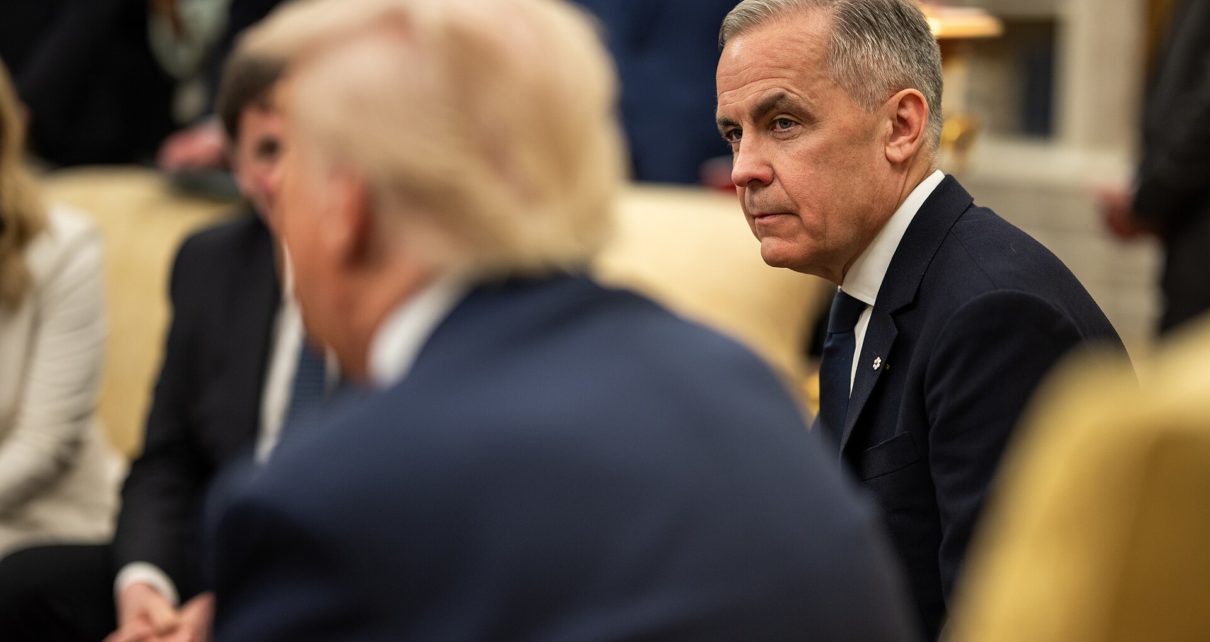
Photo Citation: “President Donald Trump meets with Canadian Prime Minister Mark Carney in the Oval Office”
Disclaimer: Any views or opinions expressed in articles are solely those of the authors and do not necessarily represent the views of the NATO Association of Canada.

.jpg)