Long before the formal establishment of the NATO Alliance, the Allied victory in World War II relied on a critical, often overlooked asset, which was the specialized talent of marginalized groups. Hundreds of Caribbean women crossed the Atlantic to join the Auxiliary Territorial Service (ATS) and the Women’s Auxiliary AirForce (WAAF). Travelling far from home, they engaged in high-stakes technical fields including aircraft mechanics, radar, and complex wartime logistics. These women left the Caribbean to join the American, British, Canadian and French troops, now NATO member states. Facing a dual wall of institutional sexism and colonial-era racial prejudice, they survived and excelled by building powerful, informal peer support networks. Their contributions did more than sustain military resilience, as they laid the foundation for transnational networks of leadership and civic engagement that continue to shape Caribbean societies today. As historians like Dr. Dalea Bean have documented, trailblazers like ATS radar operator Ena Collymore-Woodstock and community advocate Connie Mark used their wartime service as a training ground for civic leadership. The transnational networks they built did not just aid the war effort. They structurally reshaped post-war Caribbean judiciaries, youth organizations, and political activism.
True regional resilience in defence and amongst defence networks cannot be achieved without acknowledging the foundational contributions and historic leadership of Caribbean women, as their legacy and leadership have created a blueprint that is needed for modern cooperation and security networks. Recognizing their contributions is essential for policymakers and those with decision-making capabilities in the defence network who wish to strengthen regional cooperation and women’s participation in defence in the twenty-first century. Strengthening networks for women and women of colour is operationally essential for navigating complex security landscapes.
Today, the Alliance prepares for a different kind of conflict, a global race for dominance in fields ranging from artificial intelligence (AI) to quantum computing. Modern warfare has shifted from physical borders to digital infrastructure, where adversaries actively target the social and technological fault lines of NATO states through AI, cyberattacks, disinformation, and psychological warfare. True national defence can no longer depend on a uniform area of expertise or a homogenous demographic. Just as in the 1940s, the Alliance cannot afford to leave talent on the table. Secure sovereignty requires cultivating cultural literacy, language skills, and nuanced domestic understanding to neutralize foreign interference. Strong defence includes comprehensive strategies that include a defence apparatus that reflects and understands the demographic reality of the population it is tasked to protect and partners they train with. Militaries and armed forces need to understand who they defend and represent.
This gap is not just an issue of the past but continues to persist today in modern defence. Just as Caribbean women faced institutional barriers that obscured their contributions, modern women and minority tech innovators face a funding and visibility gap in defence. Militaries like Canada are still addressing gender parity in regular recruitment, but are closing the gap in specialized units within the Armed Forces.
This is why forward-looking initiatives like NATO’s Defence Innovation Accelerator for the North Atlantic (NATO DIANA) are so critical. DIANA aims to shatter the modern “visibility gap” by sourcing cutting-edge solutions from unconventional, civilian startup founders who are traditionally locked out of defence boardrooms. Yet, the gap persists. While the Canadian Armed Forces (CAF) continues to address gender parity in standard recruitment, severe underrepresentation remains within specialized technical units. Sexism and systemic isolation will not vanish overnight; tech innovators and service members of colour require the same structural lifelines their predecessors built. In a study done by Tammy Georg, she found that women of colour in the military often felt targeted and isolated. This, unfortunately, has a major impact on the recruitment and retention of women in the Armed Forces, not just in Canada but amongst NATO member states.
Modern networks like Women in Defence and Security (WiDS) provide a vital ecosystem to share technical knowledge, seek mentorship, and demystify deep tech. This group has been a lifeline for many women in the CAF and women in the defence sector. Equally, Women in International Security Canada (WIIS) has been a cornerstone for women who aspire to work in the defence and security sector and who wish to advance international peace and security. These organizations are similar to those that were created by Jamaican women who built a support network to expand their social and political influence during and after WWII as described in Dalea Bean. To truly safeguard sovereignty, NATO countries must look beyond traditional geopolitical silos and intentionally weave an inclusive, global tapestry of human ingenuity. To illustrate an example of how NATO countries can benefit from knowledge exchange with CARICOM nations, Canada is mirroring this ethos by looking beyond conventional Western frameworks, actively partnering with countries like Guyana, Italy and Ireland to advance AI capabilities, cross-border innovation, and technology transfer. Building strategic partnerships with CARICOM nations is the logical modern evolution of this historic cooperation. Transitioning from historical wartime mobilization of Caribbean women to modern voluntary collaboration, a NATO-CARICOM defence alliance is a natural progression. Partnering strategically allows both networks to successfully leverage the region’s deep tech, AI, and cybersecurity talent. While CARICOM nations are not formal NATO members, individual states already collaborate deeply on international security. For example, Canada’s partnerships with Jamaica via Operation Helios and Operation AKEE demonstrate the existing blueprint for regional stability. Furthermore, Canada’s recent strategic AI and technology transfer commitments with non-NATO partners like Guyana and Ireland prove that twenty-first-century security is defined by the dissemination of talent, not the size of a standing army.
To honour the legacy of resourcefulness shown by Caribbean women of the ATS and WAAF, Western defence institutions must transition from verbal to structural commitments. It is recommended that NATO member states like Canada, France, and the United Kingdom should formally integrate Caribbean women’s wartime history into permanent museum structures and public heritage initiatives to bridge the past and present. Second, all NATO member states should support internal, staff-led resource groups explicitly focused on community building, such as WIIS. By fostering spaces where diverse talent and women can thrive, these internal networks will serve as vital conduits to the civilian sector, as countries make strategic partnerships to advance AI, cybersecurity, and social networks expand to share information and opportunities. These initiatives should be extended to women in the Caribbean who are already participating in cyber and AI programs offered by NATO member states. With this encouragement, mitigating some of the issues of recruitment and retention of personnel in defence would be made possible and this would further help programs like NATO DIANA to discover unconventional tech leaders, securing our collective future. Encouraging women’s participation from the Caribbean and supporting these networks would honour the history that created these transnational networks.
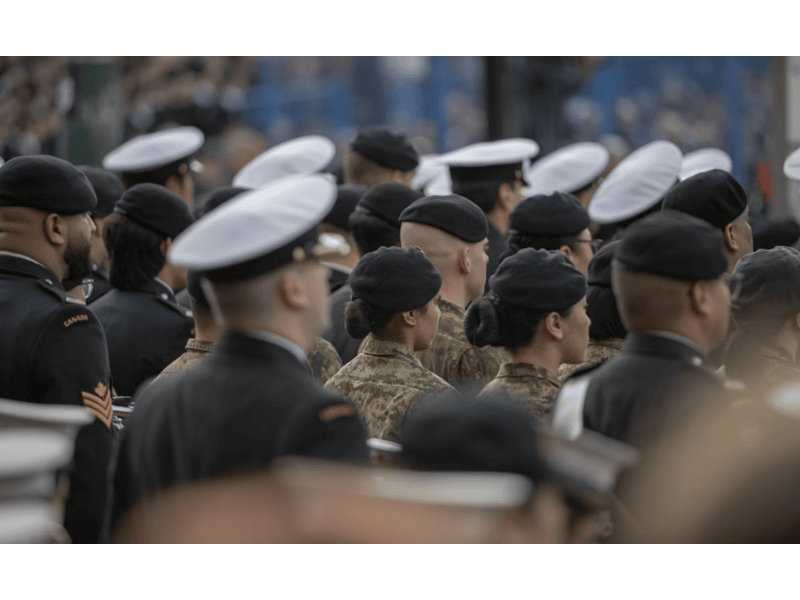
Photo: Canadian Armed Forces (2025) Photo courtesy of Eric Stoynov via Unsplash.
Disclaimer: Any views or opinions expressed in articles are solely those of the authors and do not necessarily represent the views of the NATO Association of Canada.