In a landmark announcement from Brussels earlier this month, Canadian Prime Minister Mark Carney confirmed that Canada has concluded negotiations for its participation in the European Union’s Security Action for Europe (SAFE) program, with Canada and the EU now working toward swift ratification and formal launch in the coming weeks. This move makes Canada the only non-European nation to secure preferential access to the EU’s massive €150-billion, (which is approximately CAD $244 billion), defence financing instrument. While the headlines have focused on the sheer scale of the investment, the implications for Ottawa go far beyond dollars and cents.
Canada’s entry into SAFE signals a significant strategic realignment, in that Ottawa is aligning more closely with Europe in a defence-industrial push for strategic autonomy, reducing reliance on the United States. This marks a deliberate pivot towards European-led capability development and places Canada as the only non-European country within this growing program. In tying Canadian military purchases and defence-industry growth to Europe’s supply chains, Ottawa is positioning itself as a partner whose modernization plans will be shaped with Europe, not just the United States. This move strengthens Canada’s role within NATO and suggests that future Canadian equipment purchases may be more diversified, with procurement increasingly routed through Europe’s coordinated systems. Canada’s decision to join the Security Action for Europe program reflects a threefold shift: a strategic geopolitical alignment toward Europe, a rethinking of its alliances, and a long-term defence-planning strategy that ties Canada’s future military modernization to Europe’s emerging defence-industrial system rather than exclusive reliance on the United States.
Canada has negotiated an entry fee of approximately CAD $16 million, which is a remarkably low premium for access to such a vast capital pool. In exchange, Canada gains preferential status within this program, which positions Canada to seek negotiated exemptions from the 35% non-EU content cap that applies to other third-party nations. This means Canadian defence firms can bid on European contracts as if they were domestic EU entities, and conversely, Canada can utilize low-interest SAFE loans to finance its own military modernization. For example, this could contribute to funding high-cost acquisitions like the next-generation Canadian Patrol Submarine Project fleet and future defence procurement initiatives.
Militarily, this deal aligns Canada with elements of Europe’s Readiness 2030 supply chain, effectively bolstering the status of the Canadian Armed Forces within Europe’s industrial base. Rather than buying military equipment as isolated national purchases, Canada will take part in joint procurement groups that collectively produce essential military supplies. The deal deepens Canada’s integration into European maritime and cyber defence supply chains, including underwater surveillance sensors and artificial intelligence–enabled electronic warfare systems, capabilities that directly support the future replacement of Canada’s submarine fleet under the Canadian Patrol Submarine Project (CPSP). This approach ensures that Canadian weapons and supplies are designed from the outset to be fully compatible with those used by European NATO allies, instead of requiring costly and slow modifications after purchase. This shift is already evident in the creation of the Defence Investment Agency (DIA). One of the roles of the DIA is to align Canadian military standards with European technical requirements. According to the Prime Minister’s Office, Canada’s participation is expected to attract private investment and support high-skilled employment, as the agency ties defence procurement more directly to domestic industrial development and supply chain expansion. It will also enable earlier and more consistent engagement between the military and industry to ensure operational needs and timelines are addressed more realistically. Finally, the agency will align Canada more closely with key allies and multilateral defence initiatives, making joint procurement easier and supporting Canada’s commitments to NATO defence spending and allied industrial cooperation.
Canada’s participation in the SAFE program does not directly determine the outcome of the CPSP, but it provides an important analytical and structural context within which the project now unfolds. SAFE improves the financial feasibility of the CPSP by opening access to low-interest, long-maturity European financing for this program whose lifecycle costs could exceed CAD $100 billion, thereby easing fiscal pressure. At a strategic level, the agreement situates Canada more closely within European submarine production, particularly multinational models such as Germany’s Type 212CD program, as Germany is a member of this program as well. While this alignment does not predetermine procurement decisions, it creates conditions that could facilitate faster delivery and deeper integration into shared European production and sustainment networks. In parallel, SAFE expands Canada’s potential access to European supply chains to build this new submarine system with new and novel warfare technologies. In this sense, SAFE operates as an enabling framework that could assist with the financial and industrial parameters within which the CPSP operates.
More broadly, this strategy reduces Canada’s long-standing reliance on the United States by replacing dependency with diversification. Canada’s defence industry has been closely tied to the American market through the Defence Production Sharing Agreement (DPSA). While this relationship has provided important benefits, it has also made Canada vulnerable to shifts in United States domestic politics, including protectionist policies and unpredictable export restrictions. The SAFE agreement acts as an avenue for Canada to diversify strategic alliances. Canada is not turning away from the United States; instead, it is adopting a revised foreign policy approach by anchoring its military modernization within European defence production networks. Canada will retain a dependable European supply line that both protects against disruption and supports the development of greater strategic independence.
Thus, with Canada’s introduction into SAFE, this arrangement improves upon the current situation because it changes Canada’s position within the global defence system. Through this program, Canada becomes a central connector between North American and European defence structures. Canada would bolster its global position as the nation would be fully integrated into both the North American defence framework, through the North American Aerospace Defense Command (NORAD) and the Defence Production Sharing Agreement, as well as the European defence framework, through SAFE and the European Union. This dual integration strengthens Canada’s negotiating power by allowing it to contribute European industrial capacity to North American security arrangements, rather than relying solely on American protection for our national security.
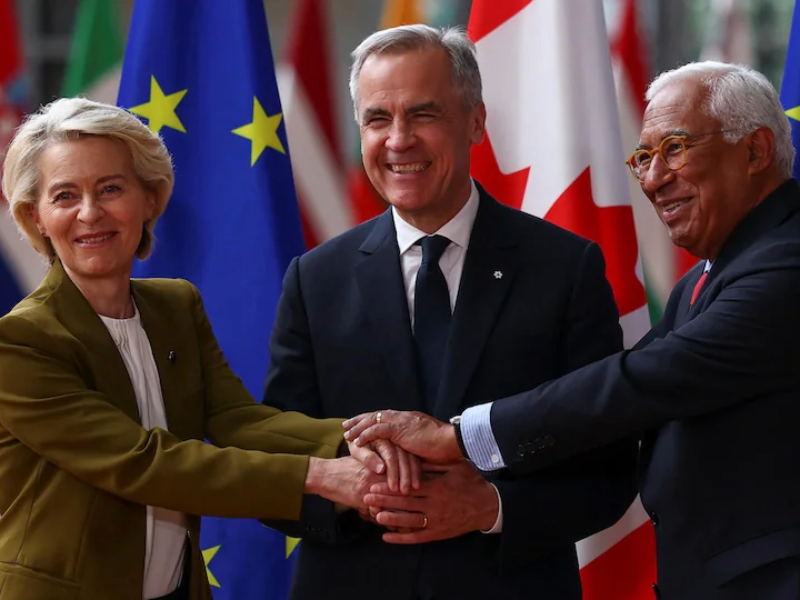
Photo: Canadian Prime Minister Mark Carney is welcomed by EU leaders Ursula von der Leyen and António Costa at an EU–Canada summit in Brussels, June 23, 2025. Source: Reuters / Gonzalo Fuentes.
Disclaimer: Any views or opinions expressed in articles are solely those of the authors and do not necessarily represent the views of the NATO Association of Canada