After 35 years of service in the Canadian Armed Forces (CAF), the C7 and C8 rifles are being replaced. Introduced in the mid-1980s, the C7 rifle became Canada’s standard service rifle, with the C8A1 later developed as a carbine version of the C7. This was a shorter and more compact rifle intended for situations where ease of movement mattered. The C8 rifle featured a shortened barrel and a collapsible stock, which made it easier to handle than the standard C7. Over time, both rifles remained important to the CAF and were updated instead of fully replaced. Their long service life suggests they were dependable weapons, but it also raises an important question: Do rifles designed for an earlier period still meet the needs of soldiers today? The issue is not only that these weapons are aging, but rather that they still provide the reliability, flexibility, and ease of use needed in modern operations.
Canada is not alone in strengthening its systems. Countries such as France, Denmark, and the United Kingdom are also reviewing their rifles and the everyday equipment soldiers rely on. These decisions suggest that military effectiveness depends not only on major purchases such as ships, aircraft and advanced technologies, but also on the basic equipment held by frontline personnel. Canada’s rifle replacement can therefore be understood as part of a wider shift across NATO, where defence modernization includes renewed attention to the weapons soldiers carry on the ground.
This change is taking place to modernize defence procurement and strengthen Canada’s domestic defence industry. On October 2, 2025, the government announced the creation of the Defence Investment Agency (DIA) to improve and accelerate the procurement process. On February 17, 2026, it then launched Canada’s first Defence Industrial Strategy, which aims to prioritize Canadian suppliers and materials, invest in domestic innovation and commercialization, and streamline procurement. Within this context, the Canadian Modular Assault Rifle (CMAR) initiative supports the effort to equip the Canadian Armed Forces more efficiently by strengthening domestic production and long-term industrial resilience.
According to the Defence Investment Agency’s March 2026 announcement, Colt Canada was awarded the CMAR contract to supply up to 65,402 assault rifle systems, with an initial phase covering 30,000 General Service rifles over three years. The announcement also noted that the contract includes system integration and engineering support, positioning CMAR as both a capability upgrade for the CAF and part of a broader effort to strengthen Canada’s domestic defence industrial base.
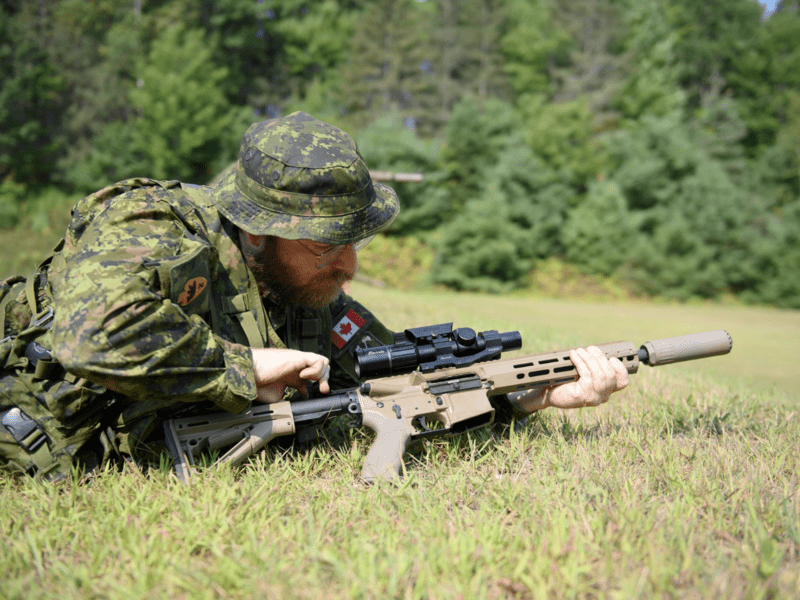
Colt Canada of Kitchener, Ontario, has a longstanding history of supplying equipment to the CAF. Formerly known as Diemaco, the company was originally awarded the contract to supply C7 rifles and C8 carbines until the early 1980s, and has continued to maintain and upgrade Canadian small-arms fleets over time. The decision, therefore, builds on an existing relationship with a domestic manufacturer already familiar with CAF requirements and equipment. The new Canadian rifles feature an M-LOK rail system, which allows accessories such as grips, lights, and aiming devices to be attached directly to the rifle, making it easier for soldiers to adapt their equipment to different tasks. In addition, the rifles feature free-floating cold hammer-forged barrels, a design that helps maintain accuracy by reducing pressure from the handguard, while also improving barrel strength and durability during sustained use. Together, these features give soldiers a rifle platform that can be configured for different operational needs, including the integration of optics, and launcher-related equipment, rather than relying on one fixed arrangement for all tasks.
Canada is not the only NATO country to replace older service rifles with new systems that are better suited to a wide range of missions. In France, the armed forces selected the HK416F to replace the FAMAS, a long-serving service rifle. This transition has been in progress since 2017 and is set to be fully implemented in 2028. This supports the shift from an outdated platform to one better suited to modern operations with greater support for optics and night-vision attachments.
Denmark has introduced a similar initiative. In 2025 and 2026, Denmark expanded its contract with Colt Canada, introducing more than 50,000 C8 Modular Rail Rifle carbines for its armed forces and Home Guard units. Colt Canada’s role in supplying Denmark reflects a collective understanding among NATO states to upgrade frontline equipment in accordance with renewed priorities.
Furthermore, in the United Kingdom, Project GRAYBURN is the programme examining a replacement for the L85, the long-time service rifle used by British forces. The importance of this case lies in what the replacement process is considering. As UK parliamentary responses indicate, the project remains in its concept phase, with an ongoing review of performance requirements and technical solutions. The response also states that interoperability, including calibre, with other in-service weapons will be considered as part of the process. This is important in a NATO context, where multinational training is mandated to improve coordination, cooperation, and readiness between allied forces.
Canada’s decision to replace the C7 and C8 rifles demonstrates that service rifle modernization is occurring in tandem within the Alliance to meet new objectives. The cases of France, Denmark, and the United Kingdom illustrate a shared goal of ensuring that these systems remain effective across a range of missions and can be used seamlessly alongside partner forces. By proceeding with CMAR, Canada is keeping pace with allied efforts to align frontline equipment with current operational demands. This decision also highlights how even small-scale changes can affect coordination between allies. As the demands placed on the CAF continue to change, including operating across different environments, integrating new equipment, and working effectively with partners, it is important that Canada continues to update its frontline systems to ensure they remain suited to current operational needs.
Photo: Trials ‘C8A4’ during evaluations in 2024, equipped with Burris Optic. Source: Canadian Armed Forces (CAF) via ArmourersBench.
Disclaimer: Any views or opinions expressed in articles are solely those of the authors and do not necessarily represent the views of the NATO Association of Canada.