Introduction
Conscription in Canada is no stranger to controversy. But with several NATO allies adopting or expanding total defence models that rely on broad civilian participation, and with Canada accelerating defence spending to meet new NATO targets, it may be time to revisit this debate through the lens of modern national service. The Canadian Armed Forces (CAF)’s recently unveiled Defence Mobilization Plan, which proposes a large voluntary civil defence corps, signals that Canada is beginning to consider whole-of-society approaches to national readiness. Central to this conversation is the issue of gender: as allies rethink their approaches to national security, questions about who serves, how they serve, and whether service frameworks reflect equitable participation are becoming increasingly salient.
NATO faces mounting pressures, including hybrid threats, renewed great-power competition, climate-driven crises, and persistent personnel shortages across several allied militaries. At the same time, the Alliance continues to advance the Women, Peace, and Security (WPS) agenda, which emphasizes that women’s meaningful inclusion enhances operational effectiveness and strengthens security outcomes. Yet women remain underrepresented across many allied forces, especially in leadership roles, even as member states attempt to strengthen recruitment, retention, resilience and operational readiness.
In this context, Canadian scholars and defence practitioners are revisiting models of peacetime conscription, or mandatory national service, as a potential mechanism to broaden participation and rebuild human-capital pipelines. For this article, mandatory or compulsory national service refers to a system in which all eligible citizens are liable for a defined period of service to the state, where they may fulfill military roles, civil defence, emergency response, or other forms of public service that support national security and societal resilience. In practice, such systems often combine universal liability with selective intake based on national requirements, which means that while everyone is obligated to be available for service, only the number required to meet annual personnel targets is called up. This idea, based on several Nordic and Baltic conscription systems, is especially timely given Canada’s acute recruitment and retention challenges, even as the military seeks to substantially expand its ranks.
However, debates about mandatory service often overlook gender and what different service models could mean for Women, Peace and Security commitments. Could a universal, gender-inclusive national service model help remedy Canada’s recruitment shortfalls while advancing its NATO and WPS obligations?
WPS Within NATO
The Women, Peace and Security (WPS) agenda emerged from United Nations Security Council Resolution 1325 (2000), which recognized that peace and security outcomes are stronger and more legitimate when women participate fully in decision-making, conflict prevention, and post-conflict recovery. NATO adopted the UNSC’s WPS principles in 2007 and has since integrated gender considerations into its strategic, operational, and tactical functions, most recently through the 2024 NATO Policy on Women, Peace and Security and the 2021-2025 WPS Action Plan. Through these instruments, WPS is increasingly framed as a strategic, not symbolic, component of allied security policy, grounded in a growing recognition that conflict is often gendered and requires gender-responsive approaches. NATO largely presents gender equality in practical terms, maintaining that greater inclusion of women strengthens overall capability and that gender-aware planning improves mission outcomes. Accordingly, WPS is treated primarily as a tool for operational effectiveness rather than a purely normative commitment, though it also serves to reinforce NATO’s values-based identity vis-à-vis authoritarian opponents.
Despite this relatively comprehensive enabling framework, the effectiveness of NATO’s WPS agenda ultimately depends on national implementation. NATO’s 2024 WPS Policy makes clear that member states are responsible for implementing WPS principles through their own National Action Plans, defence strategies, and related international commitments. Consequently, progress remains uneven, and gaps persist between NATO policy and national practice. Some allies have invested in gender-responsive force development; others have made limited institutional or cultural change. The London School of Economics and the University of Sydney’s joint dataset on WPS National Action Plans illustrates the divergence in design and effectiveness among member states.
Although representation in security and defence is by no means the only or most important measure of meaningful participation, it remains a useful indicator of institutional inclusivity. Across the Alliance, women continue to comprise a small minority of military personnel. NATO’s 2022 Summary of the National Reports shows that women accounted for only 12.7 percent of armed forces personnel among member states, up slightly from 10.3 percent in 2014. Progress is stagnant or declining in several member states, and UN reporting highlights severe underrepresentation of women in senior officer positions. These disparities underscore the divide between NATO’s WPS commitments and the demographic realities of many allied militaries, with direct implications for the credibility and effectiveness of WPS and defence objectives. As Stéfanie von Hlatky asserted in Deploying Feminism, “it is hard for an organization that displays so little diversity to consider a diversity of views when carrying out its work…”
The Case for Gender-Inclusive National Service in Canada
Canada has repeatedly affirmed that WPS is integral to its defence policy, with the Department of National Defence (DND) and the CAF committed to reaching 25 percent women in uniform by 2026 and removing barriers to women’s recruitment and career progression. Canada’s GBA Plus framework also requires that major defence reforms assess how proposed service pathways may shape access and opportunity for women. However, as of December 2024, women represented only 16.3 percent of the Regular Force and 17.4 percent of the Primary Reserve. DND acknowledges that “the level of interest among Canadian women in military employment makes this a significant challenge,” despite sustained recruitment and culture-change efforts.
The issue is not simply one of numbers. Women remain highly concentrated in eight occupations – largely administrative, logistical, and care-related – that collectively make up only 18 percent of the CAF. Structural and cultural barriers continue to limit access to operational, technical, and non-traditional roles, while research and CAF reviews consistently identify concerns about marginalization in male-dominated environments as key deterrents for women. Yet public opinion tells a different story: recent Angus Reid polling data shows that young Canadians, including young women, overwhelmingly support one year of civilian national service in areas such as public health, environmental protection, and civil defence. In other words, women are willing to contribute to national resilience and readiness – just not necessarily through the CAF in its current form.
Recent reporting on the CAF’s draft Defence Mobilization Plan describes a voluntary civil defence corps of 300,000 Canadians and a significant expansion of the Reserve. This suggests that Canada is already pursuing whole-of-society approaches to national preparedness, although the proposed model differs from a universal, gender-inclusive national service framework. The plan is voluntary, offers only a short annual training requirement, and focuses on introductory readiness skills rather than sustained pathways into operational or technical roles. Based on available reporting, it does not explicitly address gendered participation barriers or align with WPS objectives, and it is framed primarily as a modest preparedness measure rather than a mechanism for meaningful institutional change in how women participate across defence structures.
These limitations clarify why a gender-inclusive national service model warrants consideration. Research on women in the Canadian combat arms shows that greater female representation can help shift norms and erode the cultural barriers that deter women from voluntarily serving. A mandatory universal system with both military and civilian pathways could create opportunities for women to contribute to national defence and resilience, diversify the ways they participate, provide earlier exposure at the outset of service to operational and technical roles, and normalize their presence across security institutions. Advancing NATO and national WPS and defence objectives requires not only higher recruitment, which remains important, but also widening the avenues through which women can participate in ways that are consistent with Canada’s stated commitments.
Learning from Nordic and European Models of Gender-Inclusive Service
Gender-inclusive national service is already established among several NATO and European partners. Norway became the first ally to adopt gender-neutral conscription in 2015, based on the principle that all citizens share the same rights and obligations. Women now make up roughly one-third of Norwegian conscripts. Sweden reintroduced universal, gender-neutral conscription in 2017, but only a portion of each cohort is called up, selected according to motivation and aptitude to meet defined personnel needs. Denmark has recently taken a similar step. Under reforms adopted in 2024, Danish women born after 2006 will be registered and entered into the same lottery system as men, with only those selected required to serve.
Across Scandinavia and the Baltic region, these systems combine obligation with strong elements of volunteerism. Many integrate both military and civilian pathways, with roles in combat, logistics, intelligence, engineering, medicine, emergency management, and cyber defence. Collectively, these models demonstrate that national service can be reimagined as inclusive, publicly supported, and socially legitimate while strengthening whole-of-society readiness. Norway illustrates this dynamic most clearly: conscription is highly selective and competitive, with only about 17 percent of each cohort chosen, and roughly one-quarter of conscripts later pursue a military career. As security analyst Elisabeth Braw observes, selective conscription exposes a far wider segment of society to defence roles than recruitment alone, including women who have historically been underrepresented.
The Nordic experience offers several lessons for Canada. First, gender-inclusive service normalizes women’s participation across security institutions and provides early exposure to operational and technical roles that are often inaccessible through traditional military recruitment alone. Second, selective or lottery-based models enable governments to engage a wide cohort without requiring full mandatory service, which makes ambitious personnel targets more politically feasible. Finally, these systems frame service as both a civic responsibility and a pathway to transferable skills, contributing to broader societal resilience.
A gender-inclusive national service model with both military and civilian pathways could similarly broaden opportunities for Canadian women to contribute to areas aligned with their skills and interests while building competencies that are increasingly central to national defence. Strategically, drawing on proven European models would also signal Canada’s growing alignment with European allies during a period of deepening transatlantic cooperation on trade, defence, and security.
Risks and Challenges
While gender-inclusive national service is an appealing idea for advancing Canada’s WPS and defence objectives under NATO, several legal, political, and institutional constraints make it an unrealistic prospect for the near future. Any conscription-based model would immediately trigger Charter scrutiny: as defence expert Philippe Lagassé noted, a men-only draft would violate section 15(1), while a gender-neutral system would face challenges under sections 2 and 7 (in peacetime). Historical sensitivities also matter. Conscription remains deeply contentious in Quebec, and compulsory service without Indigenous co-design would conflict with self-determination and Canada’s commitments under UNDRIP. Without broad public support and constitutional clarity, mandatory service would be politically fraught.
Equally important, Canada currently lacks both the institutional capacity and the cultural readiness to implement such a system. The CAF is already struggling to recruit, train, and retain enough personnel to meet operational demands, while persistent gender-based barriers, including ongoing reports of sexual misconduct, continue to undermine genuine inclusion. Stronger protections for women in uniform and real accountability for perpetrators are not only necessary in their own right, but also a prerequisite for any serious effort to expand female participation through more ambitious reforms, such as gender-inclusive lottery or selective service models. In short, while gender-inclusive national service offers a useful framework for rethinking how Canada could advance its WPS commitments, meaningful implementation would require broad societal buy-in and major institutional reforms first.
Conclusion: What’s Next?
Canada’s evolving security environment demands a reassessment of how the country prepares for emerging risks and fulfills its WPS commitments as a NATO ally. Climate-driven disasters, growing Arctic competition, and renewed geopolitical rivalry are placing unprecedented pressures on national readiness. In this context, the example of gender-inclusive national service offers valuable insight into how Canada might strengthen societal resilience and broaden participation in defence. The experience of Nordic and European partners demonstrates that inclusive service models can expand the talent pool, normalize women’s involvement, build transferable technical and leadership skills, and reinforce whole-of-society approaches to security.
For Canada, the significance of this debate lies not in immediate implementation but in clarifying long-term priorities. This is especially pertinent given Canada’s plans for ambitious and accelerated defence spending. Serious engagement with the principles of gender-inclusive national service encourages policymakers, defence practitioners, and the public to consider how a more inclusive and resilient defence posture can be built over time. Other countries show that such shifts require sustained societal consensus. Sweden’s adoption of gender-neutral conscription, for instance, came after nearly fifty years of public debate. As Canada confronts increasingly complex threats, actively imagining and implementing pathways that enable more Canadians, especially women, to contribute meaningfully to national defence and resilience will be essential for strengthening its domestic security, WPS commitments, and its role within NATO.
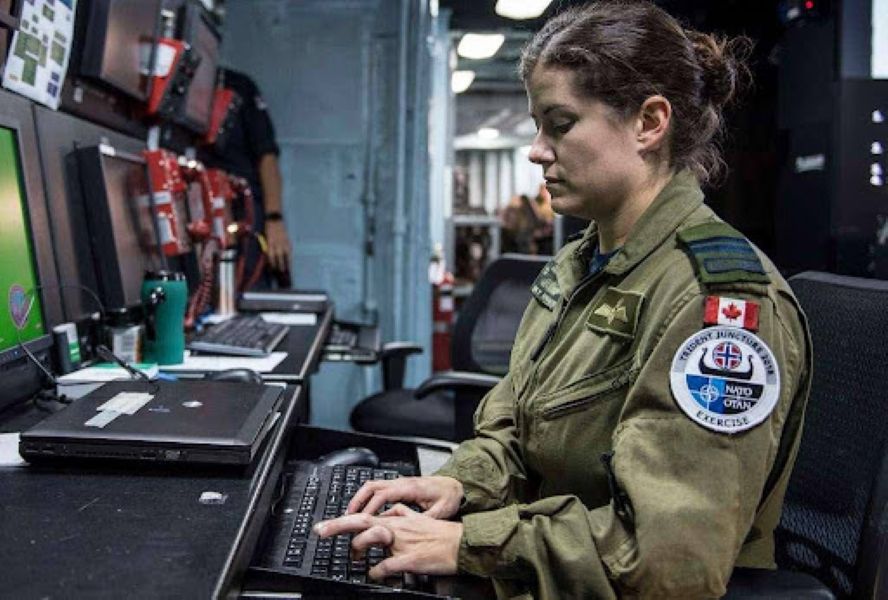
Photo: “Royal Canadian Air Force Capt. Carly Brooker, assigned to Naval Striking and Support Forces (SFN), stands watch as the air operations watch officer in the joint operations center, aboard the Blue Ridge-class command and control ship USS Mount Whitney (LCC 20),” (October 21, 2018). U.S. Navy, accessed via Picryl.
Disclaimer: Any views or opinions expressed in articles are solely those of the authors and do not necessarily represent the views of the NATO Association of Canada.