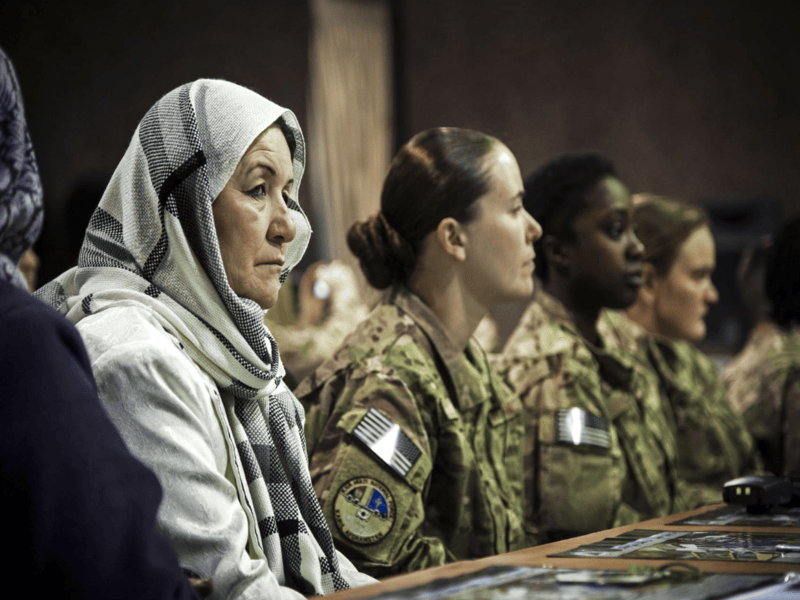
Canada and France are amongst NATO’s leading countries in advancing gender parity. With their Armed Forces compromising between 16-17% of women actively serving in the military. Despite these achievements both countries continue to face significant challenges with recruitment and retention specifically amongst women with strong backgrounds in STEM and cybersecurity. The underrepresentation of women in defence and cybersecurity presents a critical challenge to long term defence readiness and resilience.
Tag: WPS
Encoded Bias: How Gender Analysis Benefits NATO’s AI Expansion
Military AI technologies have the potential to replicate gender bias due to the ways AI machine learning encodes patterns in data. In this article, Tessa McDermid argues that as NATO expands its investment in military AI technologies, it must equally commit to monitoring how these systems risk reproducing gender bias. By adopting corrective frameworks that align its AI Strategy with core Alliance values, NATO can meet its goals in advancing the Women, Peace and Security Agenda.
Shifting Priorities in Ukraine: Is NATO’s WPS Agenda Under Threat?
WPS policies are often disregarded when matters deemed of higher priority emerge, despite NATO’s high engagement of WPS values through public diplomacy, military, and political means. Russia’s invasion of Ukraine has posed the biggest security crisis to NATO in decades, and considering the gendered dimensions of the war, which has seen high rates of sexual and gender
based violence, NATO’s limited WPS response leaves the future of the Agenda in question. As a core tenet of NATO’s values, WPS must not be disregarded; member states that have adopted FFPs, such as Canada, should continue to drive the WPS agenda forward. This article makes key recommendations, including shifting to a human rights-based approach (HRBA) and employing more intentional language in operational directives, to support Ukraine’s current WPS policies.
Enforcing UNSCR1325 & Promoting a NATO Gender Advisor for Asia: A Conversation with Betsy Kawamura (Part 2)
Part 2 of this interview with Betsy Kawamura emphasizes the need for a NATO Gender Advisor for East Asia, the legal accountability of UNSCR1325/R2P (responsibility to protect), and Ms. Kawamura’s future projects for survivors and historical reconciliation in East Asia.
Modern Day Slavery: Not for Sale
Human trafficking affects millions of victims worldwide and presents a serious threat to the safety, security, and human rights of all peoples. In Part 1 of this two-part series on human trafficking, Sabrina Natale provides an introductory analysis, and explores legal definitions.
Measuring State Commitments to Women, Peace & Security: Launch of a new WPS scorecard
In this article, Jenny Yang analyzes Women’s International League for Peace and Freedom (WILPF) newly-launched scorecard to measure implementation of the Women, Peace, and Security (WPS) Agenda by the Permanent members of the UN Security Council (P5).