
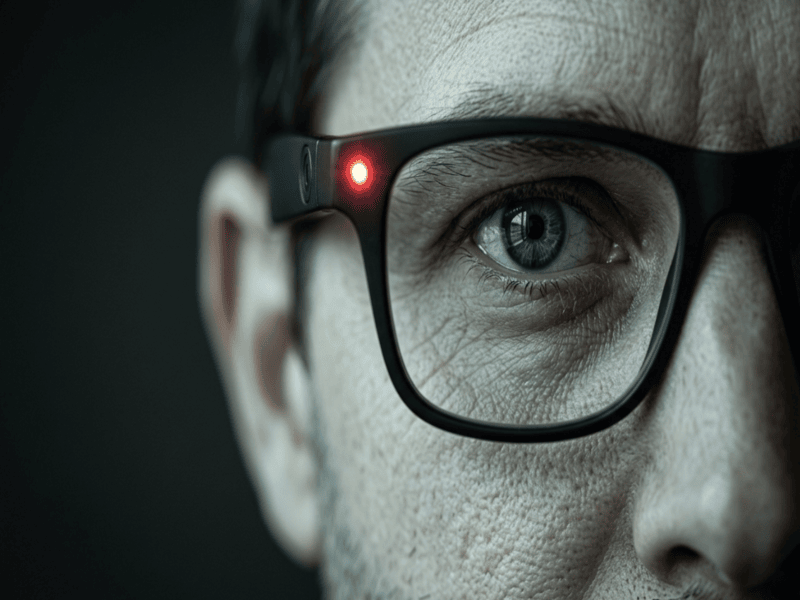
Imagine walking down the street, attending a concert, or meeting someone for the first time, completely unable to detect that the person standing in front of you is recording you. Unlike a smartphone, which is visibly raised when taking a photo or video, a pair of sunglasses can appear entirely ordinary. This distinction is becoming increasingly important as artificial intelligence-enabled smart glasses move from novelty technology to mainstream consumer products.
Recent controversy surrounding Meta’s AI-enabled smart glasses demonstrates the challenge. In August 2026, The Guardian reported that individuals from across the United States had been secretly recorded in homes, workplaces, concerts, and public spaces using Meta’s smart glasses. Particularly concerning was the emergence of businesses offering to disable the glasses’ recording indicator light, which is intended to notify people when the device is capturing audio or video.
The problem becomes particularly concerning when analyzing how these technologies are being used against women. The Guardian documented instances of women being recorded without their knowledge, including footage that sexualized or objectified them. CNN reported that “manfluencers” are filming “pick up” content of women on the street without their consent using smart glasses. The inconspicuous nature of the glasses makes it substantially more difficult for those being recorded to recognize what is happening or object to it.
A Gendered Security Threat
The implications become more significant as smart glasses become increasingly integrated with AI. Today’s primary concern may be covert recording, but the technology could eventually enable far more intrusive forms of surveillance. The Guardian reported on Meta’s exploration of facial recognition capabilities for its smart glasses, including a feature known as “NameTag” that could potentially identify people viewed through the device. Although the feature has not been released to consumers, the possibility illustrates how wearable technology could move beyond recording and toward real-time identification. In a coalition letter written to Meta in April 2026, ACLU stated, “Facial recognition technology built into inconspicuous consumer eyewear represents a serious threat to privacy and civil liberties.”
This potential shift fundamentally changes the security implications of wearable technology. A camera can record a stranger. AI can potentially help determine who that stranger is. A woman who rejects an unwanted advance from a stranger could theoretically be identified through facial recognition and have information about her located online. The possibility of linking a face in a public space to a person’s digital identity creates new opportunities for stalking, harassment, intimidation, and targeted abuse.
Technology-facilitated gender-based violence is not a new phenomenon. Digital platforms have already expanded the ability of perpetrators to stalk, threaten, monitor, and control their targets. Research from the Centre for International Governance Innovation identifies forms of technology-facilitated gender-based violence, including non-consensual distribution of private images, online stalking, threats, and technological monitoring and control.
AI-enabled wearables introduce another dimension by bringing surveillance directly into physical spaces. For women, being secretly recorded can have consequences extending well beyond the initial violation of privacy. Images can be sexualized, manipulated, distributed online, or used to identify and locate a person. An isolated incident of recording can therefore become part of a broader cycle of harassment or exploitation.
At first glance, smart glasses may seem far removed from traditional defence and security concerns. However, NATO’s approach to security increasingly recognizes that threats to individuals and societies cannot be separated from technological change. NATO’s 2024 Women, Peace and Security policy explicitly recognizes technology-facilitated gender-based violence as a growing threat to women and girls. It notes that such violence can reduce women’s participation and leadership in public, political, and military spheres, with broader consequences for democracy, peace, and security. NATO has also committed to addressing the gendered dimensions of emerging technologies.
NATO’s revised AI strategy similarly recognizes the security implications of AI-enabled information operations and gendered forms of technology-facilitated violence. The strategy emphasizes the importance of responsible AI development and anticipating emerging risks. This makes wearable AI relevant to the Alliance’s broader human security agenda. NATO does not have a role in regulating consumer smart glasses, but it does have a role in understanding how emerging technologies can create new vulnerabilities affecting human security and women’s participation in public life.
Canada provides an important example of how governments are beginning to address the broader privacy challenges associated with AI and emerging technologies. In June 2026, the Government of Canada introduced legislation intended to modernize the country’s private-sector privacy framework. The proposed reforms seek to strengthen privacy protections, meaningful consent, and transparency while addressing challenges associated with AI and data-driven technologies.
However, wearable AI still presents questions that extend beyond conventional privacy regulation. Smart glasses introduce a more complicated scenario: what happens when an ordinary individual can collect potentially identifying information about another person without their knowledge? A woman walking through a public space may never have knowingly provided her image, name, or personal information to the person recording her. Yet increasingly sophisticated technologies could allow that information to be captured and analyzed almost instantaneously.
Canada’s efforts to modernize its privacy framework, therefore, provide an opportunity to consider whether existing protections are keeping pace with the capabilities of consumer technologies. Other countries are confronting similar questions. In August 2026, a German digital-rights organization filed a criminal complaint concerning Meta’s AI-enabled glasses and their potential to facilitate covert recording.
The challenge is not deciding whether smart glasses are inherently good or bad. Smart glasses technology does also provide legitimate benefits, particularly for people with disabilities. This demonstrates why blanket restrictions on wearable AI could have unintended consequences. The challenge instead lies in determining what protections should accompany these technologies to ensure that their benefits can be realized without compromising privacy and consent.
Meta has attempted to address privacy concerns through a recording indicator designed to notify people when the glasses are capturing content. However, reports that users have found ways to disable or circumvent the indicator demonstrate the limitations of relying solely on technological safeguards. As wearable AI becomes increasingly accessible, governments and technology companies will need to establish clearer expectations around recording, consent, facial recognition, and the use of personal information.
The emergence of smart glasses illustrates a broader transformation in the relationship between technology and personal security. For women, this transformation carries particular risks. The ability to secretly record, identify, and potentially track individuals can amplify existing forms of harassment and technology-facilitated gender-based violence. NATO’s Women, Peace and Security framework already recognizes that these threats can undermine women’s safety and security.
The question is not whether society should reject wearable AI. It is whether governments, technology companies, and international institutions can establish meaningful protections before covert surveillance becomes an accepted feature of everyday life. As surveillance becomes wearable, protecting women’s security will require ensuring that technological innovation does not come at the expense of privacy, consent, and the ability to engage safely in public spaces.
Photo: Image generated with GoogleAI.
Disclaimer: Any views or opinions expressed in articles are solely those of the authors and do not necessarily represent the views of the NATO Association of Canada.