As NATO Members seek to expand regional alliances to secure critical energy assets, international security organizations must reconcile their hard security priorities with concrete commitments to the Women, Peace and Security (WPS) agenda. While Caribbean and CARICOM countries are not NATO member states, NATO members have engaged with specific interest countries such as Guyana, Jamaica, and Haiti for military operations and training drills. In the Caribbean Basin, military deployments are intensifying over contested territorial regions rich in offshore energy reserves. There have been previous NATO interests in the region, as further interests and partnerships can be seen between NATO and Colombia and NATO and Argentina where expertise is exchanged. Given that there is increasing interest in Guyanese oil from the United States, and Canada seeks to explore energy partnerships with Brazil, it is becoming clearer that while Caribbean nations and states in the Caribbean basin are not a part of the NATO Alliance as per their constitution, they are emerging strategic interests. As they continue strategic energy and security partnerships, attention should be given to the impacts such demonstrations have on the macro-level dynamics of the Essequibo crisis in the Caribbean basin. As NATO-allied states such as France, Spain, Italy, and the United Kingdom, including corporate entities from these states, advance their agenda for oil, gas and other development opportunities with the Caribbean basin, a question that should be considered is: do they contribute to the repair of women, peace and security in the region or do their actions contribute to the ongoing disparity?
While the territorial dispute is often framed in terms of multi-billion-dollar oil infrastructure, naval deployments, and international tribunals, Guyana’s long-term domestic stability remains inextricably linked to human security. Past resource disputes between Guyana and Venezuela set a clear precedent: every surge in border militarization destabilizes surrounding communities, leaving women and children disproportionately exposed to security threats. A clear correlation exists between the escalating humanitarian crisis in Venezuela, the discovery of offshore resources in Guyana, and renewed territorial friction. The UN’s WPS agenda emphasizes that state stability and conflict prevention are inherently compromised when women face asymmetric security risks and remain excluded from economic decision-making during crises. This human security crisis did not begin with the 2015 oil discoveries; rather, it reflects a recurring pattern seen with every wave of resource extraction and foreign intervention in the region.
To illustrate, during the 1870s–1890s Inland Gold Rush & Frontier Isolation, the discovery of gold in the Essequibo interior brought thousands of male prospectors into uncharted rainforests. The impact on women has been recorded through storytelling, as this created isolated, male-dominated mining enclaves with no civil policing or legal protections. Indigenous women faced forced domesticity and sexual abuse, while children in remote frontier settlements lacked access to basic schooling or healthcare. Such retellings can be found in Williams documentary Stains on my Name, War in my veins: Guyana and the Politics of Cultural Struggle (1991). In this documentary, Williams captures the impact the gold rush had in the 1880-1890s, through oral folklore. She retells the struggles women endured and describes the resilience women had against heinous treatment. Additionally, this is also captured in the research done by Gavin Hilson and Timothy Laing, who recount the painful history that was endured by Guyanese Amerindians during the gold mining era. Further discoveries were made during the 1970s–1990s, duly noted as Small-Scale Mining Booms (Garimpos). Specifically, mechanized gold and diamond mining expanded rapidly in Guyana’s hinterland regions (Regions 1, 7, and 8). Remote boomtowns became hubs for organized trafficking networks. Women lured to mining camps under promises of service jobs were routinely subjected to debt bondage and forced sex work. Reports of child labour in small-scale alluvial gold panning also spiked during this period. Such findings were well researched and documented in the Harvard Law School International Human Rights Clinic — All That Glitters: Gold Mining in Guyana (2007), which documented some of the most heinous harm that was inflicted towards women and children in the Amerindian community.
Additionally, the pattern continues to be seen in 2015 with the Liza-1 Offshore Oil Discovery. Increased socio-economic stress and rapid urban migration coincided with rising rates of intimate partner violence (IPV). Guyana recorded some of the highest per-capita femicide rates in the Caribbean during the post-2015 period, with over 80% of gender-related homicides committed by intimate partners or family members. While Guyana has been actively working towards achieving and sustaining the WPS agenda, its work is being threatened by the ongoing territorial dispute and influx of migrants from Venezuela, both countries that have remained unstable. The hyper politicization and rapid militarization of the Essequibo border corridor directly undermine this framework within Guyana, and has the potential to destabilize the progress the country has made from the inside out.
The first major vulnerability stems from profound macroeconomic distortions. The meteoric influx of petrodollars has triggered severe localized inflation. In a country where, historically, a vast portion of the population has lived near or below the domestic poverty line, these rapid economic shocks disproportionately burden women. Because women are predominantly anchored in lower-wage public sectors or unpaid care economies, they bear the brunt of skyrocketing costs for basic goods, housing, and services without experiencing the direct windfall of the oil sector.
Second, the heavy deployment of military efforts to the Essequibo region creates a hyper-masculinized security zone, drastically increasing human security risks. This militarization is particularly volatile given the presence of an estimated 100,000 Venezuelan migrants who have crossed into Guyana to escape their own country’s domestic collapse. These displaced women and girls face severe risks of human trafficking, economic exploitation, and gender-based violence along the poorly monitored, highly-militarized frontier. Many will argue that Guyana is not able to meet targets of the WPS agenda, not just because of the issues with Venezuela but other factors such as receiving an influx of migrants from other neighboring nations such as Cuba. In other words, all factors should be considered before claiming the territorial issue with Venezuela is the only reason why Guyana is having a hard time achieving metrics from the WPS agenda.
Finally, as Guyana is forced to pivot its national budget toward an existential defence posture, national expenditures are inevitably diverted away from health, education, and grassroots social infrastructure, all arenas where women historically drive societal resilience. For Guyana to function as a dependable global energy hub, it must maintain internal social cohesion. True security cannot be achieved solely by patrolling offshore drilling platforms. It requires a deliberate integration of the companion pillars of the WPS agenda to protect vulnerable border populations and ensure equitable socio-economic stabilization. As its economy grows, Guyana has made sustainable efforts working towards achieving aspects of the WPS agenda. Such can be seen with several investments, the passage of legislation of the Family Violence Act (2024) and the creation of the Women’s Innovation and Investment Network (WIIN).
As NATO countries look to secure assets and resources in various regions of the world, there is an increasing need for advancing the WPS agenda. In the past, NATO has partnered with two Latin American countries, Colombia and Argentina. NATO could have an advisory role within the region and further utilize their Defence and Related Security Capacity Building Initiative (DCB). Given that there is an ongoing interest with the Caribbean basin and within Latin America, operationalizing WPS here demonstrates that the framework isn’t just for post-conflict state-building in Europe or the Middle East, but is vital for border stability and conflict prevention. By embedding WPS into regional security frameworks, defence initiatives shift from strictly hard-power deterrence to holistic human security, ensuring that the protection and active leadership of local women are built directly into stability plans.
NATO’s engagement with the WPS framework rests on the revised NATO Policy on WPS and its implementation via the Euro-Atlantic Partnership Council (EAPC). Originally established to operationalize UN Security Council Resolution 1325, this framework integrates gender perspectives into NATO’s three core tasks: deterrence and defence, crisis prevention, and cooperative security. Institutional leadership is anchored by the NATO Secretary General’s Special Representative for WPS, who serves as the high-level focal point driving policy coherence, gender-responsive leadership, and accountability across both civilian and military structures. When translating these mechanisms into non-member partner engagements such as tailored partnerships or bilateral defence capacity building, these results are often found inconsistent. On one hand, tools like the DCB initiative and the Science for Peace and Security (SPS) Programme allow NATO to offer specialized gender advisory training, civil-military coordination (CIMIC) guidance, and gender inclusive military reform to non-member states. On the other hand, a structural gap persists between policy rhetoric and operational reality. This is because partner nations are not bound by NATO’s internal accountability frameworks, so WPS compliance remains voluntary and highly dependent on political will. Consequently, in regions experiencing acute militarization or resource disputes, NATO’s security interventions risk prioritizing immediate kinetic, counter-trafficking, or energy-security objectives over human security imperatives, leaving local gender mainstreaming efforts sidelined as secondary considerations.
To ensure long-term stability and counter internal destabilization in Guyana, If NATO members plan to access certain assets related to security or energy, NATO should consider leveraging its WPS and Human Security frameworks. This could offer specialized advisory support and civil-military training to Guyanese defence forces who are placed to patrol along the Essequibo region. Specific attention should be focused on mitigating gender-based violence, preventing human trafficking, and managing hypermasculinized security environments amidst heavy Venezuelan migrant inflows. Furthermore, NATO can assist security planners with civil-military coordination (CIMIC) and resilient defence budgeting strategies that prevent the total diversion of public funds away from critical social infrastructure like healthcare and education. By supporting regional counter-trafficking intelligence, vulnerability assessments, and the active inclusion of local women in border security decision-making, NATO can help Guyana safeguard its vulnerable populations and maintain the internal social cohesion necessary to remain a stable global energy hub.
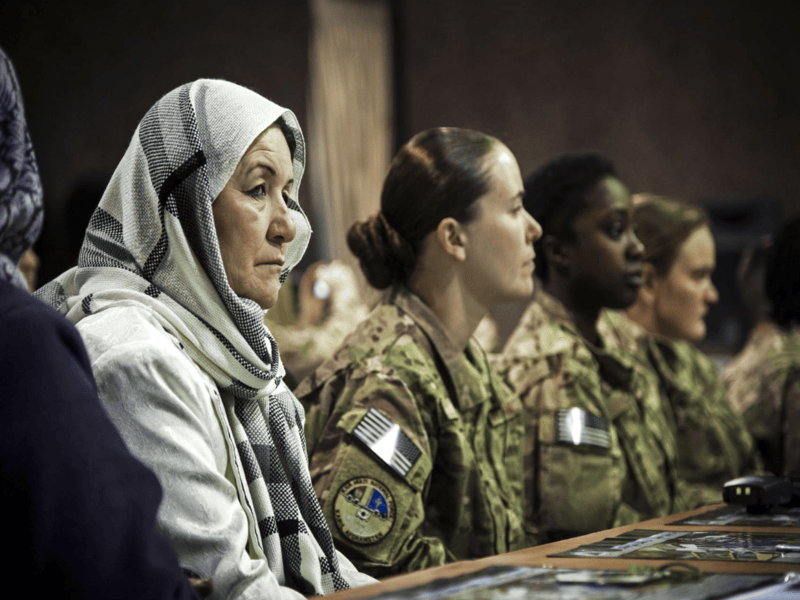
Photo: U.S. Department of Defense, Staff Sgt. Dustin Payne. Source: Public Domain.
Disclaimer: Any views or opinions expressed in articles are solely those of the authors and do not necessarily represent the views of the NATO Association of Canada.