Centre For Disinformation Studies

What We Do Not Account For When Legislating Against Disinformation

In recent years, there have been increased calls for the Canadian government to introduce legislation against disinformation. Tighter laws have been requested in an attempt to reduce the digital flow of deliberately false information in Canadian political discourse around controversies like vaccines, especially during elections. For one, in 2022, Canada’s chief electoral officer Stéphane Perrault Read More…

Centre For Disinformation Studies

Disinformation and Public Health in the Post-Pandemic Era: What COVID-19 Taught Canada and NATO About Resilience

The COVID-19 global pandemic was both a public-health crisis and a catalyst for an infodemic: the flood of misinformation and disinformation that spread as rapidly, if not more rapidly, than the virus itself. A systematic review by the World Health Organization (WHO) found that this infodemic undermined compliance with health measures, fragmented social cohesion, and Read More…

Previous Events

Democratic Resilience in an Era of Autocratic Threats: NAOC Hosts Roundtable with the 2025 Peace with Women Fellowship

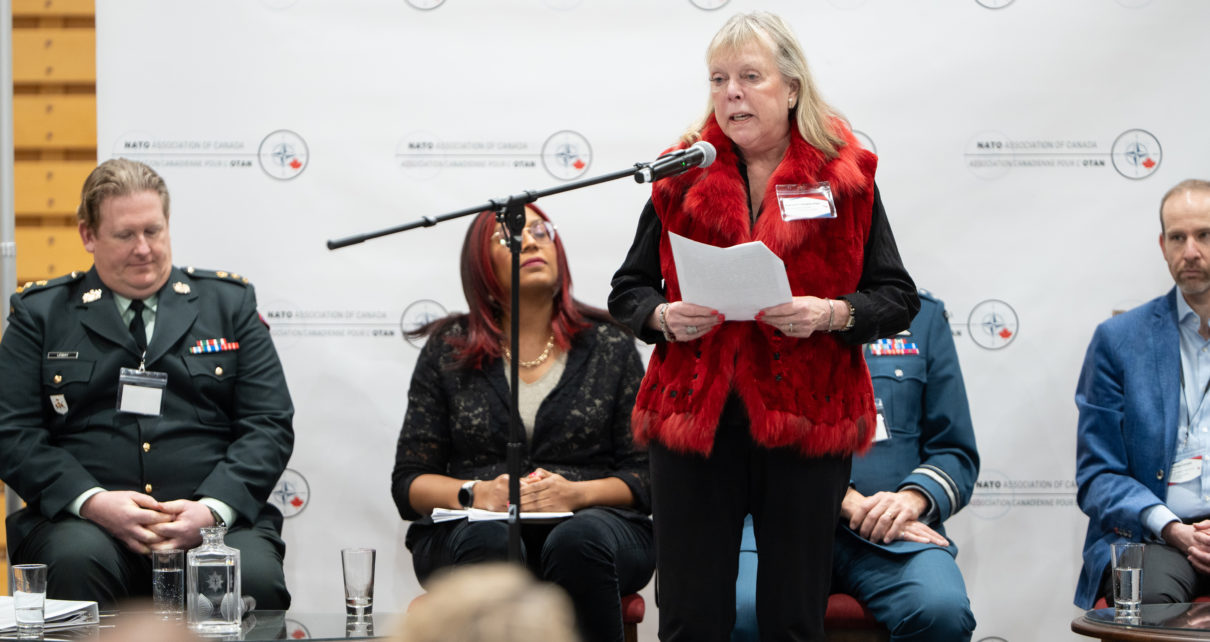
On November 18, 2025, the NATO Association of Canada hosted the 2025 Peace with Women Fellowship for a roundtable held in partnership with the Halifax International Security Forum. This event brought together senior female leaders from the armed forces of thirteen NATO states and their partners to discuss the growing threats posed by authoritarian regimes and their implications for NATO allies. This article offers a detailed overview of the conversation.

Hermean Japra Women in Security

Executing the Women, Peace & Security Agenda: Are International Human Rights Laws Able to Support NATO Commitments?

This article explores how international human rights law, through the CEDAW treaty, can help strengthen NATO’s Women, Peace, and Security (WPS) agenda. It looks at how CEDAW’s legal obligations can support NATO’s goals by adding stronger accountability for member countries. Using Canada as an example, the piece shows how combining legal commitment with political action can make real progress toward equality and women’s roles in peace and security.

Dai Johnson Society, Culture, and Security

“Patience, Tolerance, and Strength of Character of Her People:” Remembrance and Defence Policy

On November 11th, Canadians and their European allies observe Remembrance Day or Armistice Day, honouring those who sacrificed their lives in the World Wars and serving as a reminder of why maintaining the capability to fight remains important. For Canada, an extraordinary sacrifice was made in solidarity with the British. In a subtle display of Read More…

Centre For Disinformation Studies

The Culture of Distrust: : How AI Disinformation Exploits Polarization and Democracy

The voice on the line sounded like the President of the United States. It carried his cadence, his gravel, even his familiar pauses. But the words were strange. “Save your vote for the November ballot,” it told thousands of citizens in New Hampshire ahead of the 2024 primary. In reality, the call was orchestrated by Read More…

Centre For Disinformation Studies

Canada at the Crossroads: Disinformation as a Domestic Security Challenge

Canada’s greatest security risk may not lie at its borders but in its news feeds. That might sound like a dramatic statement, yet the danger is not abstract. It lives in the information Canadians scroll past each day, in the stories they share, and in the narratives that seep in unnoticed. In a country that Read More…

Esha Grewal Women in Security

When democracies censor: Alberta’s book ban and its contradiction with NATO’s mission to defend democratic principles

Alberta’s latest directive on books has turned heads nationally. But what does it mean for Canadian security? In this article, author Esha Grewal discusses how Alberta’s book ban is a part of the larger, growing trend of divisive policies among NATO countries that threaten social cohesion.

NATO and Canada

Le rôle du Canada dans le renforcement du flanc sud de l’OTAN par l’innovation et le développement capacitaire

Alors que l’OTAN concentre son attention sur les fronts oriental et indo-pacifique, le Canada a l’occasion de redéfinir son rôle sur un flanc sud souvent négligé. Cet article soutient qu’Ottawa peut renforcer la résilience nord-africaine par l’innovation plutôt que par l’intervention, en mobilisant DIANA Halifax et en renforçant les capacités pour des projets pilotes de lutte anti-drones et de surveillance maritime en Tunisie et en Mauritanie.

China Indo-Pacific and NATO Russia

China’s Calculated Partnership: Decoding Beijing’s Alignment with Russia and NATO’s Strategic Response

In “China’s Calculated Partnerships: Decoding Beijing’s Alignment with Russia and NATO’s Strategic Response,” Daniel Lincoln argues that Beijing’s support for Moscow stems from insecurity, not ideology, and that misreading this dynamic risks hardening a fragile partnership. The piece calls for a strategy of restraint and engagement – one that deters aggression while offering China reasons to distance itself from the Kremlin.