Russia’s invasion of Ukraine in 2022 has posed the largest security crisis to NATO in decades, and is a clear challenge to the Alliance’s values and integrity. However, when considering the prevalence of sexual and gender-based violence that has occurred in this conflict, NATO’s limited implementation of the Women, Peace, and Security (WPS) agenda in its response to Russia’s invasion raises questions on the future of the WPS agendas on the broader international scale.
The WPS agenda was first adopted in 2000 from the United Nations Security Council Resolution 1325, and has seen nine revisions to date. The most recently updated policy in 2024 outlines four strategic objectives to guide NATO’s WPS policies: gender-responsive leadership and accountability, participation, prevention, and protection. In addition, individual member states have adopted National Action Plans (NAP) or a Feminist Foreign Policy (FFP). This integration supports the revised policy pillars and advances the WPS agenda within their respective domestic frameworks, which aim to mainstream gender initiatives across administrative and military operations.
As one of the first countries to adopt a NAP, and a leading voice for the participation of women in peace operations, Canada has been at the forefront amongst NATO member states’ commitment to WPS objectives. With this, WPS is directly linked to Canada and NATO’s values and strategy. Secretary General Mark Rutte notes that “it is so much more than a commitment, it is about who we are and what we stand for as an alliance.” Although all NATO member states, excluding Hungary and Turkey, currently have NAPs regarding the WPS in place, most of these plans are outdated and require revision.
Despite NATO’s high public engagement of WPS values through diplomatic, military, and political initiatives, WPS policies are often disregarded and remain a “hollow concept”. When examining Sweden’s initial bid to join NATO in response to Russia’s full-scale invasion of Ukraine, the idea of the WPS as a “hollow concept” emerges. A historical leader of feminist values, Sweden was the first country to adopt a Feminist Foreign Policy (FFP) in 2014, and had previously engaged with the WPS agenda as a core part of its diplomatic narrative and identity. It was expected that Sweden might lead NATO WPS efforts once affiliated; yet, the government abandoned its FFP, citing the irrelevance of implementing the feminist agendas with the impending threat from Russia.
Russian President Vladimir Putin’s authoritarian regime has long perpetuated the normalization of rape, a form of gendered violence, and use of conflict-related sexual violence. Though the international community has publicly supported combatting such gendered violence, in practice, WPS priorities have been neglected while the alliance shifts its focus to addressing other concerns on the Eastern front. This leaves the future of the WPS agenda in question.
UN Women estimates a 36% surge in sexual and gender-based violence since the beginning of the war in 2022, with higher rates of domestic violence amongst women and girls. However, resources and support for NATO’s operations in the war in Ukraine are currently centered on providing military and financial aid; while these remain a crucial contribution to support war efforts, WPS priorities should not be neglected in the meantime. Even though the WPS agenda functions as a public diplomacy tool and a projection of NATO’s democratic values of gender equality, operations are often sidelined when priorities deemed more urgent arise.
As a champion of democratic values, multilateralism, and inter-state cooperation, the WPS agenda is a hallmark of NATO’s broader strategy and goals. Considering the clear gendered dimensions of the war, where women have had an increasing role in war efforts despite also being exposed to higher rates of conflict-related sexual violence, the WPS agenda is of high pertinence to the conflict in Ukraine to mitigate and improve these negative effects.
The implementation of the WPS agenda in Ukraine would greatly benefit the women in the region; as the largest multilateral military and political alliance, NATO’s wider hesitance to carry out WPS strategies specifically in Ukraine illustrates the challenges that WPS and feminist policies face in practical implementation. While this mirrors that of other international organizations and member states’ foreign policy, this undermines NATO’s values-driven foundations, where the issues of gender equality and justice have been largely sidelined.
As millions of women and girls in Ukraine are subjected to sexual and gender-based violence as a result of Russia’s invasion, the WPS agenda’s pillars of “Protection” and “Prevention” are increasingly relevant. Additionally, as Russia continues to challenge NATO’s borders, reaffirming the Alliance’s commitment to upholding its foundational values is imperative. As a prominent multilateral alliance, NATO has the potential to lead the reevaluation and implementation of the WPS agenda in Ukraine.
One course of action is to shift current WPS policies to take a human rights-based approach (HRBA). NATO’s gender mainstreaming efforts and WPS agenda have faced criticism, but in the broader international environment, human rights are less likely to be contested. Moreover, human rights have a stronger likelihood for a solid legal framework as they are codified into international law. The UN and other development and aid organizations have previously adopted HRBA into their missions; NATO could imitate these existing systematic structures that are “transparent, orderly, and consistent” to support current WPS approaches and its operations in Ukraine.
Further, future resolutions should specifically include language that creates tangible mechanisms for the WPS agenda to be integrated at the operational level in Ukraine. For the objectives of the WPS agenda to be fully attained, mission parameters must have intentional language that addresses the protection, participation, and empowerment of women and girls in a conflict setting. Given this, there is a higher likelihood that established processes can then be translated into achievable tasks at the field level.
The WPS remains a core tenet of NATO’s values, and as military tensions in Ukraine continue to increase, it is important that the agenda must be prioritized. Canada and other NATO member states who have adopted FFPs and led WPS initiatives, should reinvigorate the core pillars of the WPS agenda and continue to drive NATO’s values forward in Ukraine, continuing to work towards alleviating the gender-based effects of war.
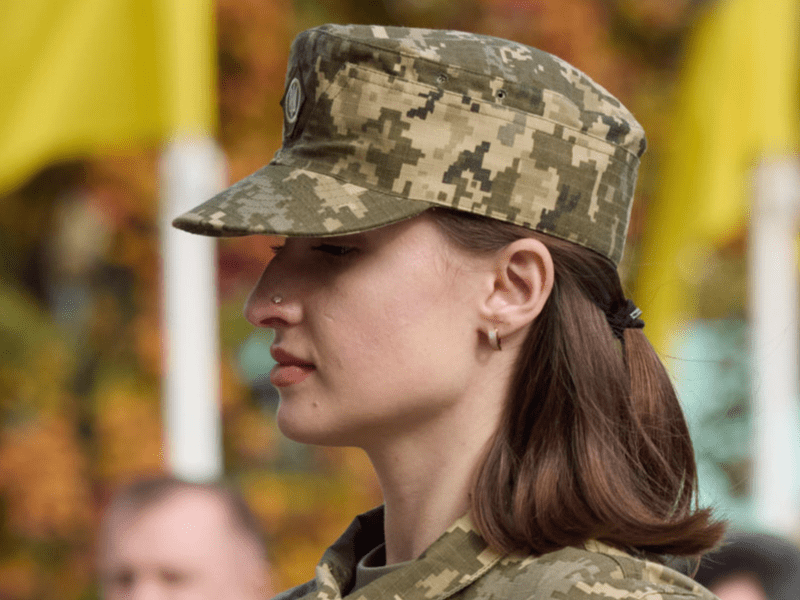
Photo: This image depicts the events on the Day of Defenders of Ukraine, near the Mariinsky Palace, Kyiv, 2022. Source: Wikimedia.
Disclaimer: Any views or opinions expressed in articles are solely those of the authors and do not necessarily represent the views of the NATO Association of Canada.


.jpg)
