On April 1, 2026, U.S. President Donald Trump called the North Atlantic Treaty Organization (NATO) a “paper tiger” after Allies refused to back United States (U.S.) military action against Iran. This article treats the phrase as a question of cohesion, not capability, and argues that U.S. trade pressure exposes the gap between NATO’s formal unity and its members’ freedom to disagree with Washington. Article 2 offers the first evidence of that gap: it calls for economic cooperation but sets out no mechanism for resolving trade pressure between Allies. Article 4 permits consultations over threats to territorial integrity, political independence, or security, not economic coercion. NATO’s consensus process offers the second: it can record agreement without showing whether every ally felt free to disagree. Canada, which championed Article 2—often called “the Canadian Article” because Ottawa defended it despite early Allied resistance—has a particular stake: the Canada-United States-Mexico Agreement (CUSMA) and F-35 reviews now place its trade and defence ties with Washington under scrutiny.
Article 2: A Principle Without Protection
Article 2 calls on NATO allies to “seek to eliminate conflict in their international economic policies.” In July 2025, Trump threatened 30% tariffs on European Union (EU) goods; the subsequent Joint Statement on a United States–European Union Framework imposed 15% tariffs on most EU goods in exchange for the EU eliminating tariffs on U.S. industrial goods. In January 2026, Trump threatened new tariffs on eight European NATO allies that opposed his push to acquire Greenland. The danger of accommodation is not compromise itself; it is that concessions may encourage further threats.
Canada’s experience is similar. At the July 1, 2026 review, Washington declined to extend CUSMA in its current form, forgoing a further 16-year term and triggering annual reviews while the agreement remains in force until 2036. On August 22, Prime Minister Mark Carney suspended Canada–U.S. talks aimed at resolving the countries’ tariff dispute, including recent U.S. tariffs and Canadian retaliation, saying that Washington “asked too much and offered too little.” U.S. trade representative Jamieson Greer countered that Canada introduced new demands after progress was made, a “missed opportunity.” Either way, Article 2 supplied no mechanism to resolve the dispute.
Asked after the April 4, 2025 NATO Foreign Ministers’ meeting whether U.S. tariffs breached Article 2, Secretary General Mark Rutte replied, “I don’t think this is in breach”. That does not imply that NATO would fail to honour Article 5, since trade disputes and collective defence tests are distinct. Yet if adversaries perceive NATO’s unity as concealing unresolved divisions, they may be more willing to test its resolve.
Consensus: The Cost of Dissent
NATO decides by consensus, meaning that no member objects, but this expresses collective will only if an ally can object without paying an unacceptable price. Canada illustrates the economic exposure created by U.S. tariffs. After the U.S. raised its steel tariff to 50% on June 4, 2025, Canadian steel exports were 45.1% lower year over year in March 2026. Canadian manufacturing also lost 51,800 jobs over the first year of U.S. tariffs, though not all of those losses can be attributed to tariffs. These figures show how economic pressure raises the domestic cost of resisting U.S. demands.
The dependence extends to defence. According to the Stockholm International Peace Research Institute, the U.S. supplied 58% of European NATO members’ arms imports in 2021–25; U.S. arms transfers to those members rose 142% from the preceding five-year period. When the EU later considered favouring European suppliers, Washington threatened to review exemptions from its Buy American laws.
Canada’s F-35 purchase prompted a similar warning. In January 2026, U.S. Ambassador Pete Hoekstra said the North American Aerospace Defense Command (NORAD) “would have to be altered” if Canada reduced its order of 88 jets; by August 2026, he called Canada’s review of the purchase a “trade irritant.” NORAD is bilateral, not a NATO body. The warning shows bilateral ties give Washington leverage over Canada’s defence choices.
None of these cases shows an ally changing its position on a NATO decision under pressure, but they do show why the costs of disagreeing with Washington could extend well beyond the decision at hand. An ally might agree to a NATO decision partly to protect its economic or security interests, rather than because it supports the decision on its merits.
A Counter-Argument: Military Unity, Political Strain
NATO’s recent military cooperation offers a counterargument: allied unity remains substantive despite political and economic strain. In NATO’s 2025 Defence Expenditure of NATO Countries report, all 32 allies were estimated to have met or exceeded the guideline to spend 2% of GDP on defence for the first time. All but Spain also pledged to the 5% Hague defence commitment by 2035.
Operation Eastern Sentry is the strongest rebuttal to the claim that U.S. pressure is weakening NATO. After Russian drones entered Polish airspace on September 9, 2025, prompting Article 4 consultations, NATO launched Operation Eastern Sentry three days later to bolster the Eastern flank. Alongside record defence spending and joint exercises, Eastern Sentry demonstrates that NATO remains cooperative in deterring external threats. These measures, however, cannot tell us how much confidence allies retain in one another when their interests diverge, including under U.S. trade pressure. In his 2025 Annual Report, Secretary General Mark Rutte warned that European allies and Canada were over-reliant on US military might. The Danish Defence Intelligence Service’s Intelligence Outlook 2025 likewise warned that U.S. force “even against allies” could no longer be ruled out.
Washington portrays economic leverage as a way to “align incentives” and “share burdens” in pursuit of allies’ 5% defence-spending commitment, and argues that Article 2 does not prohibit tariffs between allies. Yet this defence concedes the point: economic pressure can influence defence choices, weakening the freedom that makes NATO consensus meaningful.
Washington’s trade pressure exposes the risk of NATO becoming a paper tiger: an alliance whose formal unity endures even as its members’ freedom to disagree erodes. That does not mean the tiger has no teeth, and collective defence may still hold. But a tiger that looks like paper invites adversaries to test it.
Conclusion
Reducing this exposure requires two reforms. First, Canada should use Security Action for Europe (SAFE), the EU’s joint-defence-procurement programme, to help Canadian firms bid for European defence contracts. SAFE could help Canadian firms diversify away from U.S. suppliers. It also carries costs: Canada must make an initial €10 million contribution, and deeper alignment with the EU could create friction with Washington. Second, the North Atlantic Council should create a Secretary-General-chaired Article 2 consultation in which ambassadors can raise tariffs or procurement threats. Unlike Article 4 or World Trade Organization procedures, this consultation would flag economic pressure before it shapes NATO consensus, rather than resolve disputes. Washington may resist treating its trade policy as an alliance concern. With two years left in Trump’s term, the CUSMA review, Canada’s F-35 decision, the EU–U.S. framework, and the 2027 NATO summit in Albania will test whether the proposed reforms give allies room to disagree despite Article 2’s limits and continued U.S. trade pressure. An alliance is strongest when its members choose solidarity freely; only then does its united roar carry the weight of every ally’s voice.
Disclaimer: Any views or opinions expressed in articles are solely those of the authors and do not necessarily represent the views of the NATO Association of Canada.
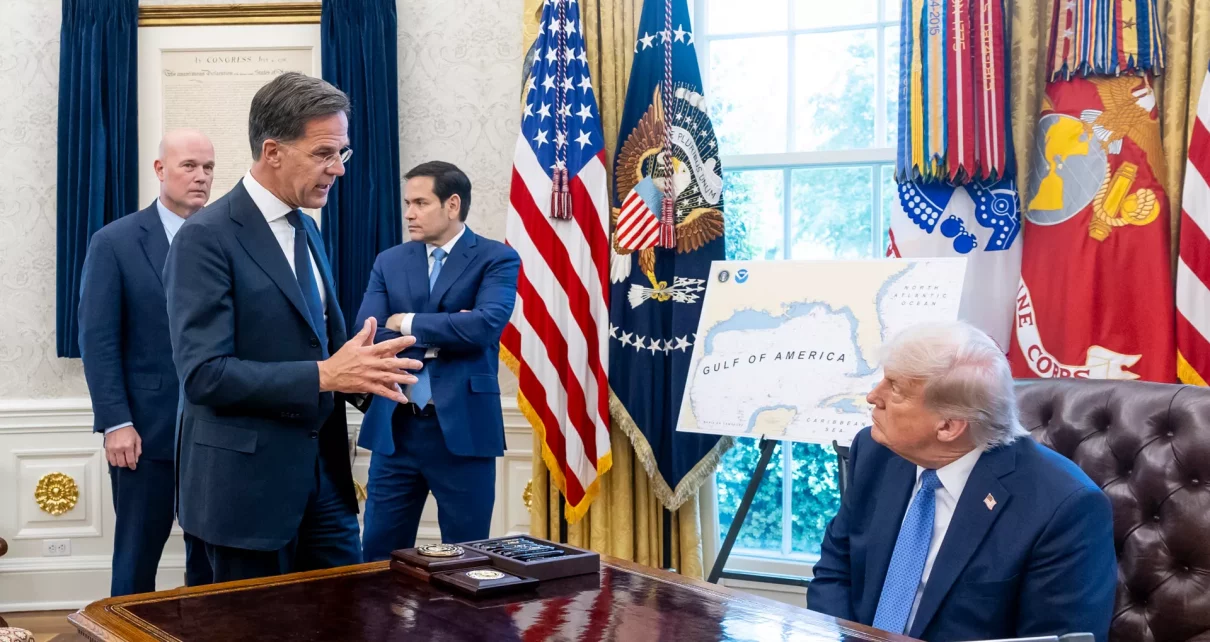
Photo: NATO. “NATO Secretary General Mark Rutte Meets with US President Donald Trump.” Photograph, April 24, 2025. nato.int/en/multimedia/multimedia/photos/2025/04/24/nato-secretary-general-visits-the-united-states?selectedLocale=