On June 25, 2025, North Atlantic Treaty Organization (NATO) Allies made an ambitious commitment at The Hague: by 2035, they would invest 5 per cent of Gross Domestic Product (GDP) annually in defence and defence-related requirements. Of that total, at least 3.5 per cent of GDP is intended for core defence requirements and NATO capability targets. Canada reached 2 per cent of GDP in defence spending in 2025-26, with current funding provisioned to reach 4 per cent by the end of the decade before moving toward the 5 per cent target by 2035. As Canada increases defence investment, its new Build–Partner–Buy framework prioritizes building capabilities in Canada, partnering with trusted allies where appropriate, and buying from abroad when neither option is feasible. This article argues that the framework’s success will depend on whether Canada can expand domestic industrial capacity while delivering the timely, interoperable capabilities that both Canada and NATO require.
Greater spending, however, addresses only part of NATO’s challenge: greater investment matters only if Allies can turn it into the equipment, technology and industrial capacity their armed forces require. Canada’s approach broadly aligns with NATO’s efforts to expand defence production and industrial cooperation, but it raises an important question: can Canada prioritize greater domestic defence-industrial sovereignty while still meeting NATO’s need for timely, interoperable and increasingly integrated capabilities?
NATO’s challenge goes beyond spending
The connection between defence spending and industrial capacity has become increasingly explicit within NATO. Under the Alliance’s 2024 Industrial Capacity Expansion Pledge, Allies committed to accelerating defence production, providing industry with clearer long-term demand, expanding multinational procurement and reducing barriers to defence trade and investment. These industrial commitments are connected to the NATO Defence Planning Process, which identifies the capabilities the Alliance requires and assigns Capability Targets to individual Allies. NATO therefore needs more than higher spending: it needs Allied defence industries to produce capabilities that can be delivered on time and used effectively alongside those of other Allies.
NATO reinforced this objective further in 2026 through its Strategy for Industry–NATO Cooperation. The strategy identifies three priorities: improving collaboration between NATO and industry; advancing innovation and interoperability; and strengthening and scaling defence production. The Alliance also calls for greater visibility of NATO capability needs so companies can make longer-term investment and production decisions. For Canada, the harder question, however, is how domestic industrial objectives should fit within an Alliance increasingly focused on coordinated production and interoperable capabilities.
The tension inside Build-Partner-Buy
Canada’s Defence Industrial Strategy attempts to address both sides of this problem. “Build” directs procurement toward Canadian firms where Canada has industrial strengths or sovereign capabilities are particularly important. “Partner” allows Canada to work with trusted allies and multinational firms where domestic capacity is insufficient or cooperation offers an advantage. Only when neither option is feasible does the framework move to “Buy.”
There are clear reasons for this approach, but there are also trade-offs. The strategy acknowledges that producing and buying certain capabilities in Canada may affect cost and timelines. Prioritizing domestic production could also make interoperability more difficult if Canadian-built capabilities do not align closely with those used by other Allies. At the same time, building domestic capacity could reduce supply-chain vulnerabilities and give Canada greater control over the operation and sustainment of military equipment. The Defence Industrial Strategy also prioritizes Canadian ownership, protection and access to critical intellectual property.
However, NATO’s industrial priorities add another consideration. The Alliance encourages reciprocal cooperation, multinational capability development and interoperable equipment. Its 2026 industry strategy states that cooperation among Allied defence industries remains essential for delivering required capabilities, while also recognizing that industrial policy remains a national responsibility. These goals are not necessarily contradictory. The strategy acknowledges that cooperation can reinforce national sovereignty through co-design, co-development and co-production. Nevertheless, implementation will require choices. Building domestically may strengthen Canadian industrial capacity over the long term, while partnering with an established Allied producer may provide faster access, economies of scale or greater interoperability.
That leaves an important question unresolved within Build–Partner–Buy. The strategy establishes broad conditions for each option and states that the Defence Investment Agency will make appropriate trade-offs, but does not provide detailed criteria for weighing sovereignty, cost, delivery time and interoperability when more than one option is available. The central test will therefore be how those trade-offs are made in practice, particularly when building domestically may strengthen Canadian sovereignty but partnering could deliver a capability faster or integrate more easily with NATO Allies.
From investment to capability
The risk is not that a stronger Canadian defence industry will undermine NATO cooperation; rather, an overly rigid application of domestic-production objectives could create unnecessary duplication or delays at a time when NATO is emphasizing faster and more flexible defence production.
Canada’s Defence Industrial Strategy recognizes the importance of translating industrial investment into usable capabilities. Firms selected as strategic partners are expected to deliver capabilities on time and on budget, while the Defence Investment Agency is intended to make procurement more coordinated and responsive. NATO similarly emphasizes agile procurement, scalable production facilities, secure supply chains and the ability to increase production during heightened demand.
The opportunity, then, is to treat “Build” and “Partner” as complementary rather than competing choices. Canada does not necessarily need to manufacture every defence capability domestically to develop a stronger defence-industrial base. Domestic specialization in areas where Canadian firms possess genuine advantages could be combined with multinational production and procurement elsewhere. Putting that balance into practice, however, will depend on how effectively Canadian firms can connect with NATO’s broader industrial initiatives.
NATO’s Industry Strategy also addresses industrial integration. NATO plans to use aggregated demand signals to clarify future capability requirements and has established the NATO Engine, connecting companies needing additional production capacity with manufacturers capable of helping them scale. Canadian firms integrated into these networks could contribute to Allied capability requirements, including command and control, logistics, and air and missile defence, while expanding Canada’s industrial capacity.
From Strategy to Delivery
The real measure of Canada’s Defence Industrial Strategy will come through implementation. Canada should prioritize integrating firms in its identified sovereign capability areas, including aerospace, ammunition, digital systems, space and specialized manufacturing, into NATO initiatives such as the NATO Engine. Ottawa should also publish clear criteria for when Build should give way to Partner, including how differences in delivery time and interoperability will be weighed.
A 2026 Standing Committee on National Defence report, Canada’s Defence Industrial Strategy: From Innovation to Readiness, heard evidence describing defence procurement cycles of five to fifteen years. Progress should therefore be measured by whether the Defence Investment Agency can shorten those timelines while delivering capabilities that meet operational requirements and remain interoperable with NATO Allies.
Hence, Canada does not need to choose between building at home and delivering with Allies. The test for Build–Partner–Buy is whether it can distinguish when domestic production provides a genuine strategic advantage and when partnership offers a faster or more interoperable path. Its success will depend on whether Canada can strengthen its own defence-industrial capacity while becoming a more effective contributor to NATO’s wider industrial base.
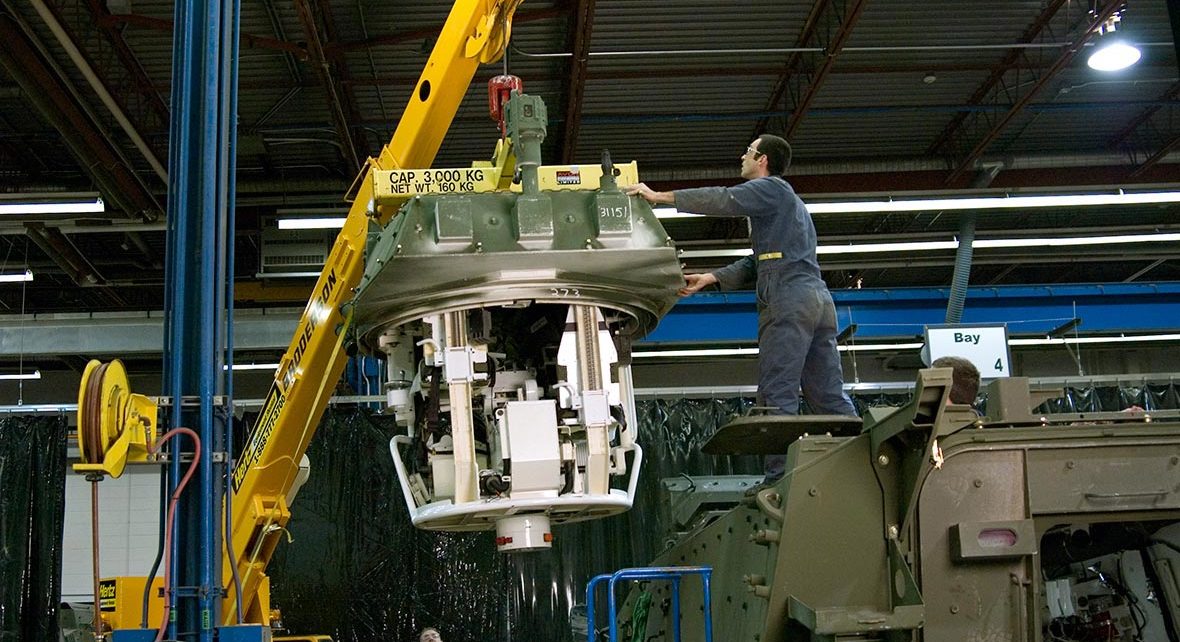
Photo: Light Armoured Vehicle III undergoing upgrades at General Dynamics Land Systems–Canada, via Department of National Defence. Photo courtesy of the Department of National Defence, https://www.canada.ca/en/department-national-defence/services/procurement/light-armoured-vehicle-iii-upgrade.html.
Disclaimer: Any views or opinions expressed in articles are solely those of the authors and do not necessarily represent the views of the NATO Association of Canada.