More people are living through armed conflict today than at any point since before the Second World War, with peace talks ongoing from Ukraine to Gaza, across Africa, Asia, and the Middle East. Yet the central message of a day-long UN Security Council debate this June was that more than two decades after the adoption of Resolution 1325 on Women, Peace and Security (WPS), women remain largely absent from these negotiations. Peace agreements are crucial because they do more than serve to end armed conflict, they set the stage for constitution-making and the redistribution of power, measurably lowering the odds of conflict recurrence. Despite their exclusion, evidence is clear that when women have an influence, they improve both the probability of reaching an agreement and its durability once signed, making inclusion a strategic imperative to peace.
Sima Bahous, UN-Women’s Executive Director, used the debate to press UN member states and mediation officials to adopt the Secretary-General’s Common Pledge on Women’s Participation in Peace Processes, which aims to fast-track women’s direct role in formal talks. The Pledge sits plainly within NATO’s WPS pillar on participation; however, only 43 mediation actors worldwide have signed it, which includes only some NATO Allies. In alignment with its WPS policy, NATO must encourage the Allies who haven’t yet signed to do so, and help those who have, translate their commitment into practice.
The scale of women’s exclusion from peace negotiations is substantial. UN Women’s 2024 data shows women made up just 7 percent of negotiators and 14 percent of mediators in formal peace processes worldwide, with many talks including no women at all. That year, South Sudan was the only country where a concluded peace agreement included women’s groups as signatories. This trend is not improving: women’s share of negotiators in UN-led or co-led peace processes fell from 23 percent in 2020 to 18 percent in 2024. Conflict-by-conflict data going back to 1992 shows similar results, with women making up roughly a quarter of participants in talks over Israel-Palestine, Libya, and Myanmar, against zero percent in Ukraine’s negotiations.
Several dynamics account for this gap. Peace processes have traditionally prioritized including those who started the conflict, a group rarely made up of women. And because military forces are largely male, they dominate the process by default. Women experience conflict differently, too: they are more likely to face domestic violence once war breaks out and become victims from its indirect effects after fighting ends. This often leads to women being classified as victims of conflict in need of protection rather than as parties to its resolution, making them less likely to be taken seriously at the table. That divergence in wartime experience also helps explain why women’s understanding of security is often at odds with a peacemaking tradition built by and for men.
These normative biases have made the effects of women’s inclusion harder to measure systematically, but the data that does exist shows a positive effect on reaching and sustaining agreements. The Broadening Participation Project, run out of Geneva’s Graduate Institute of International and Development Studies, examined forty cases and found that when women’s groups were able to strongly influence negotiations, an agreement was almost always reached and more likely to be implemented. The issues women tend to raise at the negotiation table, such as human rights, security, or development, are broader than the dominant definition of peace as simply the absence of armed conflict. This allows for more comprehensive agreements that hold better over time: agreements with women’s participation are 35 percent more likely to last fifteen years than those negotiated without. The Philippines, a NATO partner nation, illustrates this. Women’s groups were instrumental in shaping the 2014 Comprehensive Agreement on the Bangsamoro, pushing successfully for gender provisions in the settlement, advocating for more gender-equitable post-conflict institutions, and setting up a unit to monitor the ceasefire. Similarly, in Northern Ireland, women’s participation in the 1998 Good Friday Agreement gave greater weight to social issues that would otherwise have been sidelined and pressed for women’s full political participation going forward. Other examples show up across Liberia, Kenya, Burundi, and Guatemala, where women pushed for measures aimed at preventing relapse into violence and secured context-specific gender equality provisions. Women tend to have different social roles and community networks, take more collaborative approaches to peacemaking, and are often viewed as more impartial, honest-broker mediators than men. Together, this is what gives these agreements their increased breadth and durability.
Meeting the UN’s call for equal participation in peacemaking falls within the Alliance’s own commitment. NATO’s WPS participation pillar commits it to promoting the full, equal, safe and meaningful participation of women at all levels and acting in line with the purposes and principles of the UN. Signatories of the Pledge commit to appointing women as mediators, advocating for their participation, consulting them throughout the peace process, and building gender expertise into mediation teams. This makes alignment with the Common Pledge a logical extension of NATO’s existing policy. Currently, NATO Allies advance their WPS commitments through National Action Plans tied to broader international frameworks, so building coherence between these national commitments and the Common Pledge is a natural fit under NATO’s WPS Policy.
NATO can draw on its existing WPS infrastructure to advance the aims of the Common Pledge among its Allies on several fronts. To encourage those who haven’t yet signed, it should use engagement through the NATO Committee on Gender Perspectives (NCGP) to frame the Pledge as consistent with commitments Allies have already made under NATO’s own WPS policy. For those who have, NATO should use the Summary of National Reports, which collects WPS implementation data to track how signatories are acting on the Pledge in practice. NATO’s existing research capacity, including through the NCGP, should be directed at documenting gender dynamics in conflicts where Allies have a stake and at researching models of inclusion beyond a seat at the table. Participation can take many forms: direct participation, observer status that allows women to act as guarantors of an agreement, consultative bodies that advise the negotiation process, post-agreement commissions, and public mechanisms like referendums. These models can be adapted to increase both women’s participation and the chances of resolving conflict. NATO’s research and policy frameworks grant it a strong position to help Allies practice these models.
Peace cannot fully serve a population without a representative body negotiating for it, and the evidence shows it holds less well. NATO’s WPS Policy already obligates the Alliance to strive towards this equal participation, and the Common Pledge gives Allies a standard to work towards when doing so.
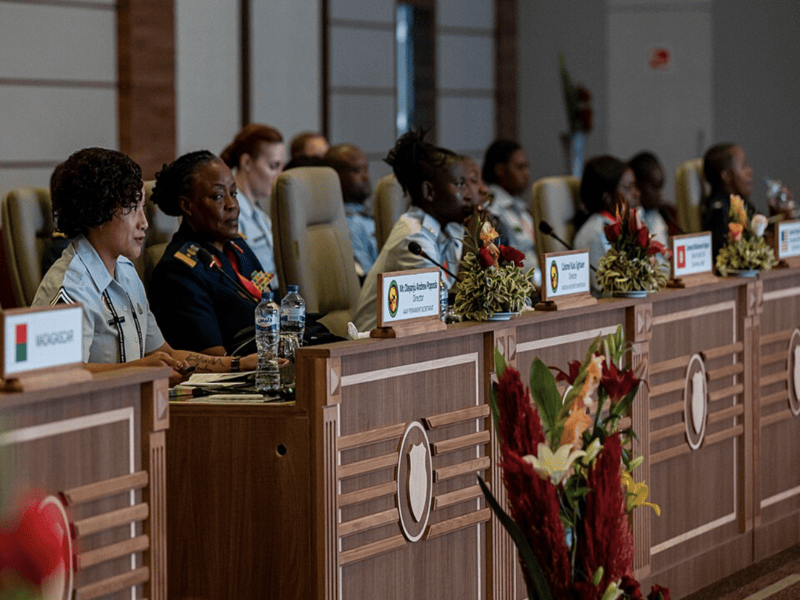
Photo: Women, Peace and Security panelists attend a briefing on the United Nations Security Council Resolution on Women, Peace and Security (2024). Source: Senior Airman Regan Spinner, U.S. Air Force, via Wikimedia Commons. Public Domain.
Disclaimer: Any views or opinions expressed in articles are solely those of the authors and do not necessarily represent the views of the NATO Association of Canada.


.jpg)
