When modern state borders are superimposed onto an inherently diverse geography, centralized state systems often enforce strict administrative and cultural uniformity to align the human landscape with centralized state identities.
This friction is acutely visible along NATO’s southeastern flank, where regional authorities frequently treat ethnic and administrative plurality as an inherent challenge to state sovereignty. For the Kurds, the world’s largest stateless ethnic group with a population between 25 and 45 million worldwide, this rigid nation-state template has resulted in a historic cycle of exploitation and abandonment, where their security is frequently coordinated with Western tactical objectives on the front lines, leaving them uniquely vulnerable to shifts in broader regional diplomacy.
For Canada and NATO, this persistent double-dealing is an active operational liability that systematically destabilizes the Kurdish ground forces serving at the front lines against threats like ISIS. To halt this strategic self-sabotage, the Alliance must pivot towards a framework of Pluralism-Indexed Stabilization, where internal defence tools explicitly condition security assistance on a state actor’s verifiable protection of minority rights.
History of Kurdish Persecution
The systematic insistence on a monocultural state has historically targeted the Kurds as obstacles to centralized rule, giving rise to an architecture of cross-border erasure designed to dismantle their local autonomy.
In Syria, this manifested through the infamous 1962 Hasakah census, which stripped citizenship from over 150,000 Kurds overnight, rendering them stateless in their own ancestral homes, alongside the state’s aggressive ‘Arab Belt’ policy that criminalized the Kurdish language and outlawed mother-tongue education.
Across the frontier in Iraq, this impulse reached its most violent peak under Saddam Hussein’s Ba’athist regime. Decades of state-orchestrated violence and genocidal operations, most notably the Anfal campaigns of the late 1980s, killed tens of thousands of Kurdish civilians, destroyed thousands of villages, and forced hundreds of thousands to flee their homes, driving massive refugee flows across the northern frontier into Türkiye. This was compounded by systemic Ta’rib (Arabization) policies that forcibly displaced Kurdish families, banned the language in official transactions, and re-engineered the demographics of resource-rich northern provinces like Kirkuk. Even today, this centralization impulse endures, exemplified by recent bureaucratic directives from Baghdad attempting to ban the Kurdish language from university classrooms in disputed territories.
The situation in northeastern Syria remains a major source of tension between Türkiye and Kurdish-led forces. The Syrian Democratic Forces (SDF), which played an important role in the international campaign against ISIS, have sought to preserve elements of political and security autonomy in northeastern Syria. Türkiye, however, views the presence of armed Kurdish groups along its southern border through the lens of its decades-long conflict with the PKK, which both Ankara and Canada view as a terrorist organization, and as such has raised concerns about links between the PKK and Kurdish armed formations in Syria.
This cross-border dynamic mirrors broader domestic frictions in Türkiye, where Kurdish civil rights and political representation remain deeply contested. While human rights organizations consistently document restrictions on Kurdish-language media, curbs on political activity, and the prosecution of elected pro-Kurdish officials, the Turkish government views demands for Kurdish political self-determination as an existential threat to its national security and territorial integrity. Left unaddressed this precarious status represents a long-term strategic vulnerability for NATO’s southeastern flank.
NATO’s Connection
The foundational blueprint for this vulnerability was drawn as early as 1975, when the United States abruptly terminated its covert support for Iraqi Kurdish rebels following the signing of the Algiers Accord between Iran and Iraq. Decades later, this transactional logic remains unaltered. In 2017, after the Iraqi Kurdish Peshmerga served as a vital shield against ISIS, Western allies stood by as centralized Baghdad forces, backed by regional militias, violently reasserted control over the oil-rich regions of Kirkuk to punish Kurdish democratic aspirations for self-determination.
This framework creates a severe operational crisis for the Global Coalition against ISIS. As a Council on Foreign Relations (CFR) analysis emphasizes, international operations are permanently caught between “the demands of its North Atlantic Treaty Organization (NATO) ally, Türkiye, and its continuing need to contain ISIS, a task that is impossible to accomplish without the SDF.” By relying on Kurdish ground forces to police the region while giving tacit diplomatic cover to their physical fragmentation, Western allies actively cannibalize their own security architecture.
Due to domestic and international legal constraints, Canada does not directly fund or arm non-state militias. Instead, Ottawa secures regional stability and defence capacity through Operation Impact, Canada’s military contribution to the Global Coalition against Daesh and NATO Mission Iraq. According to official data from Global Affairs Canada, this investment represents a major strategic footprint.
Since 2016, the Government of Canada has committed up to $3.5 billion to respond to the crises in Iraq and Syria. This massive envelope includes over $43.6 million allocated via the Peace and Stabilization Operations Program to fund localized security projects in liberated, Kurdish-administered, and diverse regions of northeastern Syria and Iraq to prevent Daesh from re-emerging.
This divergence in regional priorities means that state-centric security measures can inadvertently work against the stabilization investments and long-term security goals of other alliance members.
Recommendations
Resolving this strategic paradox demands a structural pivot away from giving blank-check military aid to centralized state governments. In its place, NATO and Canada must adopt a Pluralism-Indexed Stabilization model, a practical system that ties defence funding, equipment, and training directly to how well a government respects local diversity and regional self-governance. Instead of treating human rights as an afterthought, this approach makes protecting local communities a basic requirement for receiving military support.
In practice, this system sets clear rules before any security package is approved. Partner governments would be judged on real, measurable actions: whether they protect elected local councils, allow minority languages to be spoken and taught, and refrain from forced displacements or targeted police raids. These checks would be built directly into NATO’s primary training and assistance programs. Military funding, intelligence sharing, and specialized training would be released in stages, strictly dependent on passing regular checkups. If a government uses NATO-funded weapons or training to attack minority groups or destroy local governments, its military aid would be frozen immediately.
Crucially, this conditional support falls squarely within the spirit of Article 3 of the North Atlantic Treaty, which pushes allies to continuously build their individual and collective security. Since this model applies strictly to voluntary aid, equipment transfers, and military development programs, it never compromises the Alliance’s core defence mandate under Article 5. Should a NATO member face external aggression, the commitment to mutual defence remains absolute and entirely separate from internal governance checks. Decoupling core defence guarantees from proactive aid ensures NATO can maintain strong external deterrence without supporting internal instability.
For long-term oversight, these safeguards can be written into NATO’s multi-year partnership agreements. During regular mid-term reviews, NATO inspectors can check if the partner country is sticking to its promises. If an inspection shows that a government has backed out, for instance by firing elected local mayors, closing minority schools, or launching airstrikes against local defence forces, NATO can automatically halt weapons deliveries and shift its focus strictly to monitoring human rights abuses.
In an era of shifting geopolitical fault lines, NATO’s long-term security along its southern flank depends on the democratic stability and cohesion of its regional partners. By anchoring proactive security assistance in these principles, NATO and Canada can defend Kurdish rights and build genuine, enduring regional resilience without ever compromising mutual defence guarantees.
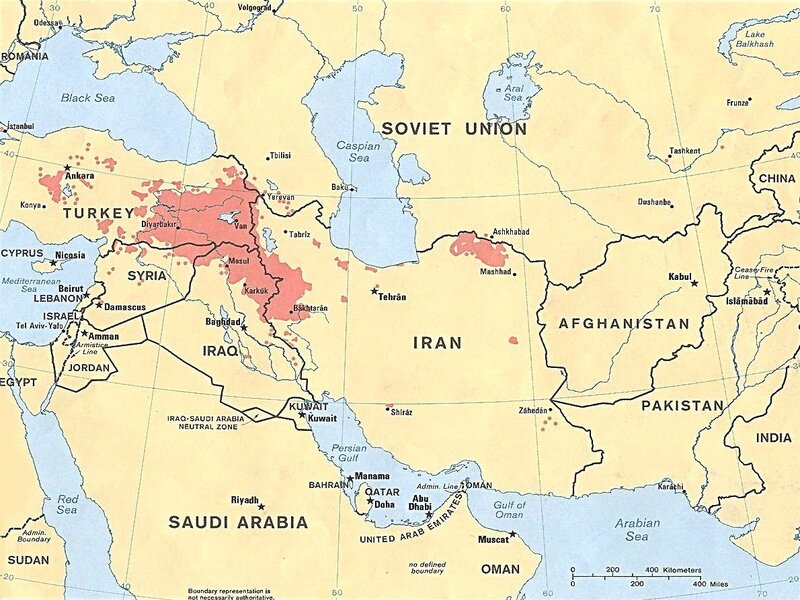
Image credit: Kurdish-inhabited areas of the Middle East and the Soviet Union in 1986 (1986) by U.S. Central Intelligence Agency via Wikimedia Commons. Public Domain.
Disclaimer: Any views or opinions expressed in articles are solely those of the authors and do not necessarily represent the views of the NATO Association of Canada.