Gender equality is a guiding principle of NATO, formally articulated in its 2024 Policy on Women, Peace and Security (WPS). The policy recognizes that conflict affects women and girls in distinct and disproportionate ways, that women are central actors in peace and security, and that gender perspectives must be integrated across all Alliance work. While this commitment enhances operational effectiveness, it also differentiates NATO normatively from authoritarian adversaries.
Yet the values underpinning this commitment, including individual liberty, human rights, democracy, and the rule of law, are increasingly contested. In an era of hybrid warfare, or “an age when democracy can be destabilized not just by tanks or missiles but by tweets, deepfakes, and manipulated influencers,” authoritarian competitors deploy information and cognitive campaigns to exploit existing social divisions within NATO societies.
Gender equality constitutes a critical vulnerability. As issues relating to gender and sexuality remain politically contested across many Alliance countries, gender has become a convenient pressure point exploited by hostile actors. Gender-based disinformation, which can be understood as the intentional weaponization of false, misogynistic, and sexist narratives, draws on entrenched stereotypes and cultural anxieties to erode social cohesion, undermine trust in institutions, and weaken military legitimacy. These tactics are particularly effective because they resonate with pre-existing domestic debates, allowing foreign interference to infiltrate national discourse at low cost, high impact, and with plausible deniability.
This article examines how gender-based disinformation weakens NATO member militaries across three levels: nationally, by exacerbating domestic polarization to weaken democratic resilience; globally, as a tool of hybrid warfare used to delegitimize NATO and fracture alliance cohesion; and institutionally, by eroding trust, professionalism, and cohesion within armed forces. Collectively, these dynamics demonstrate why countering gender-based disinformation is a strategic imperative for NATO’s resilience and collective defence.
Disinformation involves the intentional production and dissemination of false or misleading information meant to deceive or manipulate audiences, distort facts, deepen divisions, and destabilize societies, including those within NATO. Unlike misinformation, which may spread unintentionally, disinformation is deliberate, often state-sponsored, and a central instrument of contemporary hybrid warfare. Its effectiveness lies in ambiguity: such campaigns are difficult to detect, attribute, and counter, allowing hostile actors to operate beneath the threshold of armed conflict. The World Economic Forum’s Global Risks Perception Survey 2025–2026 ranks disinformation as the second-highest short-term global risk, only after geopolitical confrontation.
Disinformation is most effective when it aligns with existing identities, grievances, and social tensions, making it familiar and believable to target audiences. This helps to explain why narratives about gender and sexuality feature prominently in foreign influence operations, as debates over gender roles, LGBTQIA+ rights, and social norms are highly polarized and emotionally charged across many democratic societies, creating fertile ground for foreign-planted falsehoods.
Gender-based or gendered disinformation refers to disinformation about gender, in which women and marginalized groups, including LGBTQIA+ individuals, are disproportionately targeted through deceptive or misleading content. This form of disinformation weaponizes gendered stereotypes and is recognized as a form of technology-facilitated gender-based violence (TFGBV). Authoritarian and illiberal actors strategically deploy such narratives to discredit critics, undermine democratic values, and consolidate power in ways that directly challenge the principles and mandate of NATO. As the United Nations Human Rights Council has noted, the targeted deterioration of women’s human rights is a litmus test for a society’s broader human rights standards, with implications for democratic stability and global security that extend well beyond individual harm.
While pluralism, debate, and dissent are central to healthy democracies, gender-based disinformation exploits existing social cleavages and misconceptions to intensify political polarization across NATO countries. Social media has become a key battleground for illiberal actors to coordinate inauthentic and inflammatory content, often along gendered lines, to disrupt democratic processes from elections to policymaking. For instance, recent AI-generated videos promoting Poland’s withdrawal from the European Union, featuring idealized female influencers, illustrate how gendered content is weaponized to manipulate public debate at scale.
Female politicians are frequent targets of gender-based disinformation campaigns, diminishing the free and fair electoral processes that underpin democratic governance. Authoritarian and illiberal leaders, including Vladimir Putin, Rodrigo Duterte, and Viktor Orbán, have brandished misogynistic rhetoric and disinformation to marginalize women in politics and weaken democracy. This was evident during the 2016 U.S. general election, when presidential candidate Hillary Clinton was repeatedly attacked on the basis of her gender by Russian-backed disinformation campaigns. These campaigns use gendered stereotypes to portray women as weak, incompetent, or overly emotional, influencing voters and disadvantaging female candidates.
Gender-based disinformation can also cultivate ideological alignment between a state and foreign populations through ‘discourse coalitions,’ further undermining democratic integrity and national cohesion. Russia’s discursive efforts to justify its invasion of Ukraine as a defence of “traditional values,” for example, (including Christianity and masculine patriarchal norms), illustrate how hostile gendered narratives can be used to legitimize violence, generate transnational sympathy, and propagate illiberal and antifeminist values by resonating with ongoing cultural debates within NATO societies.
At the Alliance level, gender-based disinformation targets the moral authority and legitimacy of deployed forces engaged in NATO operations. Gendered and sexualized narratives are used to portray allied militaries as culturally intrusive or incompatible, reducing public and host-nation support. During Canada’s deployment under NATO’s Enhanced Forward Presence, for example, Russian-linked disinformation circulated images of a convicted former Canadian Air Force commander dressed in women’s clothing to depict the Canadian Armed Forces as morally corrupt and unreliable. Other false allegations, including claims that NATO finances centres that “convert” people to being gay, exploit similar sexist and homophobic disinformation to the detriment of NATO’s operations abroad.
These cognitive campaigns not only complicate current NATO missions and partnerships, but also jeopardize prospects for future Alliance membership.
Within military institutions such as the Canadian Armed Forces (CAF), gender-based disinformation reinforces exclusionary norms that undermine institutional trust, morale, and cohesion. Moreover, when misogynistic and anti-gender narratives overlap with extremist or illiberal ideologies, they create permissive environments for reputational risk. Over time, gendered disinformation can constrain recruitment, weaken institutional legitimacy, and reduce long-term readiness, which are key enablers of operational effectiveness for the CAF. This is not only a matter of national concern, but of Alliance security: when state soldiers are exposed to sexist, homophobic, or extremist propaganda, the implications extend to intelligence sharing, joint operations, and Alliance-wide trust.
Countering gender-based disinformation is strategically necessary for Alliance security. NATO’s Women, Peace and Security (WPS) agenda provides a strong framework for reducing gender-based information vulnerabilities, while countries such as Canada lead in disinformation detection and the protection of democratic processes through initiatives such as the G7 Rapid Response Mechanism. However, these efforts are only as effective as the resilience of individual societies.
Hybrid threats, including disinformation campaigns, seek to discredit institutions, sow division, and heighten distrust in NATO countries. One practical line of defence lies in everyday digital discipline. Borrowing from Natalie Turvey, president and executive director of the Canadian Journalism Foundation (CJF), before sharing content, Canadians should ask: 1) Does this provoke anger or outrage? 2) Can it be verified through a trusted source? And 3) Who benefits if I believe or share this narrative?
While enhanced monitoring and response measures are important for countering gender-based disinformation, resilience in an era of escalating hybrid warfare ultimately depends on an informed and aligned public. Democratic societies need not agree on everything, but there some principles that are non-negotiable, including constitutional rights and freedoms and the rule of law. A society that upholds WPS standards and engages in good-faith debate remains one of Canada’s and NATO’s strongest security assets. By denying traction to misogynistic and anti-gender narratives, Canadians can help sustain a healthier information environment and contribute to a stronger, more unified Alliance.
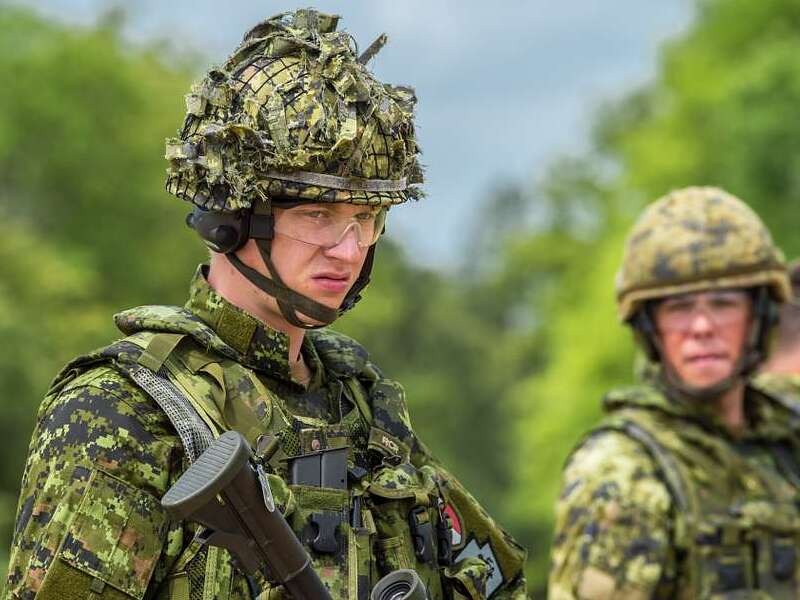
Photo: Canadian army soldiers prepare for a match at the Winston P. Wilson (WPW) and 27th Armed Forces Skill at Arms Meet (AFSAM) at Robinson Maneuver Training Centre Ark, 2018. Source: Defense Visual Information Distribution Service
Disclaimer: Any views or opinions expressed in articles are solely those of the authors and do not necessarily represent the views of the NATO Association of Canada.