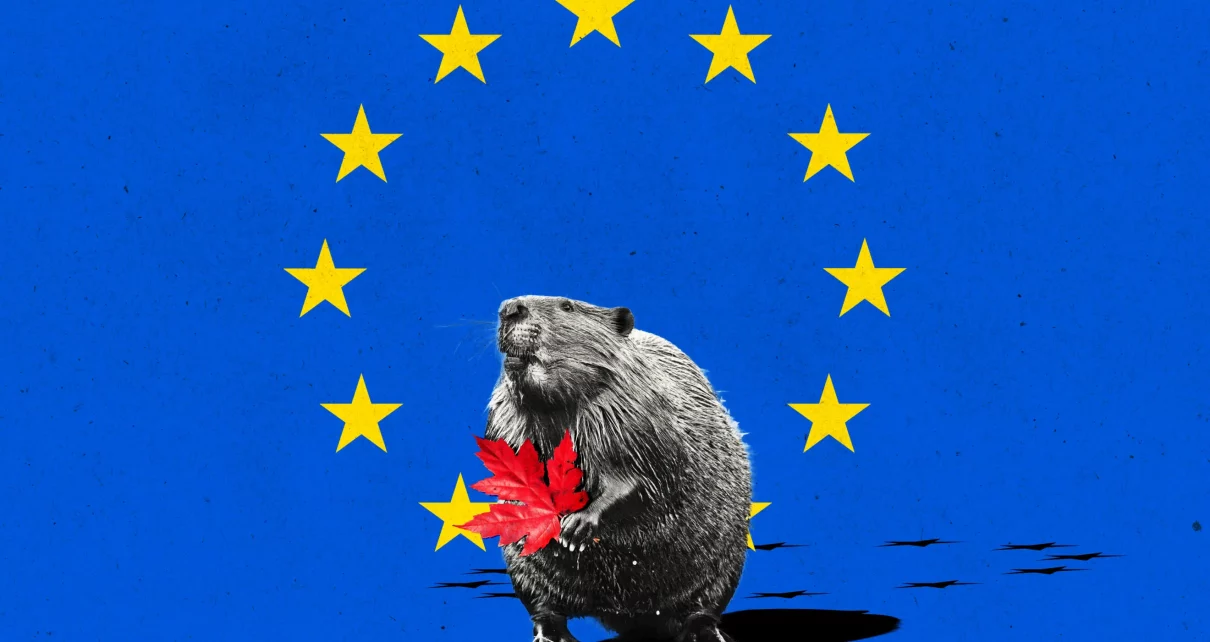
At the eighth European Political Community (EPC) summit, Canada became the first non-European country to attend, with Prime Minister Mark Carney proclaiming that the international order will be rebuilt out of Europe.
Canada is orienting itself toward the EU as an institutional partner in diversifying away from dependency on the U.S. Its accelerating integration into European defence structures, from its invitation to the EPC summit to its participation in the EU’s Security Action for Europe (SAFE) procurement instrument, reflects a deliberate redirection. What’s emerging is a new axis, one where Europe increasingly represents an alternative to Canada’s relationship with the U.S. For NATO, this diversification raises a deeper question about whether the alliance’s traditional U.S.-anchored architecture can hold as member states increasingly look to alternative institutions to adapt to the unpredictability of their largest ally.
In June 2025, Canada and the EU signed a Security and Defence Partnership, laying the institutional groundwork for deeper defence cooperation. It established frameworks for joint missions, military mobility, and defence-industrial exchange.
Canada officially joined the European Union’s Security Action for Europe (SAFE) in February 2026, becoming the first concrete step in translating that partnership into procurement-level integration. SAFE is a €150-billion EU loan instrument under the EU’s Readiness 2030 plan, financing large-scale joint procurement of ammunition, missiles, drones, and other capabilities for member states. The European Parliament formally consented to Canada’s participation in SAFE in June 2026, making the agreement fully binding and Canada definitively the only non-European country with preferential access to SAFE procurement.
That status gives Canadian defence manufacturers direct entry into EU procurement markets, positioning firms to supply European militaries rather than relying solely on the U.S.-anchored defence-industrial base.
The first payoff is a deepening of military industrial ties between Canada and Poland. In May 2026, Defence Minister David J. McGuinty and his Polish counterpart, Władysław Kosiniak-Kamysz, signed a Letter of Intent on bilateral cooperation, agreeing to pursue joint projects in emerging defence technologies and the establishment of ammunition production capacity in Canada. That framework has already produced results: in June 2026, Marconi Technologies, a Montreal-based firm, became the first Canadian company to land a SAFE contract, winning a deal worth more than $10 million to supply Canadian-made tactical radios to Poland’s military in partnership with Polish firm Enamor International, with deliveries running through 2030.
But Poland isn’t the only European partner redrawing Canada’s defence map. Swedish Prime Minister Ulf Kristersson has called Canada the most Nordic country outside the Nordics, and that bond is now translating into a major defence deal. In May 2026, Canada entered negotiations with Sweden’s Saab to buy up to six GlobalEye airborne early warning aircraft, with the Royal Canadian Air Force eyeing the planes primarily for Arctic surveillance. The system pairs Saab’s radar and sensors with a Bombardier 6500 executive jet manufactured in Toronto.
Canada’s choice of Saab over American rivals Boeing and L3Harris for its detection system is where the U.S.-Canada tension starts to show, and it is one signal of Canada’s shift away from Washington. A separate, larger one is playing out with Canada’s fighter jet fleet, where the government is weighing scaling back its F-35 dependence. Prime Minister Carney ordered a review of the F-35 program in 2025, citing concerns over Canada’s reliance on a U.S.-controlled supply chain. The government has locked in the first 16 jets and preserved production slots on 14 more, but the remaining aircraft in the original 88-jet order remain under review. A mixed fleet pairing a reduced F-35 count with Saab Gripens is now on the table, with no final decision made. Together, scaling back the F-35 order and courting rival manufacturers underscore Canada’s broader effort to build defence partnerships less dependent on the U.S. and reinforce the pivot toward Europe.
The decision risks provoking backlash from U.S. President Donald Trump, a risk compounded by a parallel move at the NATO level. NATO recently announced that it intends to acquire up to 10 Saab-manufactured GlobalEye early warning surveillance aircraft. The alliance had already signalled interest in the jet as a replacement for its aging fleet. President Trump has repeatedly accused allies of relying too heavily on the U.S. for their defence, while pushing them to raise military spending and buy more American equipment. Yet far from satisfying those demands, NATO’s diversification away from a U.S. supplier has provoked Trump rather than reassured him, with his objections continuing along familiar lines. But Canada’s decision comes with a catch.
Connecting Saab’s GlobalEye or Gripens to the F-35’s secure data link would require technology controlled by Washington. This is consequential, as F-35s are flown widely across the alliance. Washington would have to share the encryption link that lets fighter jets and early warning systems communicate, and it is unclear whether the U.S. will allow that technology to be installed on Saab’s aircraft. These technical hurdles give Washington a possible avenue for resistance and highlight the dependency threatening the deal’s broader stakes.
If anything, this situation reinforces the recalibration instead of undermining it. What separates this from opportunistic hedging is durability and breadth: SAFE is a multi-year EU procurement instrument, not a one-off contract, and the Marconi deal runs through 2030 — commitments built to outlast a single political moment. The pattern isn’t confined to Canada either, with Poland, Sweden, and NATO itself independently converging on the same choice. With Canada among the 11 countries in NATO‘s joint procurement group, the alliance’s decision to pick Saab’s GlobalEye echoes Canada’s own bilateral deal and carries direct industrial and economic stakes for Canada. Despite the complications still to be sorted out, that shared trajectory across the alliance is what marks this as structural rather than circumstantial.
Canada’s pivot, then, is not an isolated case but one node in a wider repositioning across the alliance. The result is a NATO whose cohesion may increasingly depend not on uniform alignment with the U.S., but on a growing network of institutions — SAFE, the EPC, bilateral deals like the GlobalEye — that member states use to reduce dependence on the U.S. If diversification keeps outpacing Washington’s willingness to adapt, the alliance’s cohesion won’t depend on member states excluding the U.S., but on whether the U.S. still chooses to anchor an alliance it has decreasing sway over. The open question is thus whether the superpower behind NATO’s funding responds to diversification with further retaliation or renewed engagement. Certain U.S. actions so far — troop withdrawals, tariffs on allies — suggest this is likely just the beginning, leaving NATO to reckon with what its architecture becomes without traditional U.S. leadership.
Carney is delivering on a firm reorientation of Canada toward Europe and away from reliance on Washington, strengthening EU-Canada defence ties bilaterally, not just through NATO. Agreements like SAFE have opened partnerships with countries like Sweden and Poland, built through both government-to-government agreements and direct commercial contracts. This realignment is materializing as genuine industrial and procurement integration, advancing defence cooperation between the EU and Canada and proving that European market access translates into exports, jobs, and institutional ties for Canada independent of Washington.
This pivot, however, has limits. Canada’s recalibration works because European partners are currently paying for access, not because Canada has severed its reliance on the U.S. outright. Washington remains Canada’s largest trading partner and the backbone of continental defence through NORAD, ties that European institutions cannot easily replace. Should Trump escalate retaliation, including friction over shared technology like the F-35 data link, Canada would have to weigh European gains against the cost of a strained U.S. relationship from which it cannot completely free itself. As a non-European country, Canada’s access to structures like SAFE and the EPC remains preferential rather than guaranteed, leaving its position more vulnerable than that of EU member states themselves.
For Canada, the calculus is straightforward: deepen European ties while they’re paying off. For NATO, it is murkier. The alliance’s cohesion now hinges on whether the U.S. is willing to accept the loss of control that comes with the burden-sharing it has long called for.
The next Canada-EU Leaders’ Summit will take place in October. Following the success of the 2025 Brussels summit, where leaders signed the Security and Defence Partnership, the next summit is poised to build on that success, if not exceed it.
Disclaimer: Any views or opinions expressed in articles are solely those of the authors and do not necessarily represent the views of the NATO Association of Canada.
Photo: https://www.politico.eu/article/canada-join-eu-unlikely-not-impossible/