Canada finds itself in an era of security challenges posed not only by traditional rivals, but also by its neighbour and greatest partner. The risks to its economic stability from both internal and external trials include failures to meet economic challenges caused by the 2015 oil crisis, COVID-19, and renewed European crises, all of which threaten to undermine its foreign policy resolve. Amid this miasma, Canada appears short on options.
Quietly in the background, one initiative has gained crumbs of endorsement and attracted curiosity. This is ‘CANZUK,’ in reference to the proposed alliance of Canada, New Zealand, Australia, and the United Kingdom. These countries are uniquely tied in their pasts but also in their linguistic, cultural, and political similarities. The main components of CANZUK include free trade, free movement, and foreign policy cooperation, as conveyed by the ‘CANZUK International’ campaign and its founder, James Skinner.
Canada’s Prime Minister, Mark Carney, has deep-rooted connections to the UK as the former Governor of the Bank of England. His government seeks to increase partnerships with the UK, Australia, and New Zealand as both a counterbalance to feared tariffs and as a negotiating tool with other blocs. As the United States will likely continue todominate Canadian trade for decades to come, foreign policy cooperation remains the main goal for any future alliance-building. Free movement has become politically contentious, especially for the UK, for whom the concept became a key sticking point in its campaign to leave the European Union. Similarly, Australia’s point-style immigration system is politically entrenched. Thus, foreign policy cooperation can be considered as the foundation for cooperation within CANZUK.
The foreign policy goals of these four countries align in their assessment of actors that pose a challenge to their security. China presents potential security risks to all four states. In November 2025, Australia’s intelligence chief reported that hackers connected to the Chinese government and military had been targeting the nation’s critical infrastructure, warning that Australia faced a growing risk of “high-impact sabotage.” According to UK Prime Minister Keir Starmer, Chinaposes national security threats to the United Kingdom. New Zealand’s intelligence agency cautioned that the country is confronting its most serious security challenges in decades, pointing to rising foreign interference and espionage and noting that China is the “most active” player in this space. Dan Rogers, Director of the Canadian Security Intelligence Service, noted that China’s military and intelligence services are actively trying to obtain “classified and sensitive Canadian government information” and are seeking to establish a “strategic and economic foothold” in the Arctic.
Another example of a shared stance among the potential CANZUK countries concerns Russia.
All four states have already imposed heavy sanctions on Russia for starting the war with Ukraine. Australia had cordial relations with Russia that got significantly worse after the downing of Malaysia Flight MH317 in 2014, which killed 38 Australians and led to an ongoing legal case into Russia’s culpability.
New Zealand has expanded sanctions not only on Russian oil and military hardware, but also on oligarchs and politicians. The UK’s relationship with Russia has also long been tense, given their history of assassinations and espionage on British soil. Since 2014, Canada has sanctioned more than 3,300 individuals and entities involved in undermining Ukraine’s sovereignty, territorial integrity, or committing widespread human rights abuses. Canada has also targeted Russia’s so-called shadow fleet, imposing sanctions on over 400 vessels for their role in transporting goods and assets that benefit Russia or Russian-linked actors. As is evident on key security issues, the positions of the CANZUK countries align with NATO’s security threat assessments.
All four CANZUK countries already have bilateral economic and political agreements, as well as multilateral cooperation through the Five Eyes alliance on security issues. Australia and New Zealand closely cooperate with NATO as formal partners through its “partnerships across the globe” program. This cooperation includes commitments to cybersecurity and political consultation, amongst other logistical fields that advance the concerned party’s Indo-Pacific security against China.
Despite the extensive cooperation already taking place among the CANZUK countries, each would still benefit from formally establishing the alliance. CANZUK would allow these countries to develop a unified policy to jointly represent their strategy and cooperate with NATO, the UN, and other international organizations. It would also strengthen all four countries when participating in NATO allies’ defensive exercises in the Indo-Pacific.
For NATO’s long-term resilience, the presence of a strong alliance, especially in the Indo-Pacific, would be highly beneficial. Establishing a treaty that accelerates investment and defence production toward the 5% defence-spending target would give NATO a stronger foothold in another geopolitical theatre, one that places many allies at risk. As perilous as the current global environment is, CANZUK’s foreign policy cooperation alone would amplify each member’s influence within and beyond NATO, which would strengthen the alliance.
Canada, increasingly seeking to diversify its partnerships, could take a leading role in formalizing relations with potential CANZUK partners. Through shaping the direction and scope of such cooperation, Canada could strengthen its international standing, expand its diplomatic reach, and build a more resilient network of like-minded allies.
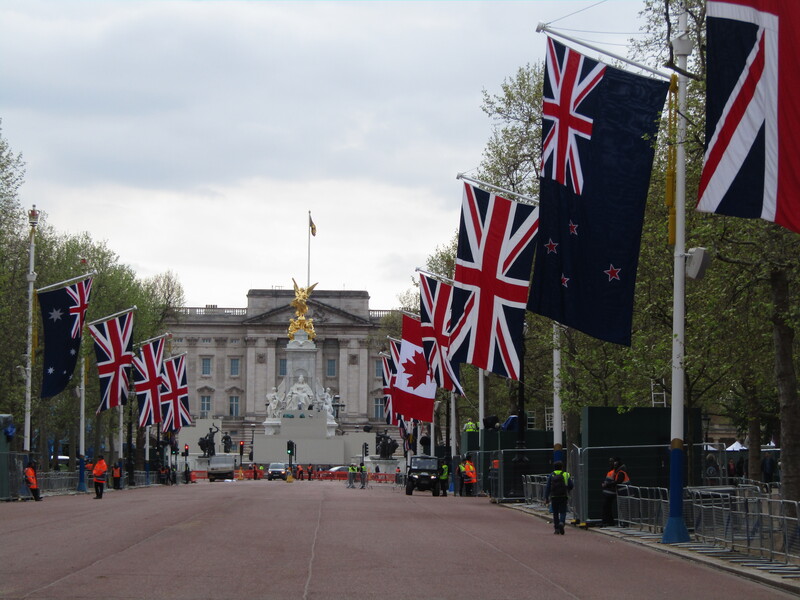
Photo: The CANZUK country flags lining the route toward Buckingham Palace in Westminster, London. By Colin Smith, Creative Commons Attribution-ShareAlike 2.0 license.
Disclaimer: Any views or opinions expressed in articles are solely those of the authors and do not necessarily represent the views of the NATO Association of Canada.