In Ukraine, a trained interviewer sits across from a survivor, recording detailed accounts of wartime sexual violence from Russian forces; a testimony that may one day be read into an International Criminal Court (ICC) proceeding. Russia’s use of sexual violence in Ukraine is not incidental; the United Nations and ICC have both characterized it as systematic, with reports detailing “gang rape, sexual torture and forced nudity” directed at women, men and children across occupied territories. The evidentiary record for these crimes is being built not primarily by states or international bodies, but by Ukrainian civil society organizations that are often women-led. Understanding their initiatives, and how it contributes to the Women, Peace and Security (WPS) agenda, is long overdue.
The organizations doing this work are not peripheral actors. La Strada-Ukraine has operated national hotlines for survivors of trafficking and sexual violence since 1997; since the full-scale invasion, those lines have documented rape deployed as a coordinated military tactic, recording over ten thousand calls and messages in the first month alone. Anonymous Telegram channels additionally ran in parallel for survivors who fear the social stigma of disclosure. The Ukrainian Women Lawyers Association, known as JurFem, provides legal representation and psychological support to survivors while training investigators and prosecutors on survivor-centred approaches designed to avoid retraumatization. Its Strategic Litigation Center develops legal strategies to address gaps in both domestic and international law. The 5AM Coalition, named after the hour Russia’s invasion began on February 24, 2022, coordinates more than thirty-five human rights organizations across geographic focus areas, maintaining databases of verified incidents that collectively demonstrate the scale and pattern of the violence. A comparable coalition, Tribunal for Putin, was established shortly after by the Kharkiv Human Rights Protection Group, with both coalitions developing separate databases while coordinating to prevent duplication of evidence. What unites these organizations is a shared understanding that documentation is the precondition for accountability.
Documentation follows rigid international standards to ensure evidence survives the journey from a frontline interview to an international courtroom: evidence that cannot hold up in court is evidence that cannot convict. The Berkeley Protocol governs the collection and verification of digital evidence, requiring footage to be geolocated and data preserved to establish authenticity. The Ukrainian government has deployed digital tools like the e-Enemy chatbot to allow citizens to report war crimes with built-in identity verification. Forensic medical evaluations authenticate verbal accounts by documenting physical and psychological injuries, with mobile gynecological stations operating in recaptured areas where clinics were destroyed. Those who document follow survivor-centred protocols built around the Murad Code, an international framework establishing best practices for the ethical documentation of conflict-related sexual violence (CSRV), covering consent, identity protection and data security. This work is performed in active conflict zones, where documenters face the same physical dangers as the populations they serve. The question of where this evidence goes is the point at which Ukrainian civil society’s work meets the international legal system, and the answer is more complicated than it first appears.
The legal pathway runs through the ICC, which opened a formal investigation into Ukraine on March 2, 2022, one of the fastest in the court’s history. Ukraine ratified the Rome Statute in October 2024, with the treaty entering into force on January 1, 2025, enabling closer coordination between domestic prosecutors and international judges. In November 2024, Ukraine’s government adopted Law No. 4067-IX on the status of CRSV survivors, enabling access to interim reparations before a final court verdict. The ICC has since issued arrest warrants for Vladimir Putin and Maria Lvova-Belova, in addition to senior military commanders including Sergei Kobylash, Viktor Sokolov, Sergei Shoigu and Valery Gerasimov. The structural obstacles, however, are significant: the ICC has no independent enforcement mechanism and must rely on member states to execute its warrants. Russia is not a Rome Statute signatory and does not recognize the ICC’s jurisdiction. Successful international prosecutions of this kind often takes decades to conclude. The evidentiary pipeline that Ukrainian women are building exists, yet offers no immediate guarantee that anyone will actually be arrested. That gap is precisely where allied commitments become consequential.
NATO’s Women, Peace and Security (WPS) agenda is where the accountability work of Ukrainian civil society and the obligations of allied governments should converge. NATO first adopted their WPS policy in 2007; the 2021 Brussels Summit reaffirmed allied commitment to integrating gender perspectives across all Alliance structures, explicitly including prevention and response to CRSV. The revised 2024 WPS Policy further strengthened those commitments, identifying protection from CRSV as a core element of NATO’s human security agenda. These are not rhetorical positions, as they carry an expectation that allies will direct concrete resources toward the mechanisms that make accountability possible. On that measure, Canada’s record is more substantive than it is typically credited. On March 1, 2022, Canada referred the situation in Ukraine to the ICC, one day before a coordinated joint referral by thirty-eight other states. Canada subsequently contributed one million dollars to the ICC Trust Fund, arranged specifically for CRSV investigations, witness protection and psychosocial support for survivors. Through the Canadian Police Arrangement, a partnership between Global Affairs Canada, Public Safety Canada and the Royal Canadian Mounted Police (RCMP), Canada authorized the deployment of up to ten specialized investigators to the ICC. These investigators drew on expertise in sexual assault, cybercrime and domestic violence from the RCMP and municipal agencies in Québec and Ontario. These commitments create a direct operational link between Canadian law enforcement and the Ukrainian women conducting interviews under fire.
Whether Canada’s efforts to help our allies are scaling alongside the documented scale of CSRV in Ukraine is a harder question and it is the right one to be asking. As the Heinrich Böll Stiftung noted, the burden of victim support has fallen disproportionately on women’s civil organizations as more territory is liberated and the volume of reported crimes grows. Here lies a gap that could be narrowed through increased allied funding to Ukrainian women’s organizations directly, rather than routing all support through multilateral institutions like the ICC Trust Fund. NATO’s WPS agenda is only as meaningful as the resources Allies direct toward the mechanisms that underpin it. The margin between a policy commitment and funded accountability infrastructure remains the central question for Canada and its allies. Closing that gap requires allies to move beyond early commitments made in the immediate aftermath of the invasion. For example, the Netherlands, a NATO-allied state, has sent multiple forensic investigation teams to Ukraine, embedding war crimes investigation directly into its annual aid packages alongside military support, treating accountability as a sustained commitment rather than a one-time contribution. Canada’s early referral and ICC funding were meaningful; the question is whether they represent a floor or a ceiling. Justice in cases like CRSV in Ukraine does not begin at The Hague; it begins with a woman, a recorder and a survivor willing to speak.
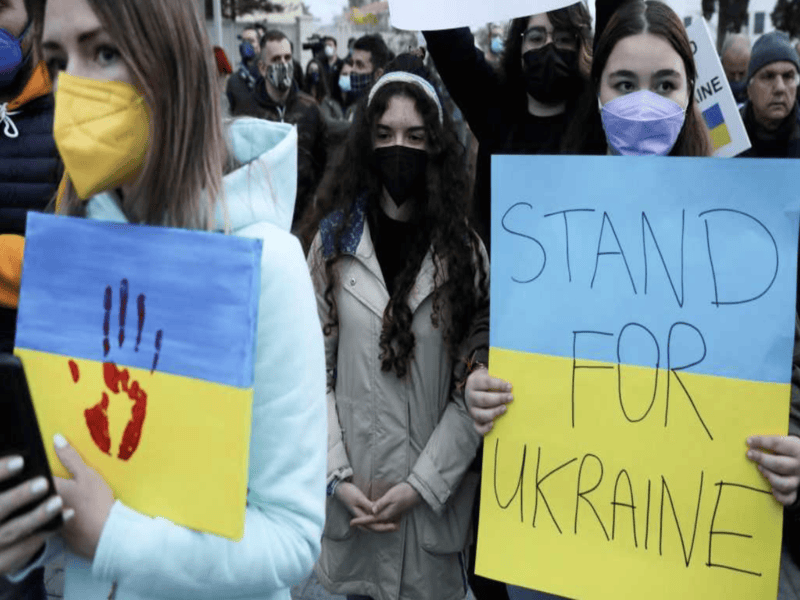
Photo: Protestors at a “Stand for Ukraine” demonstration. Source: Atlantic Council/Eurasia Center
Disclaimer: Any views or opinions expressed in articles are solely those of the authors and do not necessarily represent the views of the NATO Association of Canada.