Introduction
Canada’s Department of National Defence has set plans to modernize its aging and operationally strained fleet of CF-18 fighter jets. In 2023, the federal government finalized an agreement to acquire 88 United States (US)-produced F-35 fighter jets. Ottawa had already secured the purchase of its first 16 jets when, in March of 2025, the Canadian government announced it was reconsidering any further orders for F-35. This announcement came amid strained US-Canada trade relations and emerging threats against Canadian sovereignty made by US president Donald Trump. Ottawa suggested that it would be looking for alternate fighter jet programs such as the Swedish-manufactured Gripen jets. Deciding on which fighter jet program to pursue will have deep repercussions for Canada’s security, defence supply chains, as well as geopolitical dependencies. This article explores how the choice between F-35 and Gripen would affect Canada’s ability to defend itself and uphold its commitments to NORAD and NATO. It concludes that the Gripen could be a better choice if Canada prioritizes homeland defence and long-run industrial sovereignty, whereas F-35s perform better in terms of NATO and NORAD interoperability as well as provide better global reach and power projection.
F-35: Procurement and Politicization
The Royal Canadian Air Force (RCAF) relies on the CF-18 as the main fighter jet, but they are considered to be technologically redundant, outdated and at risk of becoming unserviceable by the 2030s. Canada has taken part in the Joint Strike Fighter program since 1997, which allows Canadian companies to bid on contracts for design and production for the jet that would become the F-35. In 2023, the Trudeau government officially announced a deal to replace the CF-18s with up to 88 F-35s, with the first delivery for training expected this year.
Since Trump’s reelection and a fracture of US-Canada trade relations however, Prime Minister Carney ordered a review of the remaining order of F-35s with a consideration of alternative fighter jet programs. Swedish manufacturer Saab’s Gripen came in second in the bidding process for procuring Canada’s new fighter jet, and National Defence Minister Bill Blair announced the government was considering the Gripen as a potential alternative to F-35s. Media reported that Ottawa has discreetly made payments for 14 additional jets to secure parts that ought to be ordered well in advance, but National Defence refused to acknowledge this payment was made for F-35s. No official decision on the fighter jet program has been made public.
Discussion
Selecting a fighter jet program is a decision whose ramifications extend for decades and affect procurement and maintenance costs worth billions of dollars. To make the right choice, Canada ought to consider key priority areas including capability of fighter jets to protect the homeland, interoperability to support Ottawa’s commitments to allies, industrial and geopolitical risks associated with the program’s long-term maintenance, and raw combat performance.
Homeland Defence
Canada stretches over almost ten million square kilometers, and most of its northern territories are sparsely populated and less accessible. An optimal fighter jet ought to be able to cover large areas and remain operable in Canada’s arctic frontier where supply chains are complex, harsh winter conditions disrupt logistics, and distances are massive. There is every argument to be made that Gripen would have an advantage in this realm because of its decidedly lower maintenance footprint, longer operational range, high adaptability to winter climates, and less demanding infrastructure.
Saab’s “Efficient Support Solution” approach is centered on making its fighter jets fully serviceable and mission-ready when deploying in remote, hard-to-reach bases, through a minimal logistic footprint. For example, Gripen jets demand fewer maintenance parts that are smaller in size and can be interchanged faster. They also need less time and manpower to rearm, refuel and launch new sorties after returning from missions compared to F-35s. Gripens also have a larger range which means they can project power and perform operations farther from air bases and are designed specifically with harsh winter climates in mind so that extreme temperatures do not compromise their performance. Saab also reported that Gripen jets do not even need conventional runways and can operate from wide roads with faster takeoff and landing than most other jets. This could prove to be an advantage for operating in areas with limited infrastructure and changing climates. All of the above together show that the Gripen has an advantage in operations across Canada’s Arctic Circle.
Alliance Interoperability and Mission Support
Considering Canada’s role in providing operational support as a part of Ottawa’s NORAD and NATO commitments, F-35s have an advantage. Deployment of Canadian jets under these alliances demands complex and diverse mission capabilities with more focus on intelligence gathering, command-and-control, and reconnaissance. Stealth is an important factor in fighter jet performance for these mission types, which makes the F-35, known for its advanced stealth capabilities, better suited for joint operations together with Canada’s allies. As many NATO allies also have F-35 fleets, physical infrastructure at air bases across the alliance would be better adapted for potential Canadian deployment.
Even though Gripens demonstrated some interoperability within NATO missions when they provided escort and support for the US B-1B, interoperability within these operations relied on US-owned encryption software called Link-16. Without this software, the Gripen would lose the ability to communicate on the same level as the F-35, thus potentially compromising its mission support role. Reliance on this software to operate Gripens for allied mission support would create a new channel of dependence on the US, which the purchase of Gripens is ironically supposed to prevent. Therefore, because of its advantages in stealth, intelligence gathering and interoperability, the F-35 could be better suited for Canada’s mission support and assistance roles within its alliance structure.
Supply Chains, Industry, and Costs
The timing of the federal government’s review of the F-35 deal comes amid concerns over sovereignty and supply chain dependence, as well as reportedly ballooning costs of the F-35 program, which tilt the calculus in favor of the Gripen. Saab has pledged to bring a significant portion of the manufacturing process for their jets to Canada, including significant technological transfers to establish local production, maintenance and upgrade centers. Apart from creating approximately 10,000 jobs, there is a strategic benefit to bringing assembly lines to Canada. Setting up a domestic production process with local maintenance and upgrade centers would significantly reduce dependence on outside suppliers and mitigate the risk of over-reliance on the US defence industry, bolstering Canadian sovereignty.
Moreover, the delays in upgrade delivery for F-35s and skyrocketing costs contribute to doubts over long-term financial sustainability and efficiency of the program. The Block 4 modernization package, for example, which includes weapons upgrades and better electronic warfare systems, was delayed until 2031. It is estimated that both the initial purchase price and long-term maintenance costs are much higher for the F-35 than the Gripen. The Auditor General of Canada reported that the price tag for the F-35 program increased from $19 to $27.7 billion since 2023. In addition, the F-35 has an hourly operation cost several times higher than the Gripen. These factors suggest that, for the purpose of reducing dependence on foreign production and maintenance, managing long-term costs, as well as bringing industrial benefits to Canada, the Gripen project fares better.
Combat Performance
Beyond cost and supply chain considerations, combat performance warrants careful evaluation.
A holistic, unbiased, and definitive comparison of the two jets in terms of combat performance does not exist. However, a recent leak from the Department of National Defence shows a scoring chart from 2021 comparing these two jets. According to the sheet, the F-35 scores higher than the Gripen in all categories. Some reports have cited the leak as evidence for the F-35’s superiority over the Gripen and advocated for continuing with the F-35 program as planned. However, further inquiry casts doubt on practicality and accuracy of such a comparison. First of all, National Defence has not disclosed what metrics they used or what variant of each jet was analyzed to produce the scoresheet. It is unknown if the comparison was made based on potential future capabilities or current performance, or whether the F-35’s long-delayed Block 4 updates were considered. If projections were made based on hypothetical updates that F-35 still does not have as a part of its Block 4 package, the scores could have overestimated the jet’s performance across all categories. Apart from this, Affärsvärlden, a Swedish business magazine, has reported that the 2021 scoresheet unfairly penalized the Gripen by adding a risk coefficient solely because it was a ‘new series aircraft.’ While the Department of Defence has not confirmed this report, these claims add to uncertainty over the metrics used in the comparison, casting more doubt on its accuracy and relevance.
Given all of the above, the leaked scoring sheet cannot be considered a definitive piece of evidence for the F-35’s superiority over the Gripen because it is misleading and lacks transparency over the metrics and modifications considered to calculate jet performance. This leads to a conclusion that there is no overall test or metric that decidedly shows which jet is better. It is factually true that the F-35 excels at advanced stealth features and carries a higher payload, while the Gripen is faster, more adaptable, and easier to maintain across Canada. However, these metrics come with tradeoffs and it is unclear how they translate into one’s superiority over the other.
Conclusion
A decision to continue with the F-35 program or to opt for a dual-fighter fleet with Swedish Gripens carries generational significance for Canada. A multitude of overarching variables likely affect the government’s calculus – sovereignty and supply chain dependence, combat performance and NATO interoperability, rising costs and long-term industrial planning. Should Canada prioritize its commitments within NATO and NORAD and favor seamless interoperability and integration, sticking with the F-35 would likely be a better choice. But if homeland defence and making crucial supply chains more independent are weighted more heavily, then Canada should lean towards a dual-fighter fleet with Gripen jets as its integral component.
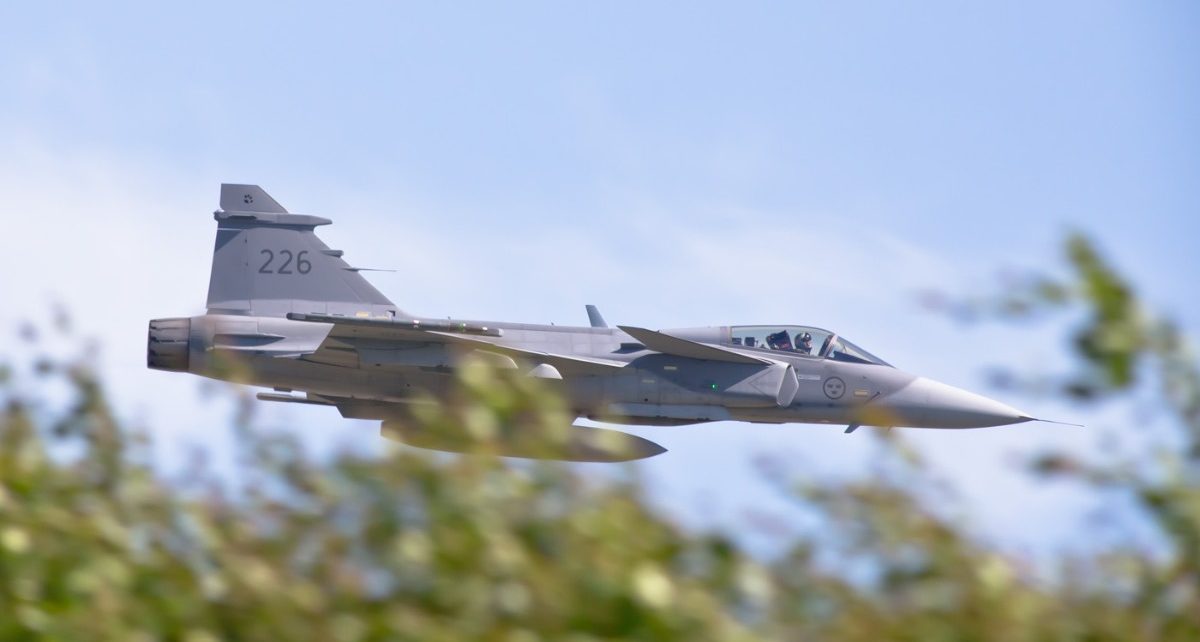
Photo: “SAAB JAS39 Gripen-7784” by Ragnhild and Neil Crawford, CC BY-SA 2.0
Disclaimer: Any views or opinions expressed in articles are solely those of the authors and do not necessarily represent the views of the NATO Association of Canada.