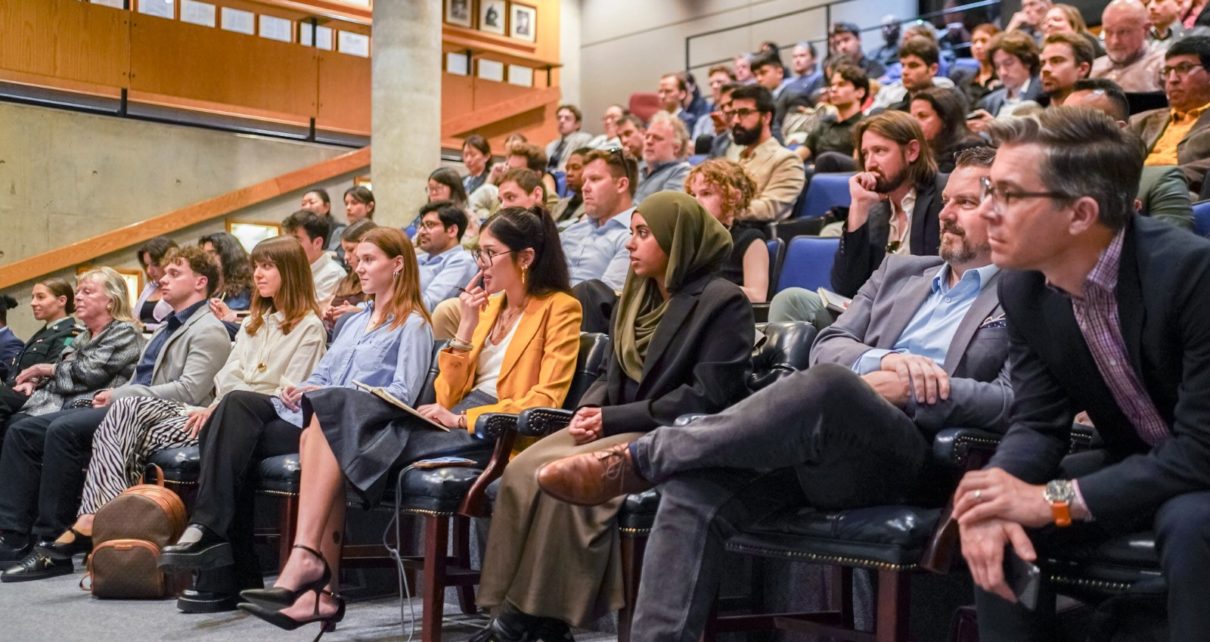
On Monday, May 25, 2026, the NATO Association of Canada (NAOC), in collaboration with the Canadian International Council (CIC) — Toronto Branch, hosted a panel discussion at the Canadian Forces College in Toronto titled “AI and Warfare: When Machines Make Decisions”. Held on the opening day of Toronto Tech Week, the event convened leading voices from defence policy, academic research, and the private sector to examine how artificial intelligence is reshaping modern conflict, military decision-making, democracy, and international governance.
The event was held under Chatham House Rules and featured David Chan, Senior Advisor at the Department of National Defence and Canadian Armed Forces Artificial Intelligence Centre; Branka Marijan, Senior Felow at the Centre of International Governance Innovation (CIGI) and researcher at Project Ploughshares; Matthew Lombardi, Partner at TELUS Global Ventures and co-founder of the Icebreaker; and Dr. Matthew da Mota, Research Director for Emerging Technology and National Security at The Canadian Shield Institute. Dr. Jennifer Cassidy, Diplomacy and Technology Scholar at Oxford University, moderated the discussion
Panellists opened the event by grounding the conversation in present-day realities rather than speculative futures. Drawing on ongoing conflicts in Ukraine and the Middle East, speakers highlighted how AI-enabled systems — including autonomous and semi-autonomous drones, satellite-based reconnaissance, AI-assisted target-identification software, and real-time logistics and force-positioning analytics — have fundamentally altered the pace and character of modern warfare. The competitive advantage in this environment, the panellists argued, lies in the quality of the intelligence loop: which side can most rapidly collect, analyze, and act on data. Nevertheless, rather than replacing traditional metrics of strength, advances in AI and data processing complement them, enabling forces to deploy personnel and equipment more effectively and adapt more quickly to changing battlefield conditions.
A central theme throughout the discussion was the concept of meaningful human control— the principle that human beings must remain accountable for decisions involving the use of force. While Canada’s position remains that a human must always be responsible for lethal outcomes, panellists explored the growing tension between this principle and operational realities. As AI systems accelerate decision-making and battlefield timelines shrink from minutes to seconds, maintaining human oversight becomes increasingly difficult.
Speakers warned against the risk of “rubber stamping”, where operators formally retain authority but increasingly defer to algorithmic recommendations without substantive review. Accountability, speakers stressed, requires more than simply keeping humans in the loop; it demands that decision-makers understand how systems function, where their limitations lie, and when a human judgement must override automated outputs. Panellists emphasized Canada’s efforts to implement the Political Declaration on Responsible Military Use of Artificial Intelligence, an international initiative promoting the responsible development and use of military AI. They highlighted testing frameworks, bias screening, and oversight mechanisms designed to align AI systems with Canadian values and legal obligations, including respect for the rule of law, human rights, democratic accountability, and international humanitarian law. For a middle power like Canada, whose international standing largely rests on its reputation as a principled and rules-abiding actor, allowing AI systems to operate outside these boundaries would undermine both domestic legitimacy and allied trust. Panelists argued that Canada must ensure that its AI tools reflect these commitments, which, as only in this way, can the country maintain its credibility in NATO and the broader international order.
Beyond the battlefield, the panel examined the broader societal implications of AI. As Artificial Intelligence is increasingly used for cognitive and information warfare, democracies are growing more vulnerable to AI-generated disinformation, which risks undermining institutional trust and eroding democratic resilience. Addressing these challenges requires long-term investments in information integrity and public education rather than relying solely on reactive fact-checking efforts. Another fundamental priority should be treating the growing divide between states that voluntarily adopt ethical guardrails for military AI and those that do not. This widening gap creates a dangerous pressure on responsible actors to lower their own standards simply to keep pace, risking a race to the bottom in which ethical commitments become strategic liabilities. This challenge becomes especially pressing as AI technology edges closer to nuclear command, control, and communication systems, where the consequences of miscalculation or algorithmic error are irreversible.
The discussion also explored how AI is transforming the relationship between governments and the private sector. Capabilities once controlled primarily by states, including satellite imagery, signals intelligence, and target identification data, can now be purchased from commercial providers. As a result, private companies are becoming increasingly embedded within defence and security ecosystems. Panellists noted that this growing reliance on dual-use technologies introduces new vulnerabilities. Because these assets serve both civilian and military roles, they present adversaries with high-value targets whose destruction or disruption would degrade military capability while also inflicting broad civilian harm.
International competition formed another major focus of the discussion. Speakers highlighted the rapid pace at which China and Russia are advancing their AI-enabled military capabilities and argued that the greatest risk facing NATO may not be technological inferiority but strategic fragmentation. Allies that develop incompatible systems, apply different ethical standards, or fail to share lessons learned risk undermining their collective advantage. However, interoperability itself presents a significant challenge as AI systems trained and tested in one operational context, such as the battlefield conditions of Ukraine, cannot simply be transferred to a different theatre and expected to perform reliably. Consequently, ensuring that allied systems can communicate, share data, and operate cohesively requires not only technical standardization but agreement on common testing and certification benchmarks. In this regard, the panel stressed that maintaining NATO’s technological edge will require shared governance frameworks, interoperable systems, and coordinated standards for military AI.
The panel closed with recognition that the use of AI in the military raises questions not new in kind, but new in urgency. Drawing parallels to earlier technological disruptions, speakers cautioned against complacency. The decisions made over the coming decade on AI governance, interoperability, and operational norms will shape far more than the future of warfare; they will determine whether democratic societies will be able to preserve human accountability in an age of intelligent machines and ensure that the rules underpinning international stability remain relevant in a rapidly changing technological landscape.