Canada is investing billions of dollars in its Arctic defences, but the battle for its northern sovereignty extends past traditional military threats and into the information environment. As Canada strengthens its military presence in the North, foreign disinformation raises concerns about how its defence initiatives and interactions with NATO allies are perceived by international audiences and Canadians. Among the foreign actors shaping the Arctic’s information environment, Russia is a key player, conducting disinformation campaigns and promoting narratives that portray NATO as an aggressive force threatening regional stability. Rather than simply reinforcing its physical defences, Canada must also recognize the danger of Russian disinformation and prioritize information resilience as part of its northern defence strategy.
Russian messaging presents NATO’s active and growing military presence in the Arctic as a threat to international audiences, suggesting that Canada and its allies’ military activities are responsible for increasing geopolitical tensions. A prominent narrative portrays NATO, and especially the United States, as destabilizing forces in the region. Mathieu Renaud, a researcher at the Observatory of Arctic Policy and Security (OPSA) in Quebec, and Julie Landriault, the director of OPSA, identified this framing in 205 of the 224 Russian press articles examined between January 2020 and February 2023. Alongside this narrative, their research additionally discovered that 72 articles portrayed NATO allies, including Canada, as subject to American influence. These articles depicted the Arctic states as pawns for Washington’s interests and lacking their own autonomy, which created a distinct opposition of Russia against the United States and its allies. The circulation of these narratives can shape how international audiences perceive Canada’s military activities in the Arctic and its ability to act independently in the region.
Concerns surrounding the increased military exercises in the Arctic can be legitimate. As Canada and its allies expand their northern defence, questions about military escalation and national sovereignty remain important topics of debate. Russian messaging can exploit these existing concerns to selectively portray Western military activities as threatening and attribute geopolitical tensions to NATO’s presence. The distinction matters, as criticism of Canada or NATO’s military activities does not automatically qualify as disinformation. The concern arises when these accounts distort the motives behind defence investments or portray cooperation with allies as evidence that Canada’s northern security decisions are dictated by the U.S. or other NATO allies.
Canada’s cooperation with NATO does not mean that its Arctic activities are dictated by its allies. For example, Canada’s position that the Northwest Passage is part of its internal waters has historically differed from that of some allies, namely the United States. This disagreement demonstrates that Canada can maintain independent positions on Arctic sovereignty while cooperating with NATO. Russian disinformation can exploit these nuances, potentially presenting allied cooperation as dependence rather than a partnership between countries with distinct national interests. These narratives can be directed both toward international audiences and Canadian audiences to undermine Canada’s northern defence strategy on both fronts. In particular, the narratives portraying Canadian defence initiatives as extensions of American or NATO interests could create domestic skepticism toward investments intended to strengthen Canada’s Arctic capabilities.
For Russia, the Arctic holds significant economic and military importance due to its vast natural resources, northern shipping routes, and strategic military infrastructure. Russia’s Arctic strategy is shaped by concerns surrounding its economic and military position in the region, particularly as NATO member states continue developing their military presence in the Arctic. By spreading disinformation and attempting to undermine NATO cooperation, Russia could serve its geopolitical ambitions in the region by weakening support for Western defence initiatives in the Arctic.
In March 2026, the Canadian federal government announced a $2.67 billion investment in northern operational support hubs and nodes, including facilities in Whitehorse, Resolute, Cambridge Bay, and Rankin Inlet. These support hubs are intended to strengthen the Canadian Armed Forces’ ability to operate throughout the North while supporting key emergency responses. These investments highlight how Russian narratives about Western military expansion could weaken public confidence in the initiatives designed to strengthen Canada’s Arctic security.
Misrepresentations of the purposes of these investments could shift public discourse away from the security needs the support hubs are meant to address, and toward concerns that Canada’s growing military presence is contributing to the tensions and instability in the Arctic. If Russian disinformation begins to influence Canadian audiences, it could weaken public support for future defence investments and create greater skepticism toward Canada’s military cooperation with NATO allies.
Canada has already established mechanisms to address foreign information threats, such as the Rapid Response Mechanism (RRM), which monitors and analyzes foreign information operations. Although Canada’s existing information security mechanisms provide a foundation for addressing these challenges, its expanding northern defence initiatives introduce opportunities for targeted public communication. Canada can adopt more specific approaches that focus on informing the public about the scope and purpose of its northern military initiatives.
One approach would be to communicate the purpose of major Arctic defence investments more clearly, explaining how individual projects can strengthen Canada’s independent military capabilities while supporting cooperation with NATO allies. This communication should also clarify how cooperation with allies supports Canada’s own priorities while preserving its independent decision-making. For instance, the federal government could utilize public communication campaigns and information sessions to explain the objectives of the new northern operational support hubs and clarify their role in strengthening Canada’s emergency response capabilities, while addressing misleading claims about American influence over its Arctic defence. Canada could build on existing public engagement practices, such as the Department of National Defence’s consultations on the Arctic Over-the-Horizon Radar project, which included public information sessions and online feedback forms to encourage understanding.
Beyond explaining defence initiatives and increasing transparency, Canada can also improve public awareness and understanding of foreign interference operations. This could include helping Canadians recognize when legitimate concerns are co-opted to support misleading narratives about the government or its relationships with allies. Developing this understanding would help Canadians identify foreign narratives without dismissing genuine concerns surrounding increased military activity.
Ultimately, strengthening Canada’s Arctic security requires a multifaceted approach that goes beyond physical defences and addresses how Russian disinformation could undermine public support for defence initiatives. As Canada continues to invest in its northern security, building an informed public must be an equally important part of its defence strategy. The battle for the North depends not only on physical military strength, but also on Canada’s ability to protect its northern sovereignty against threats posed by foreign disinformation.
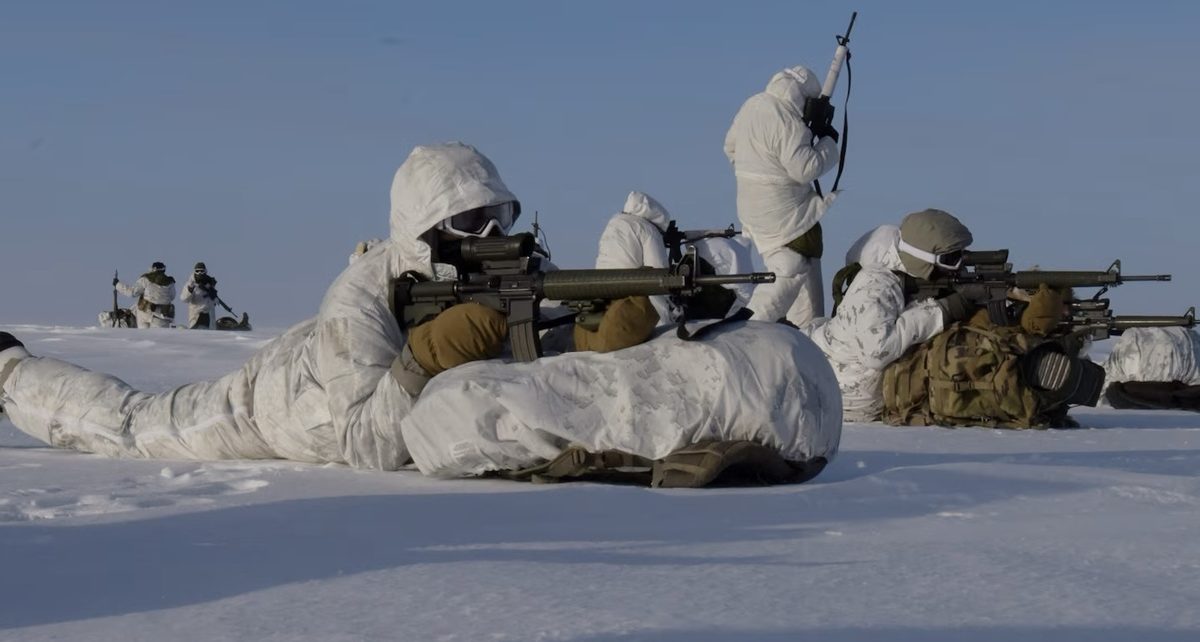
Image: U.S. and Canadian soldiers conducting Arctic military training near Cornwallis Island, Nunavut (2023), by Capt. Mikel Arcovitch via the U.S. National Guard. Public Domain.
Disclaimer: Any views or opinions expressed in articles are solely those of the authors and do not necessarily represent the views of the NATO Association of Canada.