Japan’s political landscape has undergone a tremendous shift this year, challenging long-held assumptions about its stability and its role as a democratic anchor in the Indo-Pacific. For most of the post-World War II era, Japan’s Liberal Democratic Party dominated national politics so comprehensively it was often described as a country with a “one-and-a-half party system.” That era now appears to be fading. The past two election cycles saw the LDP lose both its structural dominance and its psychological hold over voters. This coincides with the rise of new right-wing populist parties that position themselves as the guardians of Japanese identity in an era of domestic uncertainty. What is emerging is a Japan that is more polarized, more nationalist, and more willing to discard the political restraint that defined its post-1945 trajectory.
This shift was visible in the late 2025 election of Sanae Takaichi as Japan’s next prime minister. She has long represented the LDP’s nationalist faction, advocating for changes to the constitution, a tough stance toward China, expanded defence powers, and a more blatantly assertive expression of national pride. Her declaration that any Chinese attack on Taiwan would be a ‘survival-threatening situation,’ potentially requiring Japan to engage in collective self-defence, set off a regional diplomatic storm just days after she took office. Beijing reacted angrily, threatening to “bear all consequences” if she did not recant the statement. The crisis escalated with China issuing travel advisories, applying economic pressure, and using historical memory as a political instrument once more to portray Japan’s change as a return to militarism. Taiwan, in expected contrast, expressed strong appreciation for Japan’s position, strengthening a dynamic that Beijing has traditionally viewed as one of the core red lines in the region.
However, this assertiveness in foreign policy could be just one aspect of a more profound internal change. Right-wing populist parties like Sanseitō have evolved over the last three years into legitimate political actors capable of influencing national discussions. Their success is a reflection of a larger social change. Voters in their younger and middle years are facing demographic decline, economic stagnation, and disenchantment with traditional politics are more open to narratives that emphasize cultural preservation, opposition to immigration, mistrust of international organizations, and a return to “traditional values.” Far-right populism in Japan stems from concerns about identity, sovereignty, and the conviction that Japan’s security and prosperity are no longer guaranteed by the international system.
The result is a political climate that is significantly more volatile and unpredictable than it has been in the previous two generations. The LDP is forced to deal with parties further to its right, which pushes policy talks into areas that were unimaginable ten years ago. A long-standing but politically delicate aim of constitutional change now seems more likely. Japan has already indicated an allocation of 2% of GDP in defence spending, indicating a greater willingness to participate in collective deterrence efforts. Amnesty International and UNHCR have frequently brought attention to the social repercussions of Japan’s stringent immigration and asylum laws, intensifying public discussions on immigration in Japan. If these domestic forces are directed toward discriminatory or excessively nationalist measures, Japan’s democratic reputation might take a hit.
Japan’s change presents both an opportunity and a concern for NATO, which has been building its Indo-Pacific partnerships in reaction to China’s increasing strategic influence. The security alignment between Indo-Pacific democracies and Euro-Atlantic allies is improved by a more assertive Japan. Increased alignment with Japan improves NATO’s capacity to coordinate on supply chain control, cyber defence, maritime deterrence, and technology security. Japan’s readiness to adopt more precise stances on Taiwan and regional security reduces strategic uncertainty and strengthens efforts at collective deterrence. However, alliance strategy, which is focused on stability, predictability, and avoiding escalation, is further complicated by a combative or internally divided Japan. Japan’s right-wing turn may intensify regional tensions with countries like China, which can lead to more instability than peace and destabilize efforts to maintain a rules-based international order.
For Canada, Japan’s shift toward a more assertive stance in both domestic and foreign policy brings both significant opportunities and complex risks. Tokyo is not only a longstanding economic partner but also the only G7 ally in the Indo‑Pacific. Ottawa and Tokyo have been strengthening defence and security cooperation. In 2025, Canada signed a Security of Information Agreement with Japan to enhance defence and security collaboration.
From an economic and investment perspective, Japan is an increasingly important destination for Canadian capital and a key source of investment in Canada. Japan was among the top recipients of Canadian investment in the Asia‑Pacific region, reflecting deepening commercial integration. Canada’s trade with Japan is also anchored in frameworks such as the Comprehensive and Progressive Agreement for Trans‑Pacific Partnership (CPTPP), providing Canadian firms preferential access to Japanese markets and helping diversify Canada’s export base away from reliance on the U.S. market. Canadian naval vessels have also participated in joint exercises and freedom‑of‑navigation operations in the region, including through the Taiwan Strait alongside allies like Australia, demonstrating Ottawa’s interest in defending maritime norms and regional stability.
However, these opportunities are accompanied by significant risks. One growing concern for Canada should be that any escalation of Taiwan Strait tensions or wider Sino-Japanese confrontation might threaten Canadian investment and supply-chain linkages, especially with Japanese ecosystems and Taiwanese semiconductor networks. Increased conflict risk might impact the flow of energy, vital technologies, and goods, which would have repercussions for Canadian investors and exporters connected to these regional networks.
Additionally, Canada’s relationship with China remains strained, and any Canadian alignment with a more assertive Japan, including through naval cooperation or defence involvement, risks political and economic backlash from Beijing. This includes retaliatory actions against Canadian trade or diplomatic initiatives. This is important as China is a significant investor in Canada, with inward foreign direct investment exceeding CAD 30 billion, tying Chinese capital into Canadian markets.
The assertiveness of the new Japanese prime minister is a sign of a larger strategic realignment that Japan now believes is essential to its survival in an area characterized by the growth of China, the unpredictability of North Korea, and the ongoing unpredictability of American politics. Whether this increases democratic strength or erodes it will depend on how Japan’s institutions absorb these changes and how the public reacts in the coming years.
The challenge for Canada and NATO is how to actively engage with Japan rather than just react to its changed political environment. Japan is still essential to the stability of the Indo-Pacific, and its transition will potentially have a greater impact on the region’s course than any other political development this decade. As the country navigates the tensions between nationalism, democratic norms, and security imperatives, NATO partners will need to be committed to preserving the rules-based order at a moment when its foundations are being tested from multiple fronts. Japan’s rightward turn is one that will influence global security architecture for years to come in the Asia-Pacific region.
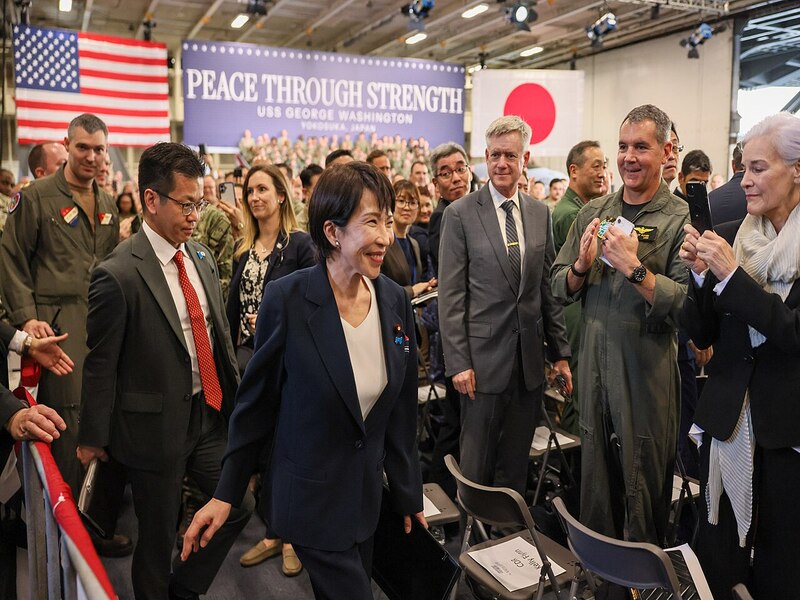
Sanae Takaichi and Donald Trump at Yokosuka Naval Base in 2025. Photo licensed under the Creative Commons Attribution 4.0 International license. Photo accessed via Wikipedia Commons. Image dimensions adjusted. Cabinet Secretariat, 2025.
Disclaimer: Any views or opinions expressed in articles are solely those of the authors and do not necessarily represent the views of the NATO Association of Canada.