On November 11th, Canadians and their European allies observe Remembrance Day or Armistice Day, honouring those who sacrificed their lives in the World Wars and serving as a reminder of why maintaining the capability to fight remains important. For Canada, an extraordinary sacrifice was made in solidarity with the British. In a subtle display of diplomacy, Canada observes the British rituals associated with remembrance including the two-minute silence, setting itself up as a fellow of the suffering reaped upon them. This is symbolic of Canada’s carefully crafted image of a diplomatic powerhouse, committed to maintaining and expanding close ties with partners worldwide.
Canada suffered its own political crises during the First World War when the Canadian Expeditionary Force (CEF) was called upon by Britain to fight in Europe. Cultural and political ties alongside imperial demands motivated many to join the CEF. Although it was up to Canada to decide on the extent of its involvement in the war effort, pre-war agreements meant that its fleet and expeditionary forces came under the command of the British Admiralty. Resentments over involvement in this war, (especially in Quebec), were made worse when casualties led to conscription being introduced in 1917 and to a lesser extent in 1942. While Quebecois objections to conscription were driven by the perception that the First World War was largely an ‘English affair’ that did not concern them, Canada’s membership in and commitments to the NATO alliance have long been among the few issues uniting the country’s English and French-speaking populations.
Building on its NATO commitments, Canada faces significant opportunities for revitalizing its defence industrial capacity in the years ahead. Massive investments, (as of the recent 2025 Federal Budget aiming for an additional $82-84 billion), have been poured into the Department of National Defence, following a concerning period of low defence spending. The Government has allocated this amount into both revitalization of the domestic defence industrial base but also into “defence partnerships,” in reference to international obligations such as allegiance with the EU and Ukrainian Aid programs. The immediate goal is to reach the minimum 2% defence threshold by the end of the 2025 fiscal year. However, the more important long-term goals are to reach a 5% defence budget by 2035. The 5% itself is split into 3.5% for core military needs, but also 1.5% for security related investments. Domestic infrastructure is marked by the need to protect industries at risk from American tariffs such as steel and aluminium. These relate to sectors such as the auto industry which are most at risk if blanket 10% tariffs are imposed. These allocations also signal to the Americans that investment is being implemented beyond mere rhetoric, helping to pre-empt future complaints that Canada is “freeloading” on U.S. defence spending.
If the current government can seize this opportunity, Canada has the opportunity to enter a prolonged period in which defence production and technological innovation can create tens of thousands of jobs in these fields. Canadian industry, such as the Ontario automotive industry, already possesses the capacity for a military shift from civilian cars to military vehicles within a few days if crisis hits due to existing contracts between them and the government. Therefore, political opposition has not resonated like it has previously. When weighing up policy options, Canada is faced with a populace unreceptive to conscription, yet eager to see revitalized defence and industry. If Canada is to directly enter into a war and mobilize troops to fight in the coming decades, revitalized defence is the assurance of political survival if it becomes a global conflict. The motivation to mobilize for conscription will not exist if Canada cannot build planes, advance cybersecurity, multiply its military bases and living quarters for soldiers, and invest in arms which are not at risk from an enemy country. Therefore, maintaining defence spending levels which are consistent with a country concerned about future conflict can be a way to avoid thoughts of conscription altogether.
Despite the current difficulty with the United States and how much more expensive their resources are compared to the Chinese, weaponry from the United States, Europe and other safe allies like Australia and New Zealand are the smartest long-term strategy for arms and infrastructure outside of that which Canada builds itself. The ‘Five Eyes’ countries already promote security cooperation. However, beyond their mutual geopolitical interests, a network of arms production and infrastructure, data-sharing and streamlined exchange of peoples in free travel, are yet to be implemented. Failure to do so risks losing the morale and opportunities amongst the populace to make Canada a more reliable military force in regions like the Arctic, (which is bound alongside the US with NORAD), safer across the Atlantic and to prepare its soldiers for a potential civilizational war.
On cooperation with Europe, the incentive towards further cooperation with the British and Europeans away from overreliance on American trade is another long-term endeavour that signals Canada’s ultimate priority of remaining steadfast in similar commitments, such as Ukrainian victory in the war with Russia and avoiding attack or subsuming of sovereignty by the US. When considering Canada’s allegiances, the value of old allies of the past centuries remain paramount. Additionally, these allies are the hubs of technological innovation and key figures in the building alliance which will be needed when a confrontation with a country like Russia or China comes around. To avoid the prospect of having to mourn another lost generation, a revitalized defence sector built with these allies is required. The circumstances and sacrifices which make ‘remembrance’ necessary serve as a reminder of the value presented by allegiance to these countries, past and present.
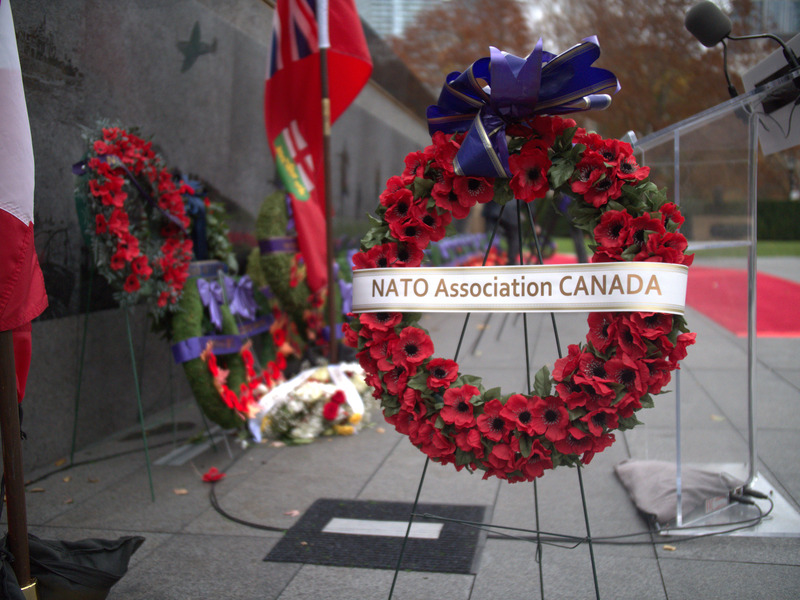
Photo: NATO Association of Canada Wreath laid at a Toronto Cenotaph, (2024). NATO Association of Canada. All rights reserved.
Disclaimer: Any views or opinions expressed in articles are solely those of the authors and do not necessarily represent the views of the NATO Association of Canada.