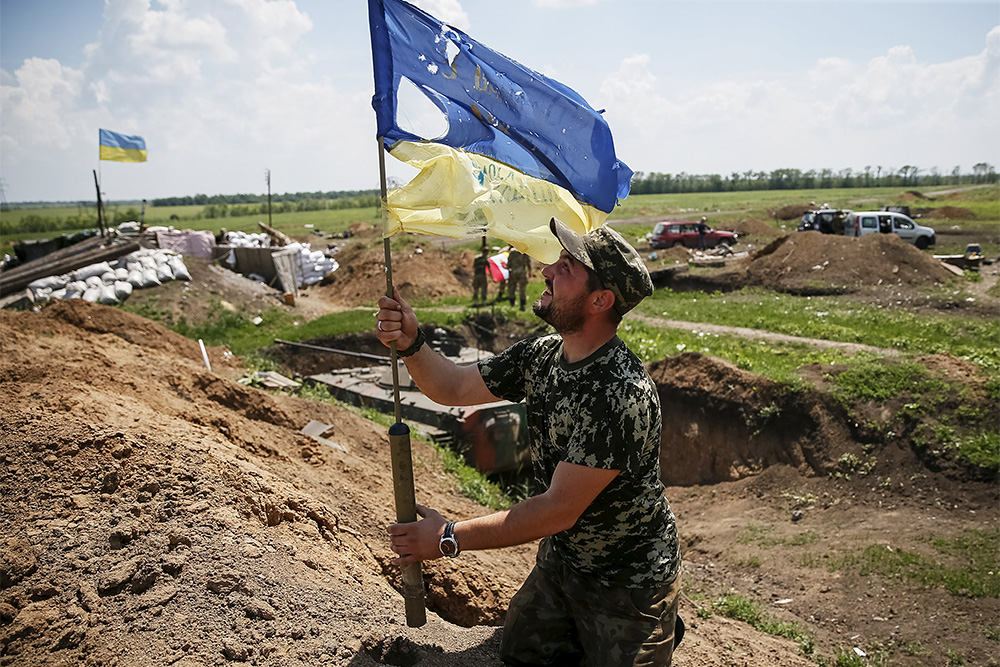
Below are photos, as well as an accompanying description from an exhibit that was organized by Canadians for Democracy in Russia and Euromaidan Canada Committee. In opposition to the war in Ukraine, the exhibit aims to reveal evidence of Russian support for anti-government militants, as well demonstrate the brutal and violent nature of the conflict (for more information, please visit http://thewarinukraine.info).
In this week’s post, both the photos below and the accompanying descriptions highlight key historic moments from the current conflict in Ukraine.

Nadiya Savchenko was born on May 11, 1981 in Kyiv. Since her childhood she was determined to become a pilot and joined the Ukrainian army. From 2004 to 2008 she served in Iraq as the only female among the Ukrainian peacekeeping troops. When the war in Eastern Ukraine broke out, Nadiya voluntarily joined the Aidar battalion, which is a volunteer military detachment of Ukraine’s Ministry of Defense.
On June 18, 2014 she was captured by the Russia-backed combatants belonging to the Zarya battalion. Later she was smuggled into Russia and was accused of killing Russian journalists. After over 8 months of investigation, the prosecutors have been unable to present any solid evidence of her involvement in the deaths of the journalists.
On December 13, 2014 after months of detention in poor conditions of the jail, and no progress in the investigation and trial, Nadiya went on hunger strike. Already in prison, Savchenko was elected member of Parliament in Ukraine in October 2014, and was included in Ukraine’s delegation to the Parliamentary Assembly of the Council of Europe, which gives her political immunity. Thus, the continuation of her custody violates the international law. Although many European and North American leaders and politicians condemned her detention and demanded her immediate release, the Russian government did not react.
On April 29, 2015 Nadiya’s lawyer Ilya Novikov, told BBC that her hunger strike will be ‘selective’ – she’ll take food prior to court hearings. This happened after she was taken to hospital due to deteriorating health. He also said, that she would like to return to the detention center as she is not given time in the open air, is kept “in a dark and gloomy special unit of the hospital” and allowed to go to the toilet in handcuffs only.

During later hearings in July, new testimonies against Savchenko began to contradict the original ones, based on which she was charged. According to the new accusations, she illegally crossed the Russian border by herself, and resided upon the Russian territory for a long time, which contradicts the original testimonies that she was captured by the “DPR” militants, and was brought to Russia. On July 30, Savchenko was relocated to the Rostov region, over 1000 km from Moscow for a closed hearing. Her place of custody there was 50 km away from the court, were she was regularly brought in for hearings.
In November 2015, Russian authorities opened a criminal case against Savchenko’s younger sister, who was charged with contempt of court for referring to the judge by an offensive word. On November 18th the “LPR” leader Plotnistky was interrogated in a closed hearing. According to Savchenko’s defense counsels, I. Novikov and M. Feygin, it was illegal to interrogate Plotnisky behind closed doors, and they published on the Internet a picture of him in the courtroom. In response, they threatened with a criminal case for this publication, but the lawyers claim there is no law in Russia prohibiting the publication of such materials on social networks.
Nadiya savchenko was released on May 25, 2016, as she was exchanged for two Russian GRU officers, Yevgeny Yerofeyev and Alexander Alexandrov. Since then, as she was earlier elected to the Ukrainian Rada, she is actively participating in its parliamentary sessions.


During early June of 2015, Russia-backed forces attempted to seize Maryinka, Donetsk Region, which was under control of the Ukrainian army. Since June 2, 2015 the OSCE began noticing an unusual movement of heavy weaponry and vehicles in the area, and on June 3 around 1000 “DNR” militants attacked Maryinka, despite the Minks-2 ceasefire agreement.
On June 5, 2015, the US Ambassador to the UN, Samantha Power, announced that according to the information available, 5 Ukrainian soldiers died and 35 were wounded. The OSCE had been trying to contact A. Zakharchenko and other representatives of the “DPR”, but they either were not available or refrained from comments. On June 8, 2015 the “DPR” forces again launched an attack, by shooting from tanks and mortars.