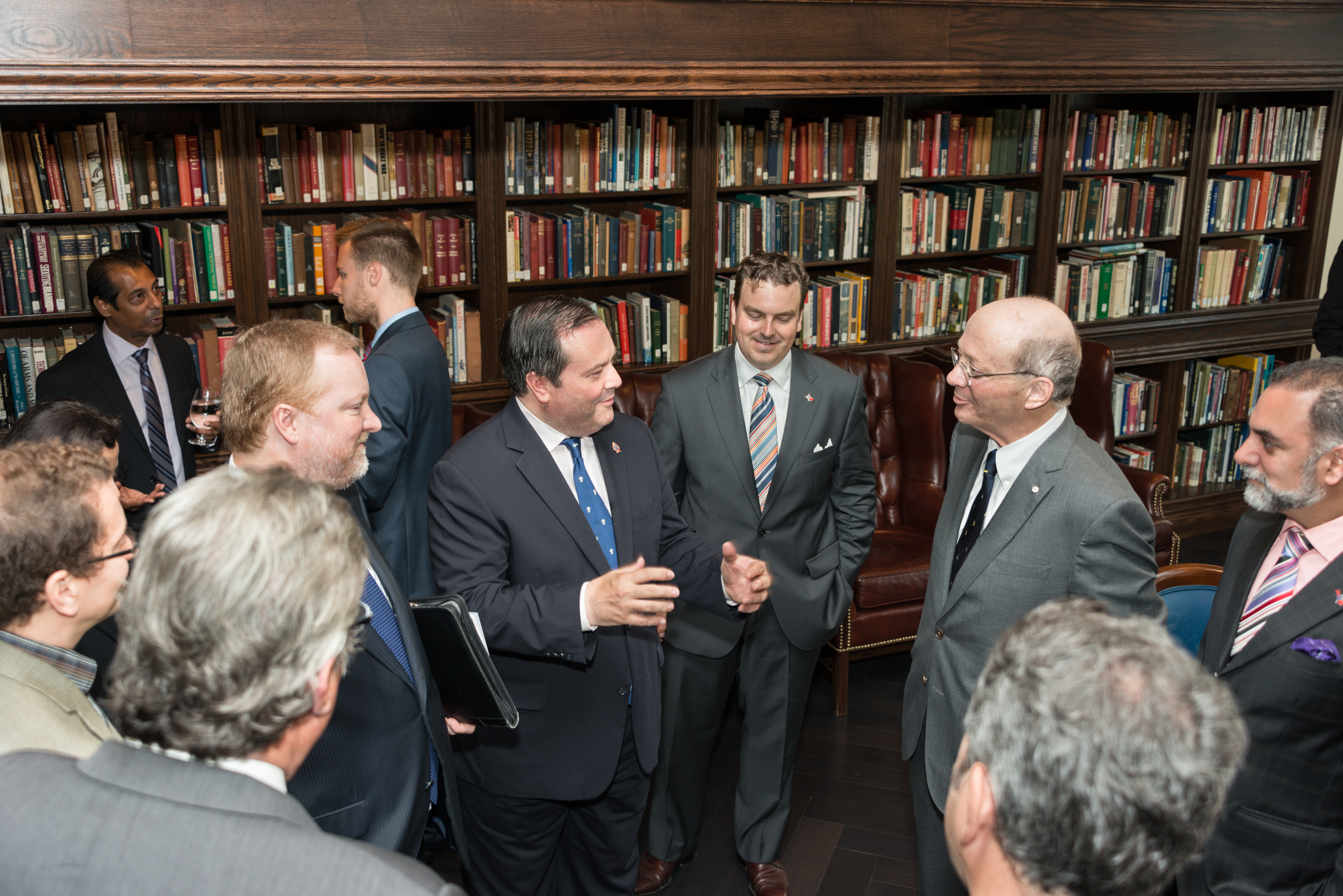

On September 18th, 2025, the NATO Association of Canada (NAOC) and the Canadian Armed Forces College Foundation organized a discussion with the Latvian Member of the European Parliament- Reinis Pozņaks. The discussion was focused on democracy, resilience, security, and the future of Europe. The event was attended by over 60 participants and included a conversation with Reinis Pozņaks, moderated by NAOC President & CEO Robert Baines, a Q&A session, and a networking reception.
The event commenced with opening remarks from Robert Baines, who emphasized that NATO can only prosper when friendships are firm and continuous, like the one between Canada and Latvia. He spoke about the importance of “sharing the burden” in times of need, which means creating peace through friendships. This can take the form of military support, volunteering, or civic contributions, all of which equally contribute to protecting peace and security.
The discussion opened with Reinis Pozņaks echoing Robert’s remarks on the close Canada-Latvia friendship and Canada’s consistent support for Latvia throughout Russia’s full-scale invasion of Ukraine. He emphasized that Canada has stepped up its military presence in Latvia, whose security is vital for NATO and its allies, given its shared border with Russia. This friendship and support serve as a clear example of NATO’s organizational success and a demonstration of Article Five in action. Mr. Pozņaks continued the discussion with insights on Latvia’s current operations in drone production and the establishment of a drone testing facility. He also emphasized the dangers posed by drones and underscored Europe’s need for advanced Early Warning Systems to counter and deter them. Mr. Pozņaks shared his part in the inception of the global campaign – “the Twitter Convoy”. The initiative began as an effort by eight friends who collectively raised funds to donate eight vehicles to Ukraine. After their success, Mr. Pozņaks uploaded a post on X (formerly known as Twitter) requesting additional support for the initiative. The post quickly gained global attention, expanding the campaign and resulting in the donation of over 3100 vehicles. This example illustrates how defense and security tools are no longer confined to the military sphere. Every industry, even X, can now be seen as part of the broader defense effort. Accordingly, Mr. Pozņaks stressed the importance of involving civic industries, fresh perspectives, and new tactics in protecting Europe, NATO allies, and the global community.
Both Mr. Baines and Mr. Pozņaks discussed the latest NATO commitment of investing 5% of Gross Domestic Product (GDP) and the increasing negative perceptions associated with the rise in defence spending. Canada has struggled to meet the 2% GDP target, and speculations of the country’s commitments to NATO are growing. However, Mr. Pozņaks claimed that the unwavering Canadian support on the frontlines of the Latvian borders is a greater showcase of Canada’s commitments to international security than a percentage of GDP could ever be. When asked about negative perceptions of defence spending, Mr. Pozņaks underlined that “it is not defence spending, it is defence investment”. Sectors like health, housing, and education are essential, but their existence is contingent on strong defence strategies, positioning defence as an investment in the advancement of society. The Russian invasion of Ukraine has been a testament that diplomacy does not always provide resolutions, and that supporting each other in defence is the only strategy to secure peace and prosperity. Mr. Pozņaks recommended that NATO and allies actively and publicly showcase the positive impacts of defence investments on media outlets and continuously communicate how these investments contribute to the protection of peace and security. The same recommendations can be used for fighting against disinformation campaigns, which have been a major component of Russian strategies to undermine NATO. The allies can fight disinformation effectively only if they provide credible information to their citizens.
During the Q&A session, many questions pertained to the future of European security. While Europe’s commitment to strong defence has been challenged, Mr. Pozņaks believes that the “Re-Arm Europe” Plan is restoring hope for others and himself. It generates unity among allies and signals long-term commitment to European security. However, maintaining consensus within Europe is challenging. Europe is often viewed as a single unit, yet it consists of 27 distinct states, each with its own interests and objectives. This diversity has fueled fragmentation. The Russian invasion of Ukraine has exposed these divisions. It undermined the very advantages of strength through unity, causing complications in jointly responding to the Invasion of Ukraine. For this reason, NATO and its allies must remain committed to keeping citizens engaged and supportive of collective defense strategies. The future of European security depends on NATO’s resilience and the sustained support of its member states.
Disclaimer: Any views or opinions expressed in articles are solely those of the authors and do not necessarily represent the views of the NATO Association of Canada.