Whether it is NATO’s eastern front or the Persian Gulf, wars today have a variety of drivers that range from troops to weapons systems. Many of these advanced technologies are dual-use in nature, often switching between military and commercial (or civilian) settings.
Bringing greater urgency to this matter, prominent defence technologies that are sensitive also increasingly have a dual-use dimension. This has serious implications across applied military sciences, autonomous systems, cybersecurity, defence, nano materials, and physics. Sensitive dual-use technologies include advanced digital infrastructure technology, advanced energy technology, advanced materials and manufacturing, advanced sensing and surveillance, advanced weapons, aerospace, space and satellite technology, artificial intelligence and big data technology, human-machine integration, life science technology, quantum science and technology, and robotics systems. For more, see here.
Today’s conflicts are also being shaped by societal perceptions of such technologies. Many of these technologies now interface ever more deeply with society, as they power everything from defence operations to financial markets to online platforms. Therefore, key challenges accompany dual-use technologies: Can these systems enhance security while maintaining trust, transparency, and democratic legitimacy?
Despite these challenges, NATO’s democratic societies and governance mechanisms must procure and commercialize these technological systems under a plethora of constraints, including uncertainty, interoperability challenges, system fragmentation, integration, and compatibility challenges. Moreover, all this must take place in the public square under oversight and media scrutiny, and at the risk of a reputational damage.
We’re slowly beginning to realize that resilience today is conditional not only on systemic capacity, but also on ecosystem readiness, adoption, social cohesion, and a political economy that aims to align across markets, institutions, citizens, buyers, consumers, and users.
It is at this point that the political economy of marketing takes off – and my work begins.
“The most powerful military force is public opinion”
My current research focuses on dual‑use technologies and military-grade marketing. After all, the most powerful military force is public opinion shaped through adoption and legitimacy.
I am a tenured Associate Professor of Marketing at the DeGroote School of Business at McMaster University, an Affiliate Faculty member with McMaster’s School of Computational Science and Engineering, and a Research Affiliate at the University of Michigan. I direct the Vaid Lab for Dual‑Use Technologies, a marketing-interfacing, interdisciplinary research lab that directly engages with parliamentarians, researchers, companies, policymakers, and public institutions and examines how technologies originally developed for defence—and increasingly repurposed for civilian markets—reshape industries, markets, regulations, and society.
For me, marketing science is not a “soft” discipline, it is a “mil-grade” one. The durability and rigour accompanying marketing science help shape technology supply and acceptance, communication of risks, and democratic responses to fast-moving technological disruptions. I see marketing science at the frontline of integrated contests that range from information and perception to legitimacy and territory.
Some people perceive “marketing” through the narrow lens of the 4Ps only (Product, Price, Promotion, Place) or advertising and branding only. Yet the reality is far more nuanced and complex in our deeply networked, interdependent, consumerist, and attention-oriented times. This has encouraged scholars like me to treat marketing as a core societal phenomenon that interfaces frequently across B2G, B2B, and B2C settings. My current research examines issues related to technological adoption, legitimacy, trust, and acceptance relevant for governments, firms, and citizens.
In matters of defence economics, military marketing, and national security, the above nuances accompanying marketing science matter deeply. The aforementioned sensitive technologies and weapons systems do not operate in isolation. They are conditional on transaction costs, social license, political support, civic credibility, governance mechanisms, and responsible commercialization.
Dual‑Use Technologies at the Commercial/Civil–Military Boundary
Dual‑use technologies have historically switched between both military and commercial/civilian applications. The above-discussed sensitive technologies and others often seen as artificial intelligence, cybersecurity tools, imaging and sensing technologies, geospatial analytics, advanced materials, and communications infrastructure have origins in defence or security labs before they were commercialized for industrial and consumer markets. Today, most such dual-use technologies may even form the core of online retail, aviation, logistics, and sports betting frequently interfacing with end-user markets.
My research group is examining what happens at these edges—as defence‑origin technologies migrate to civilian settings, or when commercial technologies are nudged into defence ecosystems.
The frequent switching and ebb and flow of these dual-use technologies keep us curious: Are there best practices for governments to procure technologies from commercial markets? How do firms ensure the absence of sanctions evasion? How do businesses signal risk mitigation and integrity? Are citizens aware of military‑grade technologies appearing in daily life? What governance mechanisms do policymakers put in place without increasing transaction costs and undermining competitiveness?
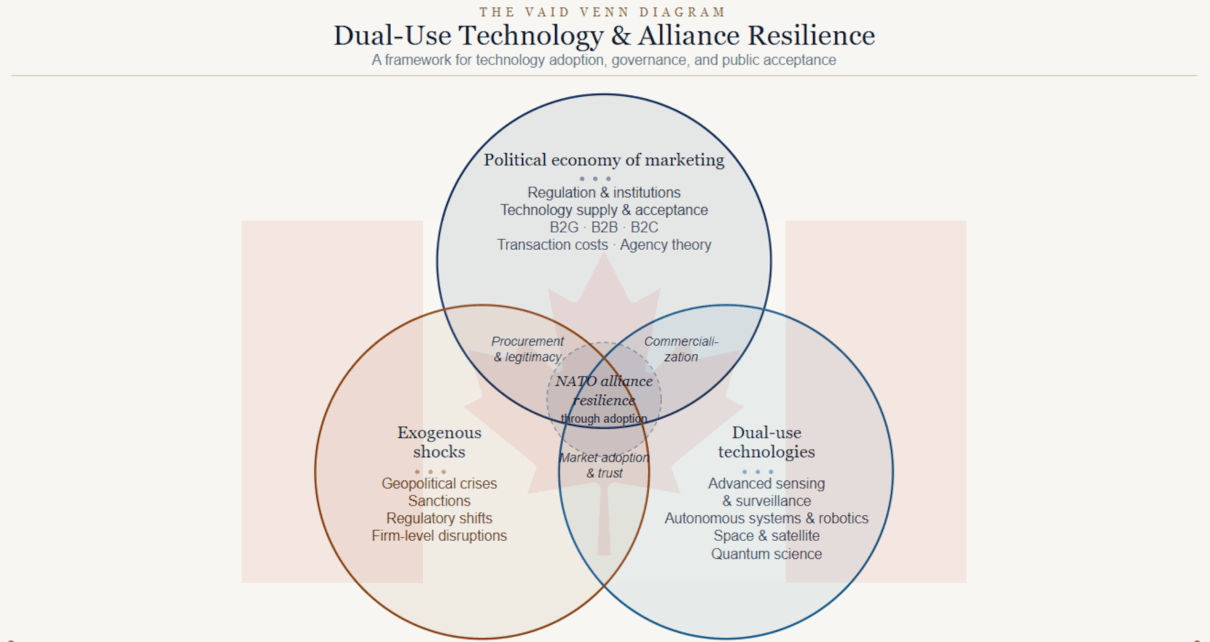
To structure these and many other questions, I developed what we call the Vaid Venn Diagram, which integrates three core dimensions. The first is the political economy of marketing, which looks at how regulation, institutions, and public policy shape technology supply and acceptance. The second is the technology layer itself, focusing on marketing’s role in accelerating or inhibiting the diffusion of industrial and cyber systems. The third is exogenous shocks—regulatory changes, geopolitical crises, sanctions, and firm‑level disruptions—that reshape markets.
Interfaces across these dimensions help us grasp the role of policy and markets in transactions governing technological supply, acceptance, and resilience.
Investigating the asymmetric effects of types of data breaches on key outcomes
I was recently (in 2026) awarded a SSHRC Insight Grant for a multi-year data breach-related research study.
Data breaches occur when personal information is accessed by unauthorized parties, resulting in service failure and harm to stakeholders. In 2022, U.S. users lost $8.8 billion to scams, a 30% increase from the previous year. In Canada, firms lose C$7 million to breaches, with many reporting price increases.
A priority for immediate action is that many of the dual-use and even sensitive technologies may be threatened by data breaches. Costs stem from the sensitive nature of data, which is difficult to replace across patient, personnel, technology, customer, and operations etc. settings and is highly valuable to threat actors. Moreover, since healthcare and other consumer-related data breaches are often covered under a variety of Data Breach Notification Laws (DBNLs) they are simply more visible.
Yet the impact of data breaches associated with sensitive technologies can be far more deleterious for NATO countries.
These comparisons underscore data breaches as a uniquely high-stakes context for evaluating the vulnerabilities and impact of data breaches technologies on a variety of key operational outcomes.
Breaches often lead to identity theft, disruptions, regulatory fines, or much worse. For additional context, recent incidents include UnitedHealth’s Change Healthcare breach affecting 100 million Americans and Ascension’s breach impacting 5.6 million individuals. Healthcare data can sell for up to $1000 on the dark web, compared to $5 for credit card data.
Data breaches related to sensitive technologies can be sold in figures that are easily in multiples of healthcare breaches.
This should give us pause.
Defence Procurement, Persuasion, and Trust
My research group is also investigating defence procurement and Business‑to‑Government (B2G) exchanges. Unlike typically efficient commercial markets, in defence-related settings buyers and sellers operate in what some call less efficient industrial markets. These B2B/B2G markets are characterized by asymmetric information, long lead times, high transaction costs, and intense politico-economic uncertainty.
Using frameworks such as Agency Theory and the Capability–Intent Matrix, we examine defence procurement adoption and marketing of dual-use technologies. We study how misalignment between governments (as principals) and firms (as agents), especially in dual‑use technology adoption, results in opportunistic behavior such as sanctions evasion.
Across multiple studies, my collaborators and I run field experiments testing persuasion mechanisms, a closed-loop supply chain design, and a combination of graph and game theoretic models predicting sanctions evasion.
Through these studies we aim shine some sunlight on procurement efficiency, alliance interoperability, sanctions enforcement, and technology governance—fundamental concerns at the heart of how NATO members may navigate increasingly complex defence ecosystems.
AI, Integrity, and Civilian Spillovers
My research has also examined AI‑driven markets, exploring contexts where defence‑origin technologies sneak into popular civilian contexts. Some of our current work has focused on modern sports betting. One may wonder what modern sports betting has to do with defence technologies? Well, these are dual-use technology markets that have gradually seen anomaly detection, security, and surveillance systems spill over into consumption contexts. These technologies have been commercialized to segment behaviors, personalize user targeting, predict needs and wants, and optimize value through engagement.
These technologies have disrupted the level playing field between businesses and unsuspecting users. Asymmetric power in favor of platforms has triggered an arms race to manipulate and likely harm those who have been effectively persuaded to gamble away their last dollars for sports betting. But persuasion mechanisms can also be redirected to reduce harm. Democratic systems must nudge themselves to leverage these cutting-edge technologies without compromising trust, subverting autonomy, or devaluing legitimacy.
Retail, Commercialization, and Alliance Readiness
Another research stream we are currently examining focuses on dual‑use technologies in retail and industrial markets. While retail and defence may seem poles apart, retail sets the stage for large-scale deployment and serves as a proving ground for many sensitive technologies: AI, sensing, imaging, and logistics systems. We’re studying these markets to not only uncover the underlying phenomena but also make sense of the “construct” of dual-use technology, which unfortunately (or shall I say, fortunately) has largely stayed undefined in empirical settings. The Vaid Lab addresses this gap by developing frameworks and dashboards that map defence‑origin technologies to performance outcomes and regulatory constraints.
Methods: From Experiments to Synthetic Consumers
Methodologically, my lab emphasizes causal inference, field experiments, and advanced analytics. We also examine new experimentation paradigms to uncover underlying dual-use technology phenomena by using evolutionary coding agents to validate synthetic expertise through a mix of silicon sampling and Large Language Models. This way we can generate personas, where each persona is a vector of traits of hard-to-reach populations, say, defence procurement officers (buyers) in military and government and sellers in industrial firms. The evolutionary coding pipeline uses more recent advances in fitness, mutation, and selection mechanisms to generate behavior, metrics, and selection that can then be looped at scale.
Using evolutionary algorithm discovery, our study of synthetic personas aims to test hard-to-reach scenarios, ones that are very difficult to observe directly, such as procurement negotiations.
Importantly, our work is not conducted in isolation. The lab engages regularly with parliamentarians, researchers, companies, policymakers, and public institutions, translating complex research into actionable insights. Researchers and students in the lab study real dual‑use firms across sectors such as aerospace, cybersecurity, simulation, maritime systems, and advanced manufacturing, building practical understanding of defence‑industry dynamics.
Why This Matters for Canada, NATO, and Public Dialogue
The coming decade or two are critical for the world we call home. NATO-allied countries (e.g., Japan, Korea), and partner democratic countries (e.g., India) that are major defense and strategic partners too have much at stake.
Canada’s Defence Industrial Strategy and related initiatives must be seen not only in the context of our “only” neighbor and closest ally, the United States, but also in the context of increased defence cooperation with countries like India. As Canada signals massive public outlays for defence (estimated at ~500 billion dollars over the next decade) and looks to create 125k defence-related jobs, the role of marketing science in the procurement and commercialization of dual-use technologies across jurisdictions is ever more important.
Most if not all roads to Canada’s Defence Industrial Strategy pass through Southern Ontario, home to hundreds of defence‑capable organizations. Yet, it is now time to also accept what we don’t know. Signaling investment alone is likely to have little bearing on success. As my current research shows, the key lies in adoption, trust, and public acceptance of these massive initiatives.
This is precisely where my research group and its work align with the mission of the NATO Association of Canada. NATO’s strength is derived from military capability, resilient economies, informed citizens, and transparent institutions. My current scholarship enhances trust between governments and society in dual-use technology settings. By focusing on the marketing science of their adoption, governance, procurement and commercialization, my research brings “mil-grade” evidence to alliance resilience.
That goal sits squarely at the intersection of the political economy of marketing, dual-use technology, and exogenous shocks, which is why I welcome engagement with the NATO Association of Canada.
Photo: Vaid Venn Diagram (June 4, 2026), by Dr. Sash Vaid via Claude Sonnet 4.6
Disclaimer: Any views or opinions expressed in articles are solely those of the authors and do not necessarily represent the views of the NATO Association of Canada.