The Arctic, a remote and expansive region, is heavily reliant on satellite surveillance to maintain domain awareness. As climate change accelerates, increased access to the region, along with its growing strategic and economic value, has drawn heightened interest from states such as Russia and China. The interests and activities of these actors raise security concerns for Canada, positioning satellite surveillance systems at the center of national defence and security. This article examines whether Canada’s satellite systems are sufficiently robust to withstand potential disruptions from technologically advanced and persistent actors, and whether they can provide the resilience required to safeguard national interests in the Arctic.
Canada’s first efforts towards satellite surveillance began in 1995 with the RADARSAT program, which has since expanded to multiple different projects. The most recent was the 2019 launch of the RADARSAT Constellation Mission (RCM). The RCM is an Earth-observing satellite constellation that provides regular coverage over Canada and the Arctic. Following these advancements, at the beginning of 2025, the Department of National Defence (DND) and Canadian Armed Forces (CAF) launched their first R&D microsatellite initiative- the Gray Jay Pathfinder. This initiative deployed three R&D microsatellites designed to evaluate and test new technologies that could enhance Arctic surveillance. Microsatellites are an increasingly prominent and commercialized technology due to their simplified launch procedures, accurate detection capabilities, and relative cost efficiency.
Together, these initiatives have enhanced Canada’s Arctic domain surveillance by providing broad coverage in both range and scope. The RCM delivers multiple high-resolution images across Canada, while the Gray Jay Pathfinder focuses on advancing methods for detecting and characterizing ships and aircraft. However, space has gradually shifted from a domain primarily associated with exploration and scientific discovery into a contested environment that increasingly requires protection and defence. As satellites collect sensitive information, including location data, communications, and environmental intelligence, they have become dual-use technologies and, consequently, more attractive targets for cyber operations.
Arctic domain awareness, the ability to understand conditions, threats, and activities in the Arctic, depends on the assumption that satellites and their supporting ground systems remain functional and undisturbed. Canada’s satellite programs form the backbone of its Arctic surveillance architecture, but their effectiveness ultimately depends on their resilience to disruption. As a result, the survivability of Canada’s satellite infrastructure is a critical determinant of space security and operational continuity.
Russia, which poses a significant challenge to Canada’s Arctic security, has been linked to multiple cyber operations targeting allied satellite networks. One of the most significant Russian cyber operations occurred in 2022, targeting ViaSat’s KA-SAT satellite network. ViaSat supplies internet connectivity to tens of thousands of Ukrainian and European customers. The operation caused state-wide communication outages, which resulted in severe disruption as thousands of Ukrainians struggled to gain information during the initial hours of Russia’s Invasion of Ukraine. This operation demonstrates how actors can destabilize critical satellite systems, raising serious concerns about the resilience of space-based networks worldwide. In the Arctic context, these types of operations could lead to impairments in surveillance, detection, and military communication.
China’s interest in the Arctic has been steadily rising through large investments, Arctic expeditions, and its goal of maintaining dominance over critical minerals. China has been accused of conducting multiple espionage attempts on critical infrastructure, but has more recently been involved in operations that aim to gain full access and control of critical sectors. Earlier in 2025, state-sponsored cyber threat actor Salt Typhoon infiltrated the Canadian telecommunications sector, gathering sensitive information and breaching the privacy of thousands of Canadians. Such operations highlight how space-based assets can be disrupted without physical destruction, reinforcing the importance of cyber resilience for satellites supporting Arctic domain awareness.
Given their geographic proximity to the Arctic, both Russia and China stand to gain economic and political advantages from increased access to the region. Their documented histories of cyber operations position them as potential disruptors of Arctic security through interference in space-based systems. The question, therefore, is whether Canada’s current approach to satellite systems provides sufficient resilience to counter technologically advanced and persistent actors. In comparison, Canada’s satellite capabilities remain limited relative to those of Russia and China, which operate more extensive coverage, higher resolutions, constellations consisting of tens of thousands of satellites, and have even been testing Anti-Satellite technologies, which further raise international security concerns. However, increasing and advancing satellite capabilities for Canada is not the sole solution for protecting the Arctic; a resilience approach is needed.
Canada remains the only Western ally without the capability to launch satellites from its own soil, leaving Canada to rely on foreign launch services. This dependency undermines Canada’s sovereignty and space capabilities, inferiorizing Canada to its Arctic competitors. Holistic communications within the Arctic are incomplete and in need of improvement. The CAF is mainly reliant on unreliable commercial satellite networks for military communication, which furthers Canada’s vulnerability to cyber operations. A clear and enforceable telecommunications cybersecurity framework has yet to be fully established. While initiatives such as Bill C-8 aim to strengthen Canada’s cybersecurity, ongoing privacy challenges have limited their effectiveness, intensifying risks to the security, resilience, and survivability of Canada’s Arctic communications and space-based infrastructure.
The Space domain is rapidly transforming into a battlefield, and Canada must be prepared to adapt to these new challenges. Arctic domain awareness stands strong, but more advancements are needed to safeguard the heavily relied upon “view-from-above”. These advancements could include establishing secure cybersecurity frameworks, investing in cyber defence, domestic launching services, and forming partnerships with allies and commercial powers.
The Canadian government has acknowledged the gaps in Arctic satellite capabilities, and plans for modernization and investments have been discussed. On December 9th, 2025, the Canadian government announced a new partnership with Telesat and MDA Space. This partnership falls within the Enhanced Satellite Communications Project- Polar (ESCP-P) and aims to enhance military communications within the Arctic. Days earlier, it also announced a 44.7 million dollar investment in sovereign satellite data through the addition of a satellite to the RCM constellation. However, as geopolitical competition in the Arctic intensifies, Russia and China are unlikely to pause their activities while Canada works to close existing capability and resilience gaps.
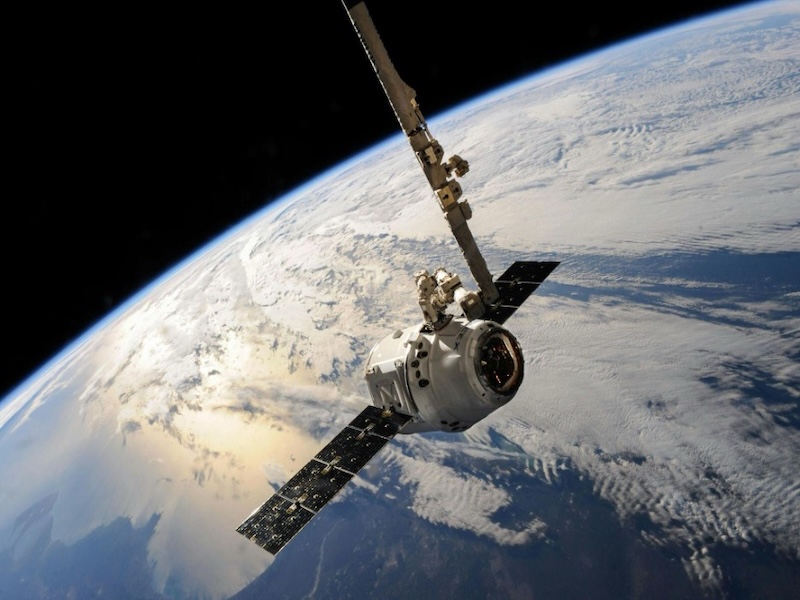
Photo: White outer space satellite orbiting above Lago Argentino Department, Santa Cruz Province, Argentina. Image courtesy of an open-access source. Licensed under Creative Commons CC0 (Public Domain).Free to use, no attribution required.
Disclaimer: Any views or opinions expressed in articles are solely those of the authors and do not necessarily represent the views of the NATO Association of Canada.