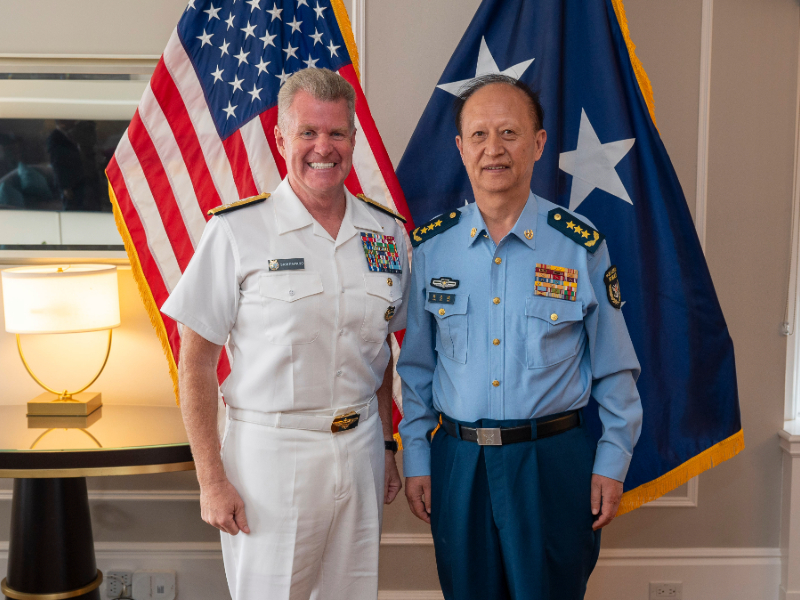
On the sidelines of the 28th Indo-Pacific Chiefs of Defense Conference in Victoria, BC, Admiral Samuel Paparo, commander of U.S. Pacific Command (PACOM), met privately with his Chinese counterpart, General Yang Zhibin, commander of the People’s Liberation Army’s (PLA) Eastern Theater Command. This was the first time in more than two years that senior commanders of the U.S. and Chinese armed forces have met in person, following a breakdown in U.S.-China military communications that began in August 2022. The meeting came just weeks before Chinese President Xi Jinping met with U.S. President Donald Trump in Washington, DC.
China’s growing military pressures on Taiwan and throughout the South China Sea, particularly in recent years, have been a significant concern for the United States, Canada, and other NATO allies. U.S. arms sales to Taiwan have also become a source of friction with Beijing in relations across the Taiwan Strait. At the same time, rapid Chinese militarization and aggression in the South China Sea since 2014, and the East China Sea since 2008, have increased the likelihood of conflicts in the region. As tensions harden between the region’s two most consequential military powers, the communication mechanisms meant to prevent an accidental war have become increasingly important.
The Paparo-Yang meeting will not by itself lead to mutual trust between the U.S and PRC or rid the region of strategic instability. It is, however, critical for incident management, ensuring minor incidents don’t spiral out into larger peer conflict. As U.S. and Chinese forces are operating in increasingly close proximity, a collision at sea, an unsafe aircraft interception, or miscommunication between operational units during exercises can quickly escalate into an unintended conflict or create political pressure for hawkish security policies. Direct communication between commanders, as shown by the summit between Adm. Paparo and Gen. Yang, is an example Canada, with its increasingly active presence in the Indo-Pacific, should advance.
Following the meeting, PACOM stated the two commanders “discussed the importance of maintaining open lines of communication” to “reduce the risk of miscalculation and promote safe and professional conduct between forces.” China’s Ministry of Defense confirmed the meeting with their own statement. According to the Ministry, the Chinese delegation introduced the PLA’s position on maintaining regional stability and proposed cooperation and exchanges among regional countries to address common challenges. Each side framed the discussions differently in subsequent public statements. While PACOM emphasized operational risk, such as miscalculation and professional conduct, Beijing’s statement prioritized regional stability and cooperation among regional states. It portrayed Chinese forces as a stabilizing actor while shifting attention away from individual incidents. These gaps suggest Washington wants a channel for managing incidents, while Beijing seeks one that also serves as an avenue to broadcast its regional significance.
The incident record between the United States and China demonstrates why an incident-management channel matters. In 2001, a U.S. EP-3 reconnaissance aircraft collided with a Chinese J-8 interceptor over the South China Sea, killing the Chinese pilot in the process. Having been forced to make an emergency landing on Hainan Island, 24 American crew members were detained in Chinese custody for 11 days, until direct intervention from the U.S. Department of State secured their release. In 2023, a Chinese J-16 strike fighter conducted aggressive maneuvers against a U.S. RC-135 reconnaissance aircraft, marking one of the nearly 200 confrontational interceptions between the two countries’ militaries in the region from 2021-2023. That same year, the USS Chung-Hoon and HMCS Montreal, while transiting the Taiwan Strait together, came under direct harassment from Chinese warships. One came within 150 yards of the transiting vessels.
Both 2023 incidents occurred while the communications breakdown that began in August 2022 was in effect, with the crew of HMCS Montreal in particular being forced to speculate on what happened and what the Chinese intended. In this case, direct contact between operational commanders could better clarify that process. While inter-military dialogue may not resolve the strategic disagreements between Washington and Beijing, it can keep them from escalating into a war that neither country wants to fight.
PACOM, the largest of the U.S. Armed Forces’ 11 combatant commands, is arguably the most strategically important to Washington. China’s Eastern Theater Command, formed in 2016, is directly responsible for all Taiwan-related combat operations. These two commands are the closest to a Taiwan contingency, so decisions at their level will carry outsized weight. Given their strategic significance, operational-level decisions from both sides will have significant implications for the region’s security outlook.
Additionally, the increased frequency of leader-level engagements between the U.S. and China this year has made the need for military dialogue even more apparent. Presidents Trump and Xi are set to meet four times in 2026, marking an unprecedented amount of engagement between the two leaders. If Washington and Beijing can maintain direct communication at the highest political level despite their differences, then their military leaders should be expected to do the same.
Skeptics, however, do present a fair case. Beijing has previously suspended military communication channels to punish Washington, as it did in August 2022. These actions suggest that China treats dialogue as leverage rather than a safeguard. Furthermore, direct contact has its limits, as it cannot prevent deliberate aggression or shape long-term strategic ambitions. While these concerns do warrant caution, these channels are not substitutes for long-term trust or a means of altering China’s Indo-Pacific strategy. Their purpose is to manage the consequences of confrontation when it cannot be avoided, which is why they need to be institutionalized rather than left to the political mood. A formal framework, unlike one-off meetings, makes suspension a visible breach of existing commitments. This should raise the political cost of using dialogue as leverage.
For Canada, the Canadian Armed Forces (CAF) should do two things. First, maintain and expand existing frameworks on maritime encounters, such as the Code for Unplanned Encounters at Sea, which both Canada and China have endorsed. Second, establish its own working-level channel with the PLA. Canada’s defence relations with China currently lack operational communication channels and instead rely on diplomatic officials. Under Operation HORIZON, the CAF has committed to routine exercises in the Indo-Pacific, and Canada’s Indo-Pacific Strategy commits it to push back against unilateral actions that threaten the region’s status quo. Consequently, a more active Canadian presence in the Indo-Pacific will raise the odds of encounters with Chinese forces, and the CAF should not have to rely solely on U.S. channels to de-escalate with the PLA.
Bilateral discussions, such as the Paparo-Yang meeting, are a start, but their true value depends on whether the contact is regular, institutionalized, and backed by official protocols. Canada, as an increasingly active Indo-Pacific partner, is well placed to help build them.
Disclaimer: Any views or opinions expressed in articles are solely those of the authors and do not necessarily represent the views of the NATO Association of Canada.
Featured Image: Adm. Samuel J. Paparo, commander of U.S. Pacific Command, poses for a photo with Gen. Yang Zhibin, commander of the People’s Liberation Army’s Eastern Theater Command, during a bilateral meeting in Victoria, British Columbia, Canada, Aug. 31, 2026. U.S. Navy photo by Mass Communication Specialist 1st Class Ryan D. McLearnon, accessed via U.S. Pacific Command. Public domain.