In the years following the September 11th attacks, anti-terrorism measures became integral components of security strategies across air, land, and sea. These measures expanded security frameworks to include the maritime domain as a crucial area that can both enhance security and cooperation as well as challenge it. The ability to respond to terrorist activity has enhanced NATO’s ability to act more fluidly amidst evolving threats that require diverse policies. While counter-terrorism remains a constant facet of NATO presence in places like the Mediterranean region, the emergence of threats like sex trafficking prove that approaches to maritime security need to be comprehensive and immediate. NATO’s application of the Women, Peace and Security (WPS) Agenda and ongoing cooperation with other international organizations such as the United Nations (UN), has situated them at the forefront of combating this growing threat. Maritime sex trafficking has the ability to harm vulnerable groups around the world as well as destabilize peace and security. By utilizing mechanisms of enforcement that address the issue while incorporating gender-informed approaches, NATO can prevent these acts of sexual violence and prosecute their perpetrators.
Around 90% of all traded goods are carried by sea, and 65% of Western Europe’s consumed oil and natural gas is transported through the Mediterranean Sea. Increased levels of globalized economic cooperation have prompted the securitization of maritime regions and an influx of vessels. NATO has worked with regional partners to ensure that threats like human smuggling and terrorist activity are adequately addressed. This has included working with organizations such as the European Border and Coast Guard Agency, FRONTEX , as well as the physical hailing and boarding of suspicious vessels. Through the Alliance’s Aegean Activity, NATO has also allocated significant resources to specific maritime regions to conduct surveillance and monitoring.
NATO’s current role in maritime security has predominantly been underpinned by the events of September 11th, but also by approaches to human security, which is a type of security framework that places humans at the forefront. Operation Active Endeavour (OAE) was NATO’s primary maritime framework in a post-9/11 world, and included key components of Article 5. Initially outlined as a fundamental principle in NATO’s founding treaty, Article 5 outlines the expectation that if one member of the Alliance is attacked, all of the Alliance has a duty to assist in response. Therefore, OAE used the substantial weight of Article 5 to ensure deterrence. In 2016, OAE was replaced by the reformed Operation Sea Guardian (OSG), which remains NATO’s main mechanism for addressing maritime threats.
In contrast, OSG lacks the Article 5 feature of its predecessor but still garners immense regional and international support. OSG conducts maritime security capacity building, counter-terrorism, and promotes maritime situational awareness in collaboration with NATO and non-NATO operational partners. Expanding cooperation beyond the alliance and incorporating external countries has strengthened overall approaches to maritime security and NATO’s presence in the global community. OSG was also developed utilizing military and non-military approaches, which is a crucial integration to adequately address the various dimensions of maritime sexual violence and trafficking.
Researchers have argued that the maritime domain is one in which marginalized groups such as women are increasingly susceptible to gender-based violence. Despite this, instances of violence and sex trafficking are absent from wider maritime security frameworks. This is dangerous for victims and fragments institutional responses. In maritime trafficking, perpetrators typically seek out victims in vulnerable circumstances, such as by exploiting the fragile circumstances of migrants. NATO and security experts have also stressed the alarming rate at which these tactics can shift. Social media has emerged as an avenue for traffickers to reach out to victims and pose as trusted individuals. It complicates current frameworks for achieving maritime security and reveals the contemporary nuances of the current international arena.
Specifically in the Mediterranean, NATO has utilized frameworks like OSG in coordination with effective policies that incorporate support from the Alliance, as well as non-members, regional partners, and other international organizations. Utilizing these mechanisms for cooperation has not only played a fundamental role in preventing sex trafficking, but also acted as the groundwork for future policies on gender-based violence. In order to sustain these efforts, NATO may look to partnering with local, regional organizations that aid in the fight against transnational sex crimes. Additionally, NATO has the opportunity to improve the integration of its WPS Agenda and collaborate with UN programs aligning with the framework. Doing so will ensure that these threats are continuously addressed and prevented.
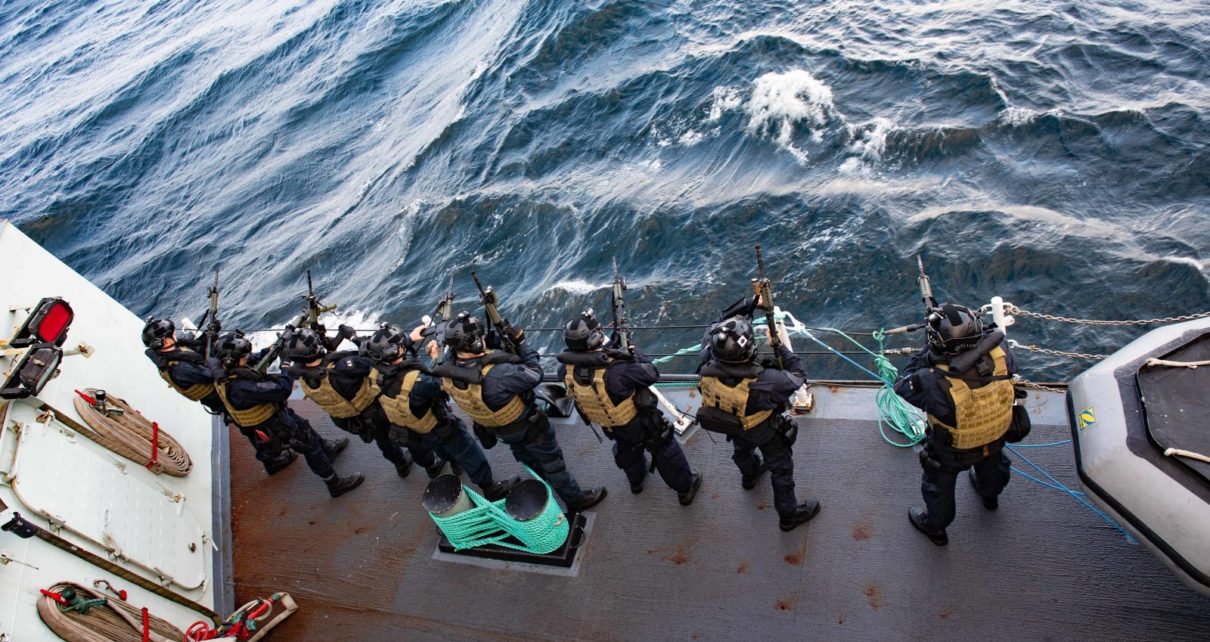
Photo: Members of Canadian Navy securing firearms before beginning training exercises as part of Operation Reassurance, Canada’s overseas naval mission which aids in NATO missions around Central and Eastern Europe, 2021, by Cpl Laura Landry via Combat Camera. Photo courtesy of the Canadian Forces Combat Camera, Department of National Defence.
Disclaimer: Any views or opinions expressed in articles are solely those of the authors and do not necessarily represent the views of the NATO Association of Canada.