*This is the fifth instalment of a six-part series.
From a legal perspective, Canada’s ability to assert its sovereignty and security in the Arctic is hindered by the United Nations Convention on Law of the Sea (UNCLOS) and the Polar Code. Notably, while UNCLOS and the Polar Code respectively attempt to create a “standard framework for international maritime law that would result in a consistent global law of the sea and relatively uniform national maritime laws” and strict guidelines for maritime operations in polar waters, these legal mechanisms also present important ambiguities. Indeed, these legal uncertainties complicate Canada’s position on the global stage, particularly with respect to rights of passage and jurisdiction over the NWP, thereby making it more difficult for Canada to establish clear authority and gain recognition from other international actors. With major geopolitical actors such as China and the United States claiming that Canada does not have jurisdiction over the NWP, Canada faces the very real risk of losing its ability to regulate and control maritime traffic sailing through the heart of Canadian territory.
The United Nations Convention on Law of the Sea (UNCLOS)
Effective as of 1994, UNCLOS has been ratified by 168 states, including all of the Arctic states (Canada, Denmark, Finland, Iceland, Norway, Russia, and Sweden), except the United States. While Washington is a signatory to UNCLOS, it has not ratified it due to concerns over sovereignty, military freedom, economic interests, and domestic political opposition. That being said, the United States follows many of the convention’s principles as part of customary international law. As a legal framework, UNCLOS governs international boundary delimitations, navigation rights, the legal status of archipelagos and transit regimes, EEZs, jurisdiction over the continental shelf, deep-sea mining regulations, resource exploitation frameworks, as well as the safeguarding of ocean ecosystems, conducting of scientific investigations, and systems for settling relevant conflicts. In doing so, UNCLOS has created a widely accepted international maritime legal framework that ensures a coherent global law of the sea and broadly harmonized national maritime regimes.
UNCLOS also describes the legal characteristics of a strait, which is defined as a constricted body of water situated between two landmasses. However, UNCLOS does not specify the minimum or maximum required distance between these two landmasses, thereby leaving ambiguity as to when a waterway should be classified as a strait or is part of a sea or even an ocean. That being said, UNCLOS does specify that straits must be bodies of water “used for international navigation,” but does not specify the required volume of navigation that would make a body of water a strait. It is also silent on whether such navigational traffic needs to be on or below the surface of the water. While these distinctions may seem trivial, they have crucial impacts on Canada’s understanding of the legal status of the NWP. Indeed, the (correct) application of UNCLOS is especially relevant (and problematic) for Canadian sovereignty and security as the Canadian Arctic Archipelago is in fact, many islands through which navigation would be possible in the absence of ice.
Navigational rights in the NWP are further complicated by Article 234 of UNCLOS, which provides states the ability to enact legislation designed to ensure the “prevention, reduction and control of marine pollution from vessels in ice-covered areas within the limits of the exclusive economic zone,” provided that “due regard” is given to navigation. However, UNCLOS does not clearly explain what is considered “due regard” for navigation or how Article 234 would be applied in the context of a melting Arctic, where the “ice-covered areas” are continually shrinking. This lack of clarity has resulted in Arctic states adopting inconsistent and, at times, conflicting regulations on Arctic navigation and environmental protection, such as Canada’s NORDREG and AWPPA. As such, Arctic states such as the United States have objected to Canada’s use of NORDREG and AWPPA as being not aligned with UNCLOS.
UNCLOS also established the Commission on the Limits of the Continental Shelf (CLCS), which is mandated with examining submissions from states to provide recommendations on whether (overlapping) claims meet UNCLOS criteria with respect to the outer limits of their continental shelf past 200 nautical miles. Indeed, Arctic states have already begun this territorial scramble, which has resulted in overlapping claims, notably between Canada and Russia. Not only did Canada submit such a claim to the CLCS for review in 2019, but so did Russia, Denmark, Norway and the United States. According to Canada’s submission, “based on massive amounts of geoscientific data measuring the seafloor, an additional 1.2 million square kilometres could be added to Canada’s land area of 9.98 million square kilometres.”Canada also filed a subsequent addendum in 2022 in response to Russia’s addendum to its own application that “tripled the area that overlaps with Canada’s own continental shelf.” Problematically, CLCS only assesses claims but does not determine ownership, settle disputes, or enforce decisions. Thus, while UNCLOS may be a useful framework for reviewing, evaluating, and recommending new territorial claims, it has not been useful when it comes to deciding, arbitrating, or enforcing those claims. Given the rich natural resources that stand to be exploited in Canada’s Arctic, Canada’s sovereign territory is literally on the line. Thus, any policy solution that aims to strengthen Canada’s sovereignty and security in the Arctic must address these intersecting gaps.
The Polar Code
The purpose of the Polar Code is to “supplement existing [International Marine Organization] instruments in order to increase the safety of ships’ operation and mitigate the impact on the people and environment in the remote, vulnerable, and potentially harsh polar waters.” However, the Polar Code has problematic gaps of its own which contributes to the perception that Canadian Arctic waters, including the NWP, are subject to international governance. Pursuant to the Polar Code, a foreign-flagged vessel may argue that the NWP is an international strait and as long as it follows the Polar Code while transiting the NWP, it is not required to follow AWPPA or NORDREG. By the same token, unless this vessel enters a Canadian Arctic port, Canada would not be able to regulate this vessel.
Embracing its Calling as an Arctic Power
Canada must become the state to which all other Arctic and non-Arctic states look to for guidance and leadership on all Arctic issues, without resorting to direct military confrontation. While this stance may run counter to Canada’s established reputation as a risk-averse, conciliatory middle power, Canada must urgently adopt a significantly more assertive and forward-leaning approach within existing Arctic legal frameworks and governance bodies by vigorously pursuing leadership positions, tabling resolutions, and setting the agenda on key issues that serve Canada’s national interests in the Arctic. Given the rapidly emerging uncertainty and recalibration of U.S. global leadership, Canada must also embrace the responsibility of initiating and leading a coalition of like-minded Arctic and near-Arctic states to adopt and ratify an International Arctic Charter (filtered through a Canadian lens) in order to reinforce global commitments to sustainable development, scientific collaboration, and Arctic security. This charter would also prioritize initiatives that reinforce norms around peaceful cooperation, Indigenous rights, and environmental protection, while also advancing Canada’s economic interests in terms of Arctic shipping routes vis-à-vis the NWP and resource development.
Furthermore, in light of NATO’s persistent lack of a unified Arctic policy, Canada, as the Alliance’s largest Arctic state, must seize this opportunity to position itself as the principal architect of a credible multilateral deterrence policy that ensures collective Arctic security remains a long-term transatlantic priority, rather than deferring to lowest-common-denominator outcomes produced by committee. This framework must expand upon Canada’s existing Arctic collaboration with allies through increased joint military exercises, augmented intelligence-sharing, and harmonized defence strategies that reflect the Canadian Arctic’s unique security environment. Only by taking these courageous steps will Canada be able to mature into its calling as the primary Arctic thought leader. This new obligation would enable Canada to counterbalance revisionist global narratives promoted by Russia and China, while expanding Canada’s strategic influence in the region, thereby strengthening its Arctic sovereignty and security.
However, this new assertive posture must be supported by a sustained, strategic public diplomacy and communications campaign that keeps Canada’s Arctic (and Canada’s role within it) top of mind domestically and internationally. It must underscore Canada’s leadership in Arctic science, Indigenous rights, and climate stewardship so that Canada becomes, more so than ever, equated with the Arctic. Indeed, domestic polls conducted in the last 20 years have shown that only 53% of Canadians know that the natural resources in Canada’s Arctic belong to Canada, while only 30% were able to correctly identify the Arctic Ocean as being Canada’s northern boundary. Thus, there is much work to be done in order for Canada to become a true Arctic power. Unless the Arctic becomes and remains a prominent and resonant issue for Canadians, it will continue to be marginalized in governmental policy and budgeting. Only a strong public narrative will generate the political will required to prioritize Arctic infrastructure, defence investments, sustainable economic development, and governance. In sum, Canada must become the Arctic’s definitive moral and policy leader.
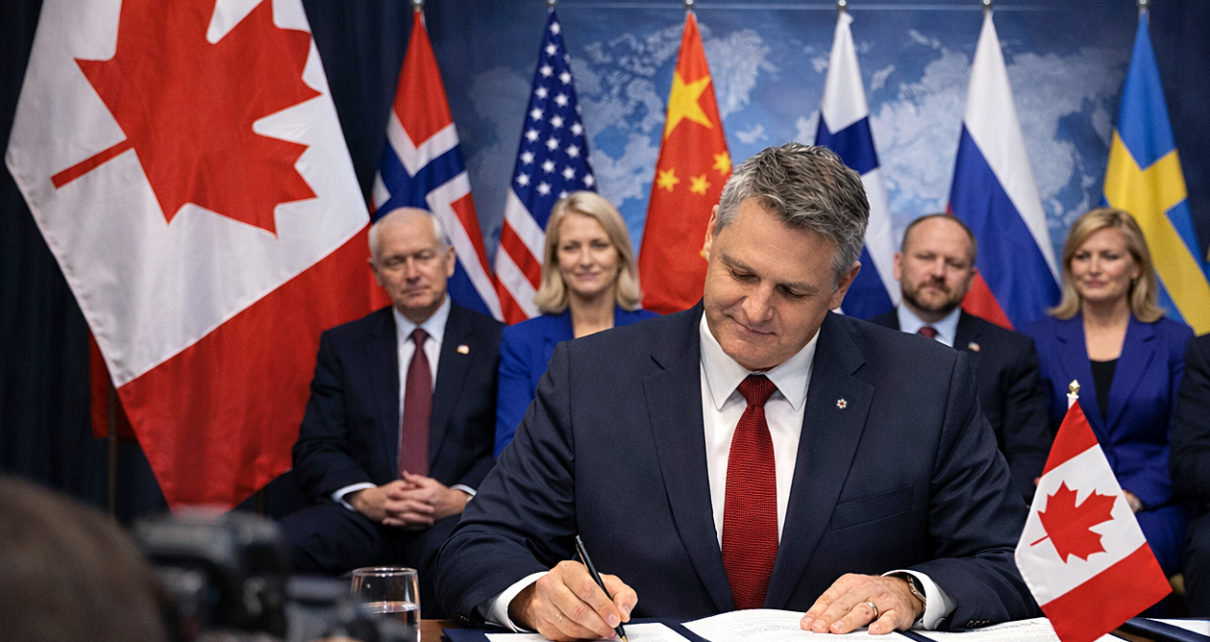
Cover photo: Canada leading the prospective signing of an International Arctic Charter having convened Arctic and near-Arctic states to establish a rules-based governance and security framework for the High North. (Chat GPT)
Disclaimer: Any views or opinions expressed in articles are solely those of the authors and do not necessarily represent the views of the NATO Association of Canada.