The August 2025 meeting between the US and Russian presidents, and subsequent summit with European leaders, including the Ukrainian president, seemed to have created momentum toward an agreement to end the war in Ukraine. But Russia’s following reiteration of its motivation to continue making military progress and Washington’s commitment to help its partner regain lost territory have shattered these hopes. Indeed, it appears that Moscow will double down on its invasion, while Europe, Canada, and the United States continue to support Kyiv’s defence of its territory.
Why is a conclusion to the war not forthcoming, despite years of fighting? In short, the conditions for peace do not exist, as no compromise acceptable to both belligerents can be found. Moscow’s demands to cease its offensive are unacceptable to Kyiv, which does not want to give away territory or abandon security guarantees from the West. Given current conditions, so long as both sides can continue fighting, no agreement is likely.
The ongoing war and the prospect of its resolution are major concerns for Canada, both because of its commitments to its NATO allies but also because of its vested interest in international stability. For Canada’s European partners, the invasion of Ukraine represents a very direct threat to their security, as it raises the prospect that they could be the next targets of Russian aggression. These concerns have been heightened by this September’s Russian drone incursions of NATO airspace in both Poland and Estonia. Further, Russia’s war of aggression goes against international norms which Canada works to uphold, which have ensured that Canada is safe and prosperous. Without these principles guiding international politics, the world could become a much more dangerous and volatile place.
The pursuit of a peace agreement
Since the beginning of the conflict in 2022, many states have sought to facilitate a peace agreement between Ukraine and Russia. The Trump administration has made this issue a foreign policy priority, with the president meeting both his Russian and Ukrainian counterparts. In parallel, US envoy Steve Witkoff has repeatedly convened with President Putin and Russian officials, in an effort to produce a meeting between the Russian and Ukrainian heads of state. In recent months, European states have also involved themselves in the peace process, with the United Kingdom and France spearheading a ‘coalition of the willing,’ a group of states committed to security guarantees for Ukraine after the end of hostilities. But overall, little progress has been made toward an end to the fighting, despite the United States marshalling significant diplomatic resources in its pursuit of peace.
For wars to end, both sides must be willing to negotiate, and a set of terms to which they can both accede must exist. But this is currently not the case in Ukraine. Kyiv’s seemingly continued ability to absorb Russian attacks makes it unwilling to make concessions. Meanwhile, Russia is a much more powerful country and continues to make progress on the battlefield, which makes a continued offensive a seemingly viable means of getting what it wants if it cannot do so at the negotiation table. Indeed, Putin stated in early September that he was willing to continue pursuing Russia’s objectives by military means if a satisfactory agreement could not be reached.
The demands of Ukraine and Russia are incompatible, with little prospect for them to be reconciled. Russia has asked Ukraine to cede parts of Eastern Ukraine, which includes the heavily fortified Ukrainian territory close to the current frontline. Further, Moscow expects Kyiv to give up on NATO membership, reject western peacekeeping forces, and commit to neutrality.
Meanwhile, Ukraine has steadfastly refused to concede any territory to Russia, especially if it is not currently held by Russian forces. Kyiv also refuses to give up on Western security guarantees and its pursuit of membership to NATO, as it believes that these are the best way to ensure its future security. Given that Russia’s and Ukraine’s positions are mutually exclusive, significant change in the situation on the ground would be necessary for the prospect of a peace agreement to emerge.
Implications for Canada
For Canada, ensuring that Russia does not succeed in Ukraine is key to ensuring the security of some of its closest partners. Canada was a founding member of NATO to deter aggression by the Soviet Union and to cement its relationships with European states, which have been some of Ottawa’s closest trading and security partners. These aims still apply today, as Russia’s actions show its ambitions to, at least, change the security landscape of the continent, and, at worst, expand its territory and influence at the expense of its neighbours. Considering how invested NATO has become in the conflict, the defeat of Ukraine could erode the alliance’s credibility, reducing how effectively it can deter Russian aggression. The success of the military alliance is dependent on how well it can convince its adversary that it will be strong and stand united in the event of an attack on its members.
In addition, the war in Ukraine has the potential to set a precedent for the future of international affairs by normalizing unjust wars of conquest. These have become taboo in contemporary foreign policy, which has contributed to the relative peace and stability of recent decades. Supporting Ukraine’s war effort is critical to ensure that the norms of the rules-based international order, which Canada has historically benefited from, prevail into the future.
Consequently, Canada has been one of the biggest suppliers of military aid to Ukraine since the beginning of the conflict. Since 2022, Canada has committed 6.5 billion dollars in the form of ammunition, weapons and vehicles, including the 2 billion dollar commitment made by Prime Minister Carney earlier this year. Under Operation UNIFIER, which is celebrating its 10th anniversary this year, Ottawa’s support has included training for more than 10,000 Ukrainian troops since the start of the war. Through the ‘coalition of the willing,’ Canada has committed military assistance to a post-ceasefire Ukraine. Beyond the conflict, Ottawa has renewed its commitment to European security at the recent NATO Summit as it agreed to move toward spending 5% of the Gross Domestic Product (GDP) on defence and defence-related infrastructure. The Carney government has also announced a significant increase in the pay of Canadian Armed Forces personnel to resolve recruitment and retention issues.
These efforts are Canada’s best option to ensure that Ukraine does not lose against Russia and to promote European security. The high economic and human costs of Moscow’s offensive is the best hope that Kyiv has of obtaining an acceptable resolution to the conflict; if the price of continued military advances is maintained or increased, Russia may eventually conclude that the war is no longer a worthwhile way to achieve its ends. The war is thus a battle of wills and mobilization between Ukraine and its supporters on one side and Russia on the other. The best potential outcome for Kyiv, which Canada should help make reality, is that it can continue resisting until Moscow’s economy and society can no longer sustain its war of aggression.
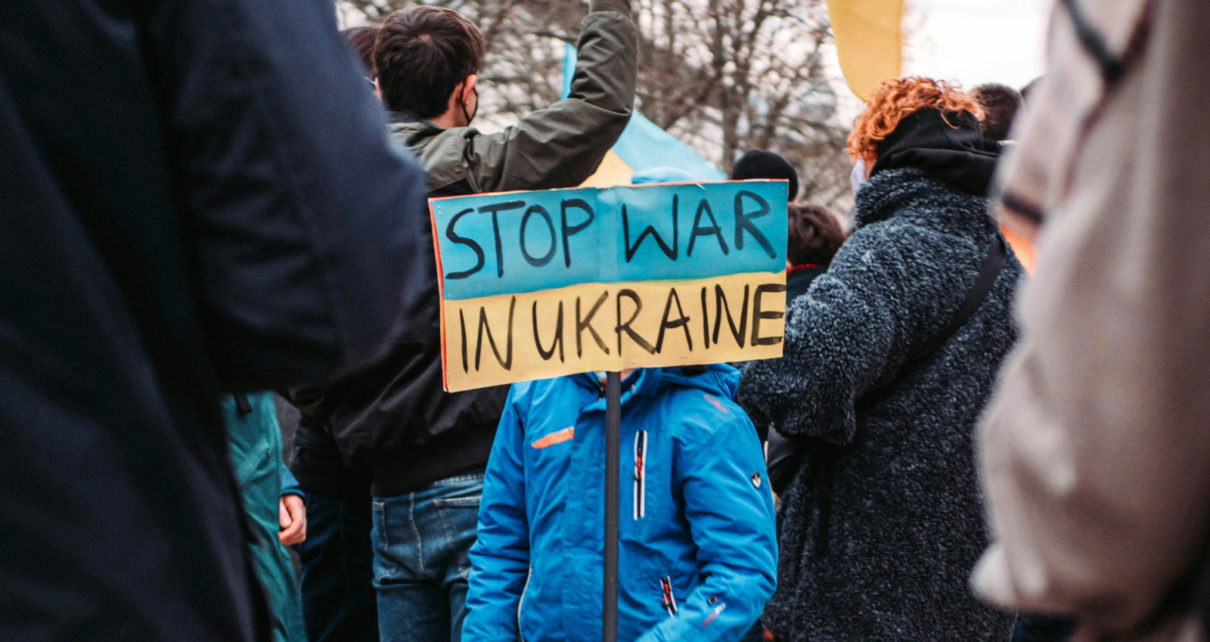
Photo: Photo Credit: Matti Karstedt, A Kid Protesting Against the War in Ukraine, Berlin, Germany. Courtesy of Pexels. Source
Disclaimer: Any views or opinions expressed in articles are solely those of the authors and do not necessarily represent the views of the NATO Association of Canada.