In March 2026, the United Kingdom and Ireland held joint exercises to evaluate how they would respond to disruptions in undersea cables. The practice followed a series of cases in European waters in which cables were broken under unknown circumstances. These events are no longer viewed as accidents. Governments increasingly see them as potential acts of intentional interference. This move demonstrates a more fundamental shift in how infrastructure is understood. More than 95% of worldwide internet traffic is carried by undersea cables. They also facilitate financial transactions worth trillions of dollars per day. These wires are not only technological systems. They are currently involved in global power politics.
Recent incidents show a definite pattern. Since 2022, cables in the Baltic Sea have been repeatedly damaged. In October 2023, the Balticconnector gas pipeline connecting Finland and Estonia was damaged. In December 2025, Finnish officials seized another vessel when a connection between Finland and Estonia was damaged. The ship was suspected of dragging its anchor down the seafloor. In both instances, these incidents fall below the level of open conflict. At the same time, they impose significant economic and political costs.
The Indo-Pacific region now faces similar dangers. In February 2023, Taiwan captured a Chinese-manned vessel suspected of destroying a cable connecting Taiwan to the Matsu Islands. Many residents were unable to communicate because of the destruction. Taiwan had to rely on backup satellite systems for several weeks. In early 2024, numerous Red Sea subsea cables near Yemen were damaged. This occurred amid a period of increased attacks by Houthi forces on commercial ships in the Red Sea, an important route that transmits roughly 17% of worldwide internet traffic. When cables were cut, data had to be redirected via longer routes, increasing delays and hindering digital services.
Private enterprises are already responding to these issues. New cable projects in the Red Sea were delayed in 2024 and 2025 by companies such as Google and Meta as increasing insurance prices and security concerns made them less practical. This shows how security risks influence infrastructure decisions. It also highlights how non-state actors can influence global systems. A few focused attacks can alter the flow of data between continents.
These threats become considerably more acute at key chokepoints. The Strait of Hormuz is one such example. It handles around 20% of worldwide oil commerce. It is also an important route for subsea cables linking Europe and Asia. Tensions between Iran and Western countries have escalated in recent years drastically. There have been numerous incidences of maritime attacks and vessel seizures. If wires in this region are damaged, the impact will be severe. Financial systems rely on fast and consistent data flows. Interruption might hinder transactions, cause communication delays, and generate confusion in global markets.
Control of cable infrastructure is also becoming more contested. China has taken on a larger role in the construction and maintenance of submarine cables. This extension is tied to the Digital Silk Road, which was established in 2015 as part of the Belt and Road Initiative. Chinese enterprises, such as HMN Technologies, have worked on projects across Asia, Africa, and the Pacific. These projects have raised concerns about data security and strategic dependency. In 2020, the United States vetoed the Pacific Light Cable Network proposal. The project would have connected California with Hong Kong. US officials emphasized national security threats associated with Chinese engagement. This move shows that cable projects are now seen from a strategic viewpoint.
India is attempting to establish itself as an alternate hub. In 2023, firms led by Reliance Jio announced the India-Europe Xpress cable project. This project proposes to connect Mumbai straight to Europe via the Middle East. It is intended to increase speed and lessen reliance on older routes. In 2023, India launched deliberations on the Digital India Act. This policy is intended to promote data governance and digital infrastructure. India’s digital economy is expanding rapidly. This rise increases the demand for safe and dependable cable networks. It also opens up new potential for international investment.
Canada is part of this system. Canada’s Indo-Pacific Strategy was launched in November 2022. The policy allocated 2.3 billion dollars to enhance trade, investment, and security partnerships in the region. Digital and infrastructure connectivity is an important aspect of this approach.
At present, these risks are no longer theoretical. The ongoing United States–Iran conflict in 2026 has pushed some of the world’s most critical cable routes into active conflict zones. Since late February 2026, the Strait of Hormuz has seen a near halt in commercial shipping after Iran’s Islamic Revolutionary Guard Corps warned vessels against transit and carried out drone and missile strikes in the region. At the same time, Houthi forces in the Red Sea have resumed attacks on maritime traffic, effectively placing two of the most important digital chokepoints under simultaneous stress. These corridors are not just energy routes. Around 17 major undersea cables pass through the Red Sea alone, carrying most of the data traffic between Europe, Asia, and Africa, while additional cables run through the Strait of Hormuz connecting Gulf economies to global networks.
Military activity, sea mines, and drone strikes increase the risk of accidental cable cuts, and repair ships are often unable to safely access damaged areas. This has already begun to affect infrastructure planning. In March 2026, work on major cable projects in the Persian Gulf, including extensions of Meta-backed networks linking India, the Gulf, and Europe, was suspended because operators could not safely function in the region.
These changes leave a gap in NATO’s policy. The alliance has mostly focused on traditional military domains. It has also invested in cyber defence. However, the physical infrastructure that enables digital communication has received less attention. In 2023, NATO established the Critical Undersea Infrastructure Coordination Cell. This was a step towards improved monitoring and protection. NATO has also strengthened its patrols in areas such as the Baltic Sea. These activities reveal rising awareness. However, they remain limited in comparison to the scope of the problem.
Some governments have already taken steps to mitigate risk. Japan has invested in several cable lines and landing stations, decreasing its reliance on any one route. Australia has financed the Coral Sea Cable System. Finished in 2019, it connects Australia with Papua New Guinea and the Solomon Islands while reducing cable vulnerability. The European Union has likewise taken this approach. In 2023, it proposed the Secure Connectivity Programme to upgrade digital infrastructure and increase resilience.
These cases provide clear lessons. Diversification lowers risk. Variety increases resilience. Public investment can help to shape a secure infrastructure. Canada can use these lessons in its Indo-Pacific policy. It may invest in new cable lines that avoid high-risk areas like the Red Sea and the Strait of Hormuz. It can collaborate with partners such as India, Japan, and Australia to establish reliable networks. It can also use its financial power to encourage improved security standards in infrastructure projects. For Canada, the stakes are rising as its economic ties to the Indo-Pacific strengthen after Prime Minister Carney’s diversification of partners. Protecting subsea infrastructure will require collaboration, investment, and long-term planning. What lies under the ocean floor now influences what occurs above it.
Disclaimer: Any views or opinions expressed in articles are solely those of the authors and do not necessarily represent the views of the NATO Association of Canada.
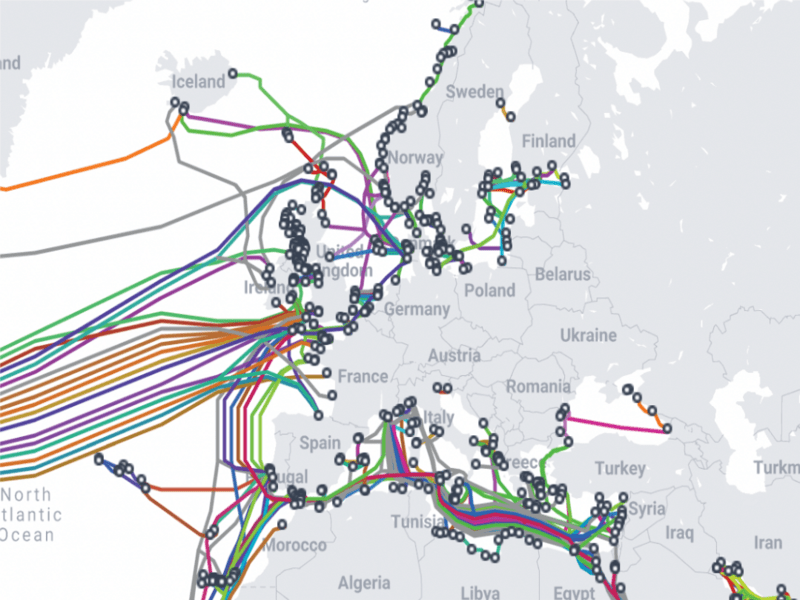
Image Credit: TeleGeography, Existing and Planned Submarine Cables Connected to Europe October 2022. Accessed via Wikipedia Commons