The maritime domain remains a fundamental element of NATO’s collective defence, economic resilience, and strategic mobility. While secure maritime transportation is essential to Allied economies through the movement of essential goods and resources, NATO also relies on a secure maritime environment to support military deployments and protect critical infrastructure. Maritime navigation is also becoming increasingly automated, shifting NATO’s strategic calculus. This automation involves functions traditionally performed by onboard crews, including navigation, vessel operations, and decision-making, either autonomously or remotely from shore. The emergence of Maritime Autonomous Surface Ships (MASS) presents both opportunities and challenges for the Alliance. The International Maritime Organization (IMO) adopted the MASS Code in May 2026, which entered into effect on July 1, representing an important step towards the international regulation and deployment of autonomous vessels.
Autonomous vessels can strengthen Allied maritime security through maritime domain awareness, persistent surveillance, and critical infrastructure protection, but their reliance on interconnected digital networks presents cyber-physical vulnerabilities. NATO should adapt its existing maritime security strategy to ensure autonomous shipping becomes a force multiplier rather than a new vulnerability.
NATO & The Maritime Domain
NATO’s maritime security strategy is essential to maintaining the Alliance’s collective defence and economic resilience, recognizing the maritime domain as one of NATO’s five operational domains and underscoring its strategic and tactical importance to Allied defence, security, and global commerce. As maritime shipping carries more than 90 percent of global trade in manufactured goods and raw materials, including more than half of the world’s oil, secure maritime routes are essential to Allied economies. Thus, NATO is committed to strengthening its maritime posture and situational awareness to defend against threats across the maritime domain. Actions taken include securing trade routes and military reinforcements, protecting the Alliance’s main lines of communication and supply routes, and safeguarding maritime chokepoints. During conflict, NATO must also preserve freedom of navigation along critical transatlantic routes while supporting its three core tasks of deterrence and defence, crisis prevention and management, and cooperative security.
To achieve these objectives, the Alliance’s naval forces rely on maritime platforms, sensors, and other capabilities that support three functions: strategic presence and deterrence, maintaining a safe and secure maritime environment, and warfighting. These capabilities allow NATO to transition from lower-intensity maritime operations to high-intensity missions during conflict, including sea denial, sea control and support for Allied reinforcements. This responsibility extends across the North Atlantic, Baltic, Mediterranean, and Arctic to protect critical infrastructure, including undersea cables, pipelines, navigation routes, and ports. As these maritime networks become increasingly digitized and interconnected, NATO must also account for the growing automation of commercial and military shipping.
The Rise of Autonomous Shipping
Maritime Autonomous Surface Ships (MASS) represent a growing shift in how vessels navigate and operate with reduced human intervention. Rather than referring exclusively to fully autonomous robot ships, MASS encompasses vessels capable of performing navigational and operational functions with varying degrees of human involvement but are not granted privileges over conventional vessels or classified as unmanned ships.
The IMO identifies four degrees of autonomy, ranging from ships with automated processes and decision-support systems to remotely controlled vessels, with or without seafarers on board, and ultimately to fully autonomous ships capable of making decisions and determining actions independently. This progression demonstrates that maritime autonomy is not bound to a single technology but spans a spectrum of capabilities that reduce the need for direct human involvement.
International regulatory development reflects the growing importance of regulating and implementing this technology. In May 2026, the IMO adopted the non-binding MASS Code, which has been in effect since July 1, establishing an international framework for safe operation of autonomous vessels. Although fully integrated autonomous commercial shipping remains a bleeding-edge capability, automation is already reshaping how vessels are operated and monitored.
Integrating Autonomous Vessels into NATO Defence
Autonomous vessels could provide NATO with new capabilities that complement, rather than replace, conventional naval forces. One key contribution is persistent maritime surveillance. Autonomous vessels could remain at sea for extended periods while monitoring areas of strategic importance, reducing the need for regular crew rotations and the resources required to maintain a continuous human presence. This could strengthen NATO’s maritime domain awareness by continuously collecting information on vessel movements, environmental conditions, and potential security threats, relaying information back into the Alliance’s naval data.
Autonomous vessels could also support monitoring of critical maritime infrastructure such as undersea cables, pipelines, ports, and major shipping routes. Their ability to operate in potentially contested environments could also reduce risks posed to personnel while allowing NATO to maintain a persistent presence near strategic infrastructure. Deployed alongside conventional naval forces, autonomous vessels could extend the geographic reach of Allied naval capabilities without requiring a proportional increase in manned assets. This is particularly relevant in the Canadian Arctic, where the government is exploring autonomous maritime systems to address the region’s vast distances, limited infrastructure and increasing maritime activity, which can make persistent monitoring difficult.
NATO’s Digital Ocean Vision provides an existing framework through which these capabilities could be integrated. Information from sensors, satellites, and existing naval platforms strengthens Digital Ocean’s situational awareness for naval forces. Integrating autonomous vessels into this framework could allow NATO to use them as a force multiplier for surveillance and infrastructure security while enabling conventional naval forces to focus on higher-risk, higher-intensity operations.
Cyber-Physical Vulnerabilities
While autonomous shipping integration could strengthen NATO’s maritime prowess, it could also create new cyber-physical vulnerabilities. Autonomous vessels depend on an interconnected chain of sensors, navigational GPS and data, communication networks, operational software, port systems, and remote-controlled infrastructure. Each component contributes to a vessel’s ability to navigate and operate safely, forming a digital “kill chain” through which information is collected, processed, and used to support operational decisions. If an adversary compromises part of this chain, it could undermine the systems required for subsequent navigational and operational decisions. Unlike conventional cyberattacks that disrupt digital networks or steal information, attacks against autonomous vessels could produce direct physical consequences in the maritime domain.
Adversaries could exploit these systems through several methods. Navigational spoofing or GPS interference could provide a vessel with inaccurate positioning information, potentially redirecting it from the intended route. Jamming could disrupt communications between vessels and remote operations, compromising sensors by providing false information about available ports, stunting Allied economies by withholding resource shipments. The 2017 NotPetya cyberattack against Maersk, an international shipping and logistics company, demonstrates these vulnerabilities. The attack shut down Maersk’s IT systems, disrupting port operations across its network, illustrating how a cyberattack against interconnected shipping infrastructure can disrupt maritime operations without directly compromising a vessel.
As autonomous shipping becomes increasingly interconnected, cybersecurity must therefore be considered an essential component of NATO’s maritime security. The IMO’s MASS Code demonstrates that autonomous shipping is moving from technological development toward practical international implementation. NATO should strengthen the cyber resilience of autonomous vessels and integrate them into existing maritime frameworks such as the Digital Ocean. By adapting its maritime strategy now, NATO can ensure autonomous shipping becomes a force multiplier for Allied security rather than a vulnerability for adversaries to exploit.
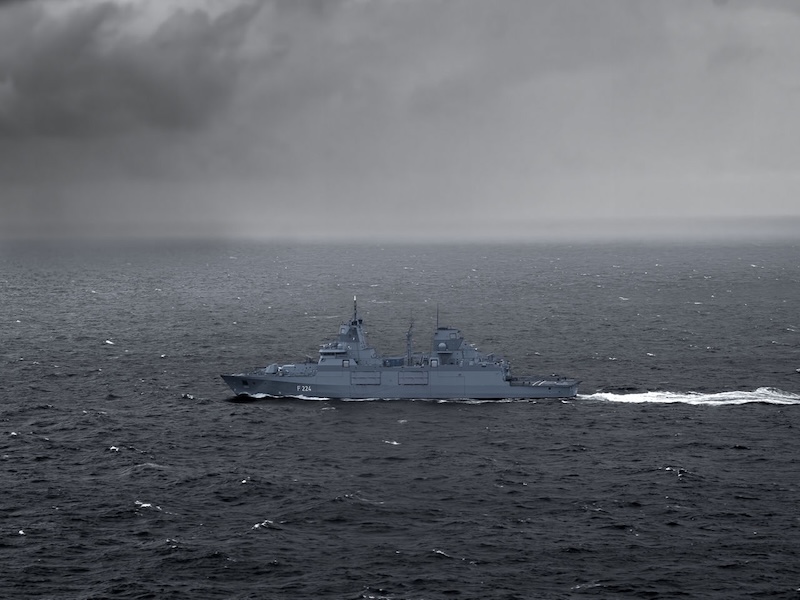
Image Credit: The German Navy Frigate FGS Sachsen-Anhalt sails through stormy waters during exercise BALTOPS. NATO Allies conducted BALTOPS 2026 in the Baltic Sea, training maritime forces to deter threats, protect sea lines of communication and safeguard critical undersea infrastructure on June 1, 2026, by NATO via Source. Photo courtesy of NATO.
Disclaimer: Any views or opinions expressed in articles are solely those of the authors and do not necessarily represent the views of the NATO Association of Canada.