Canada’s Arctic security debate mostly focuses on the visible signs of geopolitical change. While Russian military activity, Chinese interest in polar routes, and NORAD modernization dominate the debate, one serious threat is occurring under Canadians’ feet. As permafrost thaws, the physical ground supporting Arctic infrastructure is becoming less stable. This is not only an environmental or engineering issue, but a question of preparedness for defending the Arctic region.
Canada’s personal Arctic Foreign Policy recognizes that security in the North cannot be understood only in military terms. Canada’s Arctic Foreign Policy recognizes that northern security extends beyond conventional military threats and includes the protection of critical infrastructure. This broader understanding of security is essential because Arctic defence depends not only on ships, aircraft, and radar systems, but also on the infrastructure that allows Canada to operate in the region at all.
What Is Permafrost And Why Does It Matter
Permafrost is ground that remains at or below 0°C for at least two consecutive years. In northern Canada, it underlies many communities, roads, airports, military facilities, radar sites, fuel systems, and communications networks. When permafrost thaws, ice-rich ground can subside, shift, crack, or erode. The Government of the Northwest Territories notes that many of its communities and linear infrastructure are built over ice-rich permafrost, and that thaw can damage buildings, roads, and other facilities while increasing maintenance and mitigation costs.
This is important for defence because Canada’s ability to assert sovereignty in the Arctic depends on accessibility and responsiveness. Canada cannot effectively defend or survey its territory if their military cannot operate safely. This includes aircraft being able to land on runways, vehicles travelling on stable roads, dependable fuel systems, or workable radar sites. Permafrost thaw is therefore a disruption to the literal foundation of Arctic security.
This is highlighted in the western Arctic where the Inuvik–Tuktoyaktuk Highway is built on discontinuous and continuous permafrost with abundant ground ice. The 138 kilometer all-weather road that connects Inuvik to Tuktoyaktuk is breaking due to the unstable conditions permafrost creates. A 2024 study in Communications Earth & Environment found that the Inuvik–Tuktoyaktuk Highway and the Dempster Highway corridor face permafrost related threats, including settlements, embankment instability, and thaw slumps. The study also found that the Mackenzie Delta region, which includes the two highways, shows high threat levels to thawing compared with other northern transportation case studies.
Specific Defence Areas at Risk
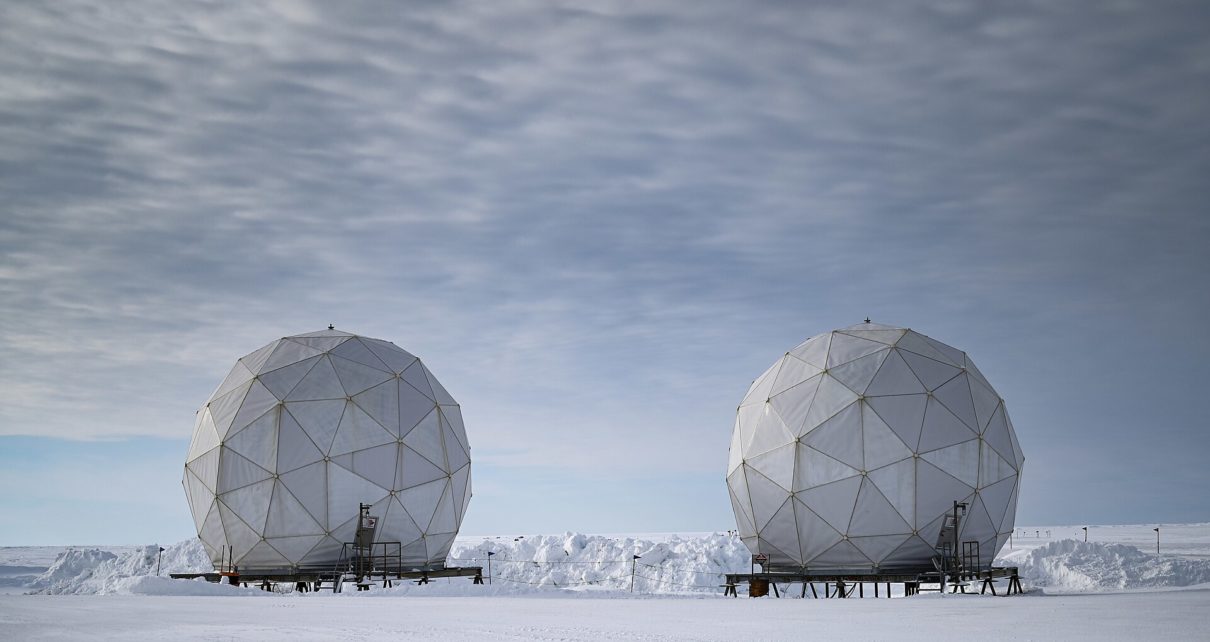
Inuvik is a strategically important area as it is connected to the Dempster Highway system. It lies in the Beaufort Sea region, and hosts a NORAD Forward Operating Location. As one of several NORAD sites (other locations include Yellowknife, Iqaluit, and Goose Bay), the area has recently been identified as a modernization site to help improve regional infrastructure. These upgrades are meant to support stronger Canadian Armed Forces and NORAD operations in the North.
The region also shows how civilian and defence infrastructure overlap. NAADSN’s 2024 Canadian Arctic Climate Change and Security Impact Assessment notes that the Government of Northwest Territories is spending $22 million to protect Inuvik Airport from climate change impacts and reduce ground settlements from permafrost thaw that have already occurred. Since airports in the North are essential for civilian travel, emergency response, and military access, damage to airport infrastructure is a direct defence-readiness concern.
Another key area is Iqaluit, Nunavut. Iqaluit is not only Nunavut’s capital, but also one of Canada’s most important eastern Arctic air hubs. National Defence lists Iqaluit as one of the Forward Operating Locations that can accommodate fighter aircraft and other assets supporting NORAD operational requirements on a temporary basis. NAADSN also notes that Iqaluit International Airport recently underwent $300 million in improvements, including extensive runway repairs after cracking and warping linked to permafrost thaw. This example shows how climate change can affect the infrastructure Canada depends on for Arctic mobility and emergency response.
Other areas such as Yellowknife, Resolute Bay, Nanisivik, and the Canadian Forces Station Alert are also relevant as they host military personnel year round. These sites show that Canada’s Arctic military presence is geographically broad but still modest, making reliable supporting infrastructure even more important.
Why Infrastructure Is Readiness
Permafrost affects defence in three main ways: mobility, surveillance, and logistics.
First, it threatens mobility. Roads, runways, and airstrips are essential in a region where distances are vast and transportation options are limited. If a runway becomes unstable, aircrafts might not be able to access remote areas. Likewise, if roads weaken and become unusable, key resources such as fuel, equipment, and personnel become difficult. Disruptions in access systems would be especially serious during a crisis, when response time and reliability are critical.
Secondly, it threatens surveillance and early warning. Canada’s northern defence depends on detecting threats and maintaining awareness across large areas. Radar sites, sensors, communications systems, and support buildings all require stable foundations and reliable maintenance access. The modernization of surveillance technology is important, yet how will advanced systems be successful if the land it is built on is unstable and unreliable. Climate-related damages would prove costly and inefficient distribution of resources. NATO’s 2024 Climate Change and Security Impact Assessment includes the North Warning System as a case study, showing that climate risks are already being applied to North American infrastructure.
Thirdly, permafrost thaw creates a logistical nightmare. Arctic operations depend heavily on fuel storage, supply chains, maintenance facilities, and communications systems in remote locations. Climate-related damages can raise maintenance costs and shorten the lifespan of facilities. It simply isn’t sustainable to maintain degradation from permafrost thaw and coastal erosion, as highlighted in the U.S. Department of Defense’s 2024 Arctic Strategy. This is relevant in a Canadian context, as the North American Arctic shares similar challenges to Alaska.
What Canada Should Do?
Canada should include permafrost resilience as a core part of Arctic defence planning. Although ships, aircraft, submarines, and radar systems matter, a nation cannot rely on these assets when the infrastructure they are built on is not stable. Being proactive allows Canada to be prepared for future climate changes, which can be completed through extensive climate-risk assessments. As well, Canada should more closely monitor runways, roads, fuel pipelines, foundations, and coastal access points in permafrost regions. Canada should also prioritize dual use infrastructure as investments in northern infrastructure, such as airports, ports, and roads, can support both community resilience and defence readiness. This does require close cooperation with territorial governance, as well as Indigenous governments and municipalities.
Canada should also highlight and discuss permafrost resilience in NATO’s climate security agenda. NATO recognizes climate change as a major security issue and Canada can contribute to the conversation with their future development in Arctic adaptation.
In conclusion, permafrost is an issue that quietly threatens Arctic infrastructure. Investing in and focusing on combating this threat will ease future military development and allow for confidence to develop on lands in the North. Arctic sovereignty depends on infrastructure that works. Canada lacks the ability to consistently operate if the systems supporting those missions are built for a climate that no longer exists. Thus, implementing northern infrastructure should be recognized as a national security priority, not an environmental issue. Deterrence in the Arctic begins not only with what Canada can deploy, but with what can endure.