Twenty years ago, on September 17, 2006, Operation Medusa came to an end in southern Afghanistan.
By then, what Canadian commanders had expected to be a counterinsurgency mission had evolved into something far more dangerous. Taliban fighters were amassing west of Kandahar, NATO was entering its first major ground battle after invoking Article 5 for the first time in its history following the September 11 attacks, and Canadian soldiers were facing an enemy operating in numbers and formations few had anticipated. Over two weeks, more than 1,000 Canadians fought alongside Afghan, American, British, Dutch and other allied forces in Canada’s largest combat operation since the Korean War.
Exactly twenty years later, several people who lived through those weeks gathered again, this time at Ottawa’s Rideau Club.
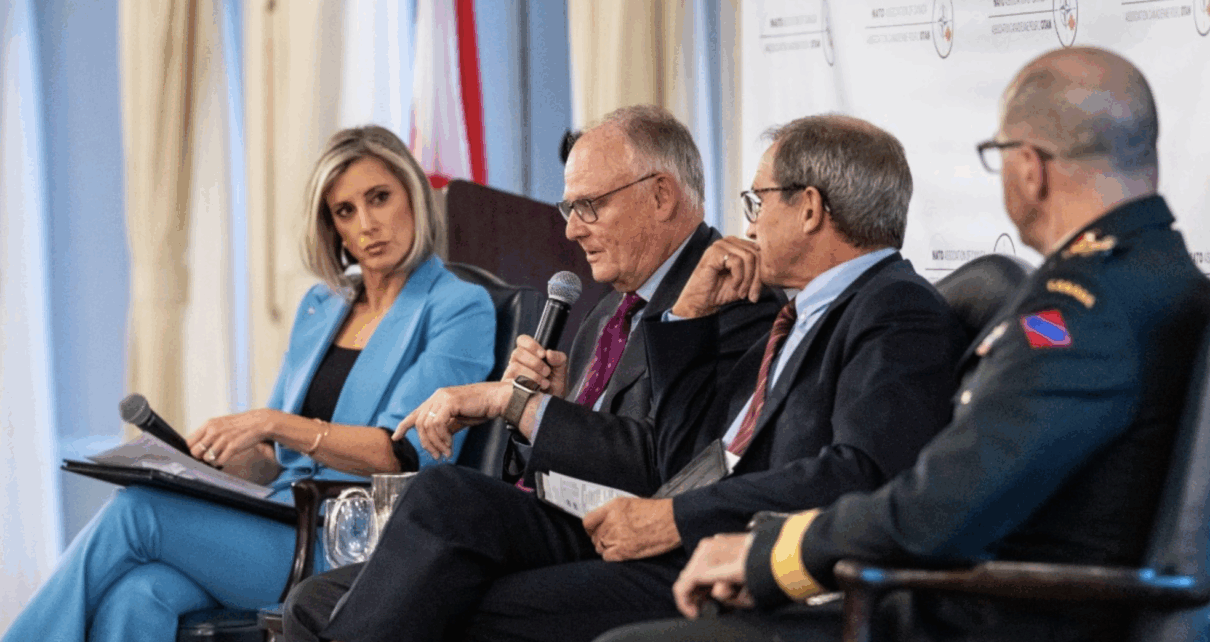
On September 17, 2026, the NATO Association of Canada brought together veterans, serving members of the Canadian Armed Forces, representatives from the defence industry and members of the business community to mark the anniversary. The evening commemorated the bravery and resilience of those who fought and sacrificed, while also examining what Canada learned from Medusa and why those lessons remain relevant today.
CTV News journalist Marcia MacMillan moderated a panel featuring LGen Michael Wright, Commander of the Canadian Army, who served as an infantry company commander in Afghanistan in 2006; MGen (Ret’d) David Fraser, who commanded NATO forces in southern Afghanistan and led Operation Medusa; and LGen (Ret’d) Michel Gauthier, who oversaw Canada’s overseas military operations from Ottawa.
When LGen Wright arrived in Afghanistan in August 2006, the security environment was already changing rapidly. Taliban forces increasingly contested movement around Kandahar, launched frequent ambushes and gathered in numbers Canadian commanders had not expected. On August 19, LGen Wright and roughly 40 soldiers fought an estimated 200 to 400 Taliban fighters for several hours near the Panjwayi District Centre.
For commanders at headquarters, those numbers fundamentally changed their understanding of what was developing. MGen (Ret’d) Fraser recalled reports arriving in succession: 100 fighters, then 200, then 300. Intelligence eventually indicated that hundreds of fighters, including senior Taliban commanders, had concentrated in the area.
“We went over to fight an insurgency,” MGen (Ret’d) Fraser recalled. “It wasn’t the battle that we prepared for, nor the battle we wanted. But it was the battle that we had to fight.”
The Taliban had prepared defensive positions west of Kandahar just as NATO was assuming responsibility for southern Afghanistan, with Canada taking a leading role. The stakes therefore extended well beyond the battle itself, testing the alliance under the pressure of sustained combat and placing Canada’s ability to organize and lead a multinational response firmly in the spotlight.
For MGen (Ret’d) Fraser, that meant assembling a coalition capable not only of responding, but of holding together against the enemy. NATO members operated under different national restrictions and political constraints, complicating access to the troops and capabilities required by the mission. While Canadian soldiers on the ground worked to buy time, Fraser was simultaneously negotiating across the Alliance for the aircraft, personnel and support needed to mount a coordinated response.
That experience shaped one of the strongest themes of the evening: alliances depend on relationships, mutual understanding and trust.
Operation Medusa repeatedly strained those relationships. On September 3, combat claimed the lives of four Canadian soldiers, and the following day, an American A-10 mistakenly fired on Canadian troops, killing Olympian Private Mark Graham.
“The plan died that day,” MGen (Ret’d) Fraser told the audience. “The mission didn’t.”
Commanders changed the direction of the advance, engineers constructed Route Summit toward Taliban positions, and soldiers adapted equipment and reassigned personnel to compensate for capabilities they did not have. As MGen (Ret’d) Fraser recalled, “We didn’t have armoured engineers. We made them. We didn’t have bridges. We built them.”
For MGen (Ret’d) Fraser, Medusa demonstrated the importance of keeping plans flexible enough to respond to reality. Leadership meant recognizing when circumstances had changed, adapting quickly and maintaining focus on the objective even when the original route toward it no longer worked.
LGen Wright connected that lesson directly to readiness today, stating that, “It is always better to train for the worst case and then be able to ratchet back.”
For LGen Wright, Canada must prepare its soldiers for demanding environments that may fall outside current assumptions. Medusa showed how quickly the character of a mission can change and why readiness, equipment and training have to be in place before a crisis exposes what is lacking.
From Ottawa, LGen (Ret’d) Gauthier was confronting the same uncertainty from another level of command. He had to connect what MGen (Ret’d) Fraser needed in Afghanistan with Canada’s military and political leadership. At the same time, the country was managing other overseas missions, including the evacuation of more than 15,000 Canadians from Lebanon after fighting broke out between Israel and Hezbollah that summer. Information from Afghanistan could be outdated almost as soon as it was briefed, reinforcing the need to give commanders closest to the problem enough latitude to respond.
When asked what he would change with hindsight, MGen (Ret’d) Fraser did not point to a weapon or tactic, but instead said that he would have spent more time building relationships beforehand. Where commanders did not understand one another, they lost time arguing over intent and expectations, and in a crisis, that delay can be extremely consequential.
The panel repeatedly returned to that human dimension as it considered how much warfare has changed since 2006. Artificial intelligence, autonomous systems, drones, cyber operations and the information environment are transforming military operations, but MGen (Ret’d) Fraser argued that the pressures placed on leaders remain familiar.
“Technology changes and the character of the battlefield does, but the demands on the human and on command and on leadership has not changed.”
LGen Wright extended that discussion to misinformation and disinformation, which he described as increasingly serious threats to the cohesion of democratic societies and alliances. Canada, he argued, has to be candid with citizens about the threats it faces, why military capabilities are necessary and what it expects its Armed Forces to do.
That question of leadership also connected Medusa directly to Canada’s position today. In 2006, Canada demonstrated that it could lead a coalition under extraordinarily difficult conditions. Maintaining that capacity today requires the same willingness to invest in readiness, relationships and the institutions that allow Canada to contribute meaningfully alongside its allies.
Michael E. Bonner, Head of Canadian Personal and Business Banking at BMO Financial Group, carried those lessons into a broader discussion of national resilience. In his opening remarks, he described Medusa as a reminder of Canada’s capacity for leadership and identified readiness, adaptability, partnership and people as its enduring lessons.
“Building a strong defence ecosystem will require all of us,” Bonner said, arguing that the government, the military, industry, academia and finance have to work together to turn Canadian innovation into Canadian capability.
Our conversation after the panel returned to the role of private enterprise. Capital, infrastructure, technology, supply chains and specialized expertise increasingly shape a country’s ability to protect its sovereignty and respond to instability. Bonner described defence spending as a “nation-building investment,” connecting military readiness with economic resilience and Canada’s ability to make sovereign decisions.
Bonner also stressed the importance of knowing who Canada’s allies are and why those relationships matter. As misinformation and disinformation increasingly shape public debate, maintaining a clear understanding of Canada’s partnerships, how they were built and what they have delivered is essential.
Twenty years after Medusa, that may be one of the operation’s most enduring lessons. The Operation did not unfold according to plan: intelligence changed, coalition politics complicated decisions, equipment was improvised, soldiers were exhausted and the enemy continuously adapted. But so did Canada. Canada succeeded because it had people willing to adapt, willing to persevere and willing to build relationships with allies that extended beyond the limits of the battlefield they had prepared for.
Remembering Operation Medusa, then, is our duty to honour the story of what Canadians did in Afghanistan, andto preserve the lessons Canada may one day need again.
Disclaimer: Any views or opinions expressed in articles are solely those of the authors and do not necessarily represent the views of the NATO Association of Canada.
Photo: LinkedIn, NATO Association of Canada