Introduction
As diplomatic negotiations between the United States and Russia continue in Moscow, Canada reinforced NATO’s dual strategy of simultaneous diplomacy and deterrence with a $200 million contribution to purchase American weapons for Ukraine through NATO’s coordinated procurement program. The announcement, made at the NATO foreign ministers meeting in Brussels on December 3, follows a strategic calculation by Western powers that Ukraine’s negotiating position depends directly on its battlefield strength, and continued deterrence through arms transfer is necessary for security.
Financial commitment
In July 2025, NATO introduced the Prioritized Ukraine Requirements List (PURL) following a meeting between NATO Secretary General Mark Rutte and US President Donald Trump. This program, meant to divide the financial burden of equipping Ukraine across NATO countries, facilitates arms transfers from the US to Ukraine that are purchased by other NATO members. Under this framework, Ukraine will compile request packages for weapons and equipment, then NATO allies will determine which country will fund them. As of August, eight countries had participated: Belgium, Canada, Denmark, Germany, Latvia, the Netherlands, Norway, and Sweden, totaling €1.9 billion in aid.
Most recently, Canada joined other NATO countries to purchase $500 USD million worth of military equipment through PURL, committing around $200 CAD million. This is the second round of Canada’s contributions to PURL, having set aside approximately $680 CAD million in August. In total, Canada has collectively committed over $22 billion since 2022, with $12.4 billion in direct financial support. Funding is allocated to military assistance, humanitarian aid, and critical infrastructure, among others. This is the largest per capita financial contribution among G7 countries.
Domestic Implications
As the war drags on and financial contributions accumulate, the guns versus butter question resurfaces, or, alternatively phrased, the trade-off between military expenditure (including foreign aid) and domestic spending on programs such as healthcare and education. With growing domestic problems such as rising living costs, a 2024 report by the Angus Reid Institute found that Canadians have shifted their priorities; the percentage of Canadians who believe that they are doing “too much” for Ukraine has doubled since 2022, and support for Ukraine aid has declined across all voters and parties.

Since the Russian invasion of Ukraine in 2022, Canada, driven both by a desire to maintain the international rules-based order and its large Ukrainian diaspora population, has pledged support for Ukraine, both materially and symbolically. Canada, for example, was the first Western country to recognize Ukraine’s sovereignty back in 1991. Given its historical and current support through PURL, it is unlikely that Canada will restrict its financial contributions in the near future, although this may mean that some domestic programs must be traded off.
Geopolitical Implications
Notably, US Secretary of State Mark Rubio was absent during the meeting in Brussels, instead choosing to send a deputy — an act that reinforced concerns that European allies are being sidelined from President Donald Trump’s direct engagement with Russia on Ukraine peace negotiations. Since January 2025, the United States has slashed foreign aid as part of its “America First” policies, and continuously demanded that other allies pull greater weight in NATO, choosing to reel in its former large military contributions. In the context of this tense geopolitical scene, Canada has chosen to further its pivot toward its European allies, seen through both the $200 million PURL contribution and Canada’s recent agreement to join the EU’s SAFE (Supplying Arms for Europe) joint procurement program. The SAFE initiative, designed to streamline weapons acquisition across European nations, marks the first time a non-EU member has been integrated into such a framework, showcasing a significant deepening of Canada-EU defence cooperation.
For European allies, Canada’s increased engagement provides valuable reinforcement. A middle power with significant resources, proven military capabilities, and strong democratic credentials, Canada offers European nations an additional anchor point for transatlantic cooperation beyond the traditional US pillar.
Next Steps
Canada should take advantage of this strategic situation, but also must recognize its position in an increasingly multipolar world. Thus far, Canada has chosen to follow its European allies’ lead in isolation and deterrence, strongly condemning Russia’s behaviour and suspending bilateral cooperation with Russia. Canada has imposed sanctions, cut trade relations, and furthered military aid to Ukraine. Pragmatically speaking, however, Russia remains a nuclear power and an Arctic neighbour; attempting to isolate such a large stakeholder might increase aggression and volatility in the Arctic, thereby eliminating opportunities for bilateral cooperation.
Instead, Canada should adopt a strategy of selective engagement: balancing solidarity with Ukraine while preparing for long-term coexistence with Russia. This includes reestablishing crisis communication channels, rebuilding analytical capacity to prevent miscalculations, and pursuing narrowly focused cooperation in areas such as Arctic search and rescue or environmental monitoring. Such engagement does not condone Russia’s aggression but recognizes that excluding major powers can undermine global governance and result in further hostilities.Historically, Canada’s effectiveness in diplomacy has stemmed from a combination of deterrence with dialogue. During the Cold War, for example, Canada maintained engagement with the Soviet Union — pursuing arms-control talks and admitting Soviet students into Canadian universities — while simultaneously condemning Soviet behaviour. Canada understood that excluding adversaries from global governance was not an option, and now, Canada must return to these same diplomatic roots to best prepare for the realities of a multipolar global order.
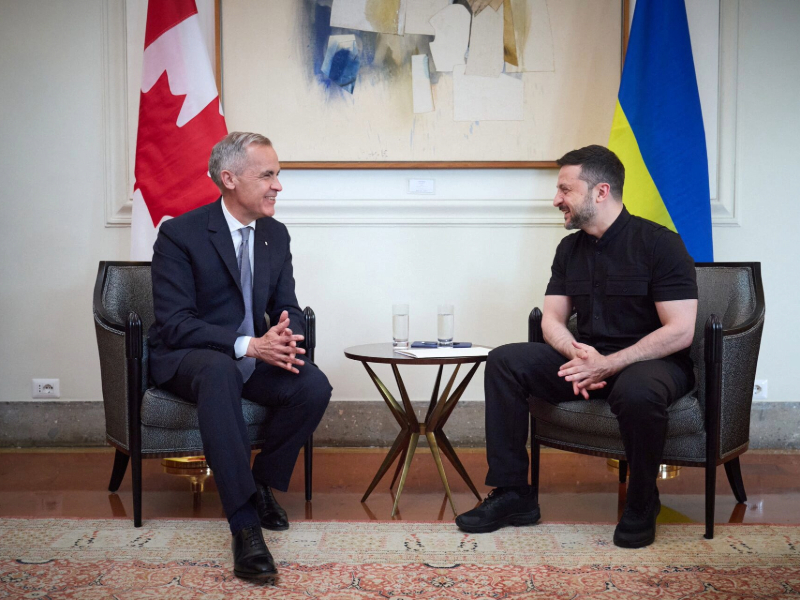
Photo: Ukrainian President Volodymyr Zelenskiy and Canadian Prime Minister Mark Carney attend a bilateral meeting in Rome, Italy, 17 May 2025. Source: Ukrainian Presidential Press Service / Handout via REUTERS.
Disclaimer: Any views or opinions expressed in articles are solely those of the authors and do not necessarily represent the views of the NATO Association of Canada.