Charles de Gaulle, the father of the French Fifth Republic and French nuclear policy, once proclaimed that “no country without an atom bomb could properly consider itself independent.” Consequently, France is the only European NATO ally with a domestically developed nuclear arsenal. Said arsenal has enabled French leaders to pursue a degree of strategic differentiation within NATO, where France remains outside NATO structures like the Nuclear Planning Group. French policymakers have long spoken of “deterrence of the strong by the weak” as the goal of the French nuclear programme, grounded in the belief that France’s arsenal would be sufficient as long as it could “[tear] off the arm of an aggressor” to guarantee the protection of French vital interests. With an increasingly unstable security environment in Europe, however, French nuclear doctrine has had to adapt.
A Primer on French Nuclear Capacity
From its inception, the French nuclear arsenal – also known as the force de frappe – was intended to enhance France’s military independence of action. French nuclear doctrine has traditionally emphasized unilateral decision-making and rejected any form of multilateral control or consultation over the use of its nuclear weapons. As a nuclear pioneer and the staunchest defender of civilian nuclear energy in Europe, France has the military-industrial capacity to produce all components of its nuclear arsenal domestically, from generations of nuclear-powered aircraft carriers to the Triomphant-class strategic nuclear-powered submarines, and Rafale fighters which carry its nuclear warheads. French leaders have continuously emphasized since the Cold War that the force de frappe is only to be used if French ‘vital interests’ are seriously threatened.
France’s some 300 nuclear warheads make the force de frappe the world’s fourth-largest nuclear arsenal, behind China’s 600 and ahead of the UK’s 225. France no longer maintains a nuclear triad of land-based, sea-based, and air-based launch capacities, having decommissioned its on-land missile launch sites in 1996. The majority of France’s warheads are based at sea, either aboard the four Triomphant-class submarines or one squadron of nuclear-armed Rafale fighters carried by the aircraft carrier Charles de Gaulle. A further two land-based squadrons of nuclear missile-armed Rafale fighters complete the French deterrent.
The Road to Advanced Deterrence
French nuclear doctrine began to clearly shift in 2025. French President Emmanuel Macron laid down an offer to allies in 2020 to engage in strategic dialogue about the European dimension of France’s vital interests, though allies seemingly paid little attention.
This changed in March 2025, when incoming German Chancellor Friedrich Merz seemingly took Macron up on this offer by expressing his interest in an extended French nuclear deterrent. In a public speech, Macron announced that he was launching a “strategic dialogue” in response to Merz’s “historic call.”
More concrete developments followed suit. In July 2025, France and the UK issued the Northwood Declaration, in which the two states unprecedentedly established a joint nuclear steering group, while declaring that “there is no extreme threat to Europe that would not prompt a response by our two nations.”
Most significantly, Macron announced in March 2026 in a speech at the Île-Longue nuclear submarine base that France would increase its nuclear arsenal and no longer publish the number of nuclear weapons it possesses. Macron introduced the doctrine of dissuasion avancée – translated either as forward deterrence or advanced deterrence – where France will integrate allied forces into deterrence exercises, albeit in non-nuclear roles, and deploy nuclear-armed aircraft in allied countries in times of crisis.
Shortly after the speech, Macron and Merz also issued a joint statement creating a Franco-German nuclear steering group, based on the Franco-British nuclear steering group established in the Northwood Declaration. Macron’s explicit identification of six additional core partners in advanced deterrence, NATO allies – Poland, the Netherlands, Belgium, Greece, Sweden, and Denmark – indicates that secret high-level discussions have likely taken place since Macron’s 2020 offer and Merz’s 2025 call for a European nuclear umbrella.
Though Macron continues to uphold the fundamental doctrine that any decision to use nuclear weapons will always remain solely with the French president, he has demonstrated a sustained and ever-increasing willingness to explicitly define French vital interests to include the European dimension, abandoning France’s previous strategic ambiguity on this front.
Implications for NATO
The 2022 NATO Strategic Concept acknowledged that the French and British nuclear forces contributed significantly to deterrence. As discrete centres of nuclear decision-making, the force de frappe and the British deterrent “[complicate] the calculations of potential adversaries.” A credible, enhanced French nuclear deterrent in Europe buttresses NATO’s role in deterring aggression and enhances allied confidence in NATO at a time when the US leadership continues to question its commitment to Europe.
Indeed, this doctrinal shift is seemingly France’s response to the trifold security challenges of the prolonged Russian invasion of Ukraine, US President Donald Trump’s threats to back out of NATO, and Trump’s belligerence in Iran. Though Macron continues to emphasize the need for Europe to start acting like a world power, advanced deterrence does not represent a decoupling with the US or a replacement of the American nuclear umbrella over Europe, but rather enhanced European nuclear cooperation.
Crucially, advanced deterrence is not an example of nuclear sharing within NATO, which continues to be provided by the US through its permanent forward deployment of nuclear weapons aboard allied aircraft in Europe. Any such arrangement with French nuclear weapons remains unacceptable to French decision-makers and to French public opinion, given the country’s consistent refusal to delegate authority over the force de frappe to anybody aside from the president of France.
Even if France were to explicitly take over the nuclear defence of Europe, the classic dilemma of whether the US would ‘trade New York for Paris’ – expose the American homeland to nuclear attack by retaliating against an attack on a European ally – may not be resolved. Instead, the question might become whether France would trade Paris for Tallinn or Riga in retaliating against an attack on a smaller ally. France’s insistence on individual control may indeed exacerbate these concerns.
The force de frappe’s material constraints must also be considered. France has no tactical nuclear weapons which carry a lower yield and can be used in regional strikes to demonstrate resolve and restore deterrence. Instead, the French deterrent relies completely on strategic weapons, raising the threshold for nuclear use. Faced with Russia’s ‘salami slicing’ tactics which continuously push the acceptable limits of what is considered an armed attack, this becomes an increasingly salient limitation.
This shift in French doctrine leaves the UK, as the third nuclear power in NATO, in an uncertain posture. While the Northwood Declaration commits the UK to joint response and coordination with France in the event of nuclear escalation, the UK’s American-supplied submarine-launched Trident missiles and approximately 120 warheads form a much smaller force than the force de frappe.
The British independent deterrent relies solely on four nuclear-armed submarines, at least one of which is deployed at sea at any given time to maintain the deterrent’s credibility. Given advanced deterrence’s emphasis on the forward deployment of nuclear-armed aircraft, it is difficult to envisage what a British nuclear role in advanced deterrence exercises would entail.
The UK’s reliance on American missile technology has also been criticized domestically as politically and strategically questionable at a time when NATO allies, including Canada, are increasingly pursuing domestic production of strategic military assets. Nuclear weapons, however, remain prohibitively expensive, and developing a domestic military nuclear industrial capacity from scratch is a herculean task.
Efforts to Europeanize the defence of Europe like advanced deterrence should be fully welcomed by American policymakers who have persistently demanded that Europe contribute more to NATO. Having coordinated his Île-Longue speech with American officials, Macron is explicitly framing advanced deterrence as an exercise in burden-shifting. This is under the assumption that European NATO allies take up more of the burden for defending Europe, it will become more costly for the US to spurn Europe or treat European leaders with impunity as it becomes an equal partner which can arm itself and provide its own nuclear guarantees to some extent.
The French nuclear arsenal is not sufficient on its own to serve as a credible European deterrent. Nevertheless, advanced deterrence was never intended to replace the American nuclear umbrella. Instead, it aims to restore European confidence in NATO’s nuclear guarantees. By providing some level of European nuclear coordination, France’s new nuclear doctrine enhances the deterrent effect of NATO’s separate centres of nuclear decision making.
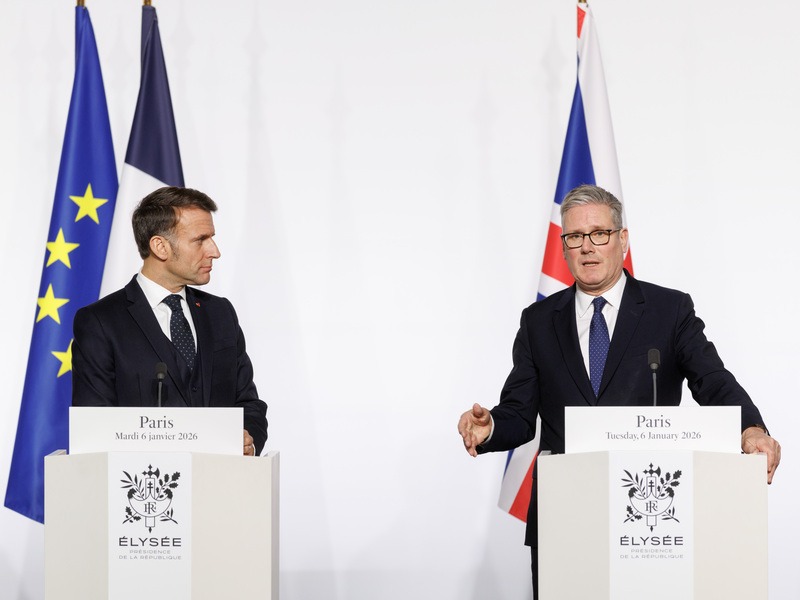
Image credit: Prime Minister Keir Starmer attends Coalition of Willing Meeting (2026) by 10 Downing Street via Flickr. Licensed under CC BY-NC-ND 4.0.
Disclaimer: Any views or opinions expressed in articles are solely those of the author and do not necessarily represent the views of the NATO Association of Canada.