In recent years, ethnonationalist movements in the Western world have gained greater visibility, pushing once-fringe ideas toward the mainstream. At the core of these movements is the belief that national belonging is rooted in race and ancestry. Under this logic, being born in a country, or even holding legal citizenship, does not necessarily make someone a member of that nation. What warrants closer examination is how these movements use selective interpretations of statistics, misleading demographic claims, and conspiracy theories to justify exclusionary measures.
The Dominion Society of Canada is an example of this movement, a self-proclaimed nationalist organization advocating for Canadian identity. Despite this framing, the Canadian Anti-Hate Network has identified the group as white nationalist, pointing to the hardline racial and ethnic exclusion found in its proposed policies. Central to its platform is the concept of remigration, which the organization’s leadership describes as “the only path forward to save Canadians from becoming a minority in our homelands.” Their proposed 11-step plan for remigration outlines measures intended to “preserve” the Canadian nation, including, but not limited to, the mass deportation of temporary foreign workers, restricting birthright citizenship, and terminating existing permanent residency status.
What calls for scrutiny is both the severity of such proposals as well as the specific chain of false and misleading claims used to justify them. Foundational to the group’s messaging is the Great Replacement Theory, which claims that immigration and multiculturalism are part of a deliberate, coordinated effort by “elites” to replace predominantly white populations in Western nations with largely non-white immigrants from developing countries. One can look to the emotive language often used to advance this narrative, with terms including “invasion,” “survival,” and “takeover,” portraying immigration as an existential threat to gain sympathy among the in-group.
This mechanism appears on the Dominion Society’s own website. The organization notes that Canadian fertility rates have been declining since the 1960s and fell below replacement level in the early 1970s. This part is correct and backed by Statistics Canada. However, the organization then takes a deliberate and unsupported leap, using these figures to claim that Canada’s declining fertility rates are being exploited by elites to justify immigration, viewing immigration policy itself as purposeful ethnic replacement. From there, it extends the same faulty logic outward, reframing housing affordability, wage stagnation and the erosion of Canadian cultural identity as immigration’s fault. By appealing to the collective worries Canadians already feel, it allows the narrative to spread and circulate more widely.
This deception is at the heart of the group’s messaging, where real statistics are deployed to construct a false causal chain. Housing affordability, for instance, is shaped by a far more complex set of factors than acknowledged. Economists at the C.D. Howe Institute point to Canada’s concentration of jobs and housing demand in a handful of major cities, restrictive zoning and land-use regulation, and up-front development charges that push construction costs onto new housing, driving prices. Research published by Immigration, Refugees and Citizenship Canada (IRCC) further complicates the group’s narratives, finding that immigrant arrivals accounted for roughly 11% of the overall increase in median house values and rental rates across Canada between 2006 and 2021. While this figure suggests that immigration is not an insignificant factor, it stands in sharp contrast to claims made by the Dominion Society of Canada, such as its assertion that “Canada now has the highest average home prices across G7 countries – entirely as a result of immigration.” By presenting immigration as the sole driver behind these challenges, the Dominion Society transforms public anxieties surrounding economic security and affordability into greater fears of ethnic replacement. Its misuse of accurate information lends credibility to deliberately manufactured claims, framing remigration as a necessary measure for national preservation.
The Dominion Society is not an isolated case. Its rhetoric follows a broader strategy established by ethnonationalist movements in Europe, where the same narratives have been used to help gain traction. Germany’s Alternative for Germany (AfD), now the country’s most popular party nationwide, provides a clear example of the model the Dominion Society draws inspiration from. Founded in 2013 to give voice to Euroskeptics who advocated for disengagement from the European Union, the AfD has since moved into far-right extremism, as classified by German intelligence. Like the Dominion Society that is following in its footsteps, the AfD endorses the Great Replacement theory to champion remigration as necessary to defend German national identity against a perceived immigration-driven cultural decline. Adopting the AfD’s playbook, the Dominion Society similarly repackages this narrative into formal policy proposals: the AfD dedicated an entire chapter to remigration in its election program for Saxony-Anhalt, while the Dominion Society devotes an entire website page outlining its 11-step remigration plan.
Notably, the AfD’s growing support has been accompanied by opposition to policies intended to advance shared NATO priorities toward Russia. Historically, Germany and Russia have been bound by deep economic ties; before the invasion of Ukraine in 2022, Russia supplied Germany with roughly a third of its crude oil imports and more than half of its natural gas. As Berlin moved to sanction Russian oil and gas, energy prices skyrocketed, compounding a broader economic downturn and fueling the AfD’s pushback against them. The AfD’s support base reflects this discontent: only about 39 percent of AfD supporters view NATO favourably, a marked departure from the German public overall. For voters already struggling with higher energy costs and economic uncertainty, pointing the finger toward continued support for Ukraine offers an outlet for citizens’ economic grievances. The AfD has capitalized on these frustrations to reinforce broader opposition to NATO and the political establishment, which is only further amplified by Russian influence campaigns that aim to fuel these social divisions.
For NATO, the implications are substantial. By amplifying domestic grievances, disinformation can deepen opposition to NATO-aligned policies, including military support for Ukraine and sanctions against Russia. This shift is already reflected in the AfD’s calls to end arms deliveries to Ukraine and lift sanctions against Russia. In addition, the security risks posed by AfD-linked connections to Russia are not hypothetical; for example, the AfD appears to have played a role in Russia’s recruitment of a senior German intelligence officer in 2022, who supplied Russia with information about the war in Ukraine. Such breaches complicate cooperation among allies, particularly where they jeopardize the protection of sensitive information and the delivery of shared security objectives. As of now, it has been reported that German defence officials are considering steps to block regional state governments from accessing confidential national and NATO defence plans as the AfD enters government.
Returning to the Dominion Society, the organization has not yet expressed an anti-NATO or pro-Russia position. Nevertheless, both movements are built on the same architecture, using real statistics to lend credibility to false and misleading claims about immigration. Yet, how the Dominion Society has developed connections with leading figures in European ethnonationalist networks raises a genuine question about where that trajectory could lead. For instance, Austrian white nationalist Martin Sellner was selected as keynote speaker for Canada’s 2026 Dominion Conference alongside British fascist speaker Charlie Downes. Both individuals are connected to the AfD’s broader network and are hardline proponents of remigration policies. Whether these connections move beyond a shared ideology into a shared strategy remains open. But the path the AfD took once it began forging those relationships makes their development with the Dominion Society worth watching closely.
Ultimately, what began as a fringe conspiracy theory about the deliberate replacement of white populations has become an increasingly mainstream tool for exploiting citizens’ economic and cultural insecurities. By wrapping real evidence around false conclusions, narratives like the Great Replacement manufacture concrete-sounding justification for exclusionary policies. The groups championing these narratives can ultimately gain reach and perceived legitimacy that, as the AfD example suggests, increases their influence over broader security and partnership choices. It is this trajectory, and its potential consequences for the alliance, that warrants serious attention from NATO and its member states.
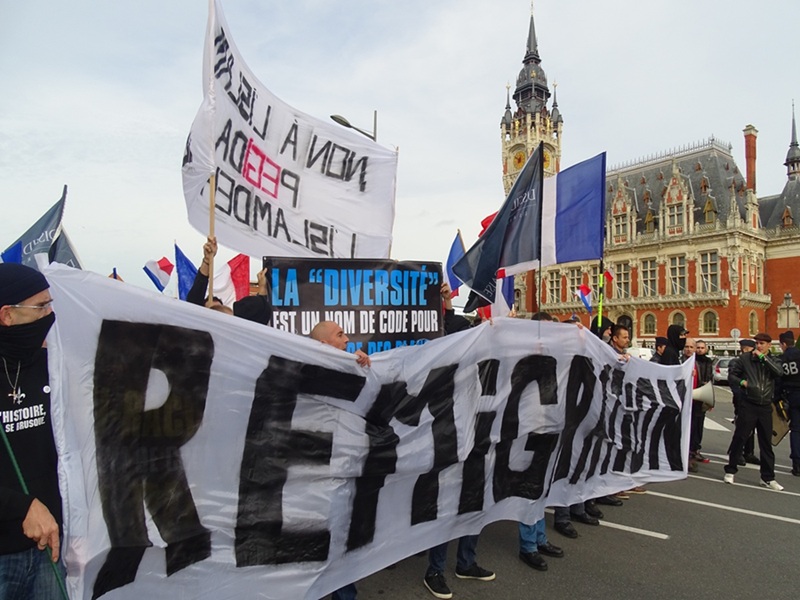
Image: “Demonstrators with a ‘remigration’ banner, Calais, 2015,” (2015) by Jérémy-Günther-Heinz Jähnick via Wikimedia Commons. Public Domain.
Disclaimer: Any views or opinions expressed in articles are solely those of the authors and do not necessarily represent the views of the NATO Association of Canada.