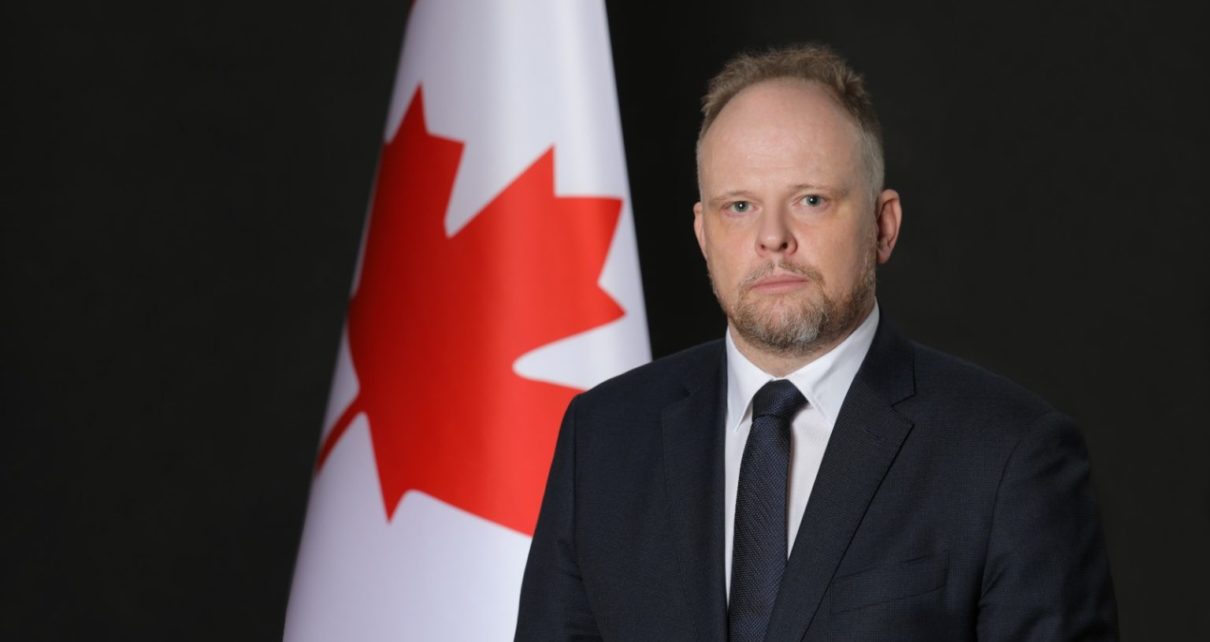
Canadian diplomat Kevin Hamilton was recently appointed NATO’s Deputy Assistant Secretary General for Partnerships and the Secretary General’s Special Representative for the Caucasus and Central Asia. Hamilton previously served as Canada’s Ambassador to Türkiye, with concurrent accreditation to Azerbaijan and Georgia, and held senior positions at Global Affairs Canada, including Director General for International Security Policy and Director of the Eastern Europe and Eurasia Division. This move from Ankara to Brussels signifies more than merit. It reflects Canada’s capacity to exert indirect influence within NATO’s political structures and coincides with the alliance’s growing attention to a region shaped by mounting geopolitical pressures, longstanding conflict, and recent instability.
His appointment places him at the centre of the alliance’s engagement with the Caucasus and Central Asia as NATO intensifies its involvement in these states. Hamilton is responsible for advancing NATO’s policy and engagement across both regions and overseeing its political relationships with partner countries, contributing to cooperation, security dialogue, and regional stability. In the Caucasus, NATO works with Armenia, Azerbaijan, and Georgia, and in Central Asia, with Kazakhstan, the Kyrgyz Republic, Tajikistan, Turkmenistan, and Uzbekistan through the Partnership for Peace Programme and, in some cases, Individually Tailored Partnership Programmes. These mechanisms embed NATO influence across non-member states, extending security beyond its borders and reinforcing the alliance’s overall stability. The Partnership for Peace provides a framework for practical bilateral cooperation between NATO and partner states, while Individually Tailored Partnership Programmes set a distinct, target-driven structure that defines the priorities of NATO’s engagement with each partner. The combined use of broad and tailored Programmes signals a clear strategic priority to remain actively involved in maintaining communication and partnership across both regions.
To this end, in January 2026, Deputy Secretary General Radmila Shekerinska visited Azerbaijan, where discussions included the development of an Individually Tailored Partnership Programme centred on defence reform, security capacity, and resilience between NATO and Azerbaijan. The visit underscored NATO’s intent to deepen collaboration with Azerbaijan and support regional stability, reflecting a deliberate push to strengthen political and security presence across the Caucasus and Central Asia.
The urgency of this engagement is driven in part by the region’s structural importance. The Caucasus and Central Asia function as a major energy-producing zone and a critical transit corridor for oil, gas, and trade, linking Asia to Europe. Infrastructure such as the Southern Gas Corridor and the Baku–Tbilisi–Ceyhan pipeline, alongside routes like the Trans-Caspian International Transport Corridor, move energy resources across the region. This centrality places NATO’s partnership framework, and Hamilton’s role within it, at the forefront of managing emerging pressures. Hamilton’s experience as Director of the Eastern Europe and Eurasia Division at Global Affairs Canada, where he oversaw political and trade relations with 19 European and Eurasian countries including Central Asia, gives him familiarity with the networks and dependencies that underpin this space.
Recent developments linked to the Iranian war have intensified the importance of Central Asia and the Caucuses to energy security and logistics, reinforcing the immediate relevance of NATO’s role and the need for experienced political coordination. American and Israeli military strikes launched in February contributed to disruptions in key transit routes and energy flows. This includes the effective closure of the Strait of Hormuz, through which around 20 percent of global oil supply is transported. The resulting strain on shipping and energy supply chains has increased prices and contributed to wider economic instability, conditions that elevate the importance of diplomatic relations with partner states and heighten expectations for Hamilton to help coordinate the alliance’s response.
For Central Asian states, the consequences are direct. Iran’s geography is indispensable for surrounding landlocked economies reliant on the territory for access to international commerce through the Persian Gulf and Indian Ocean. This is the reality for Turkmenistan, Tajikistan, and Uzbekistan, with Uzbekistan alone routing 60 percent of its European and Turkish transit through Iran. Constraints on these conduits increase reliance on alternative networks controlled by Russia or China, exposing structural weaknesses in trade and energy systems. The impact extends to food supply, as Iran’s ban on exports in response to the war has threatened regional food security and critical transit agreements.
The effects extend into the Caucasus, where the war risks destabilising neighbouring states, particularly through displacement across borders. Reports of Iranians fleeing into Türkiye point to the potential for wider population movement if the conflict persists. In a region already shaped by unresolved tensions, including the displacement of more than one hundred thousand ethnic Armenians following the Nagorno-Karabakh conflict, renewed instability raises the prospect of further humanitarian strain and regional unrest.
It is within this context of heightened geopolitical tension that Hamilton assumed his role. His regional portfolio and prior relationship to these states position him not only to respond to the spread of these pressures across Central Asia and the Caucasus, but also to manage their implications for NATO’s partnerships.
The appointment of a Canadian diplomat as a senior NATO official gives Ottawa indirect influence over how the alliance operates in these regions. Hamilton’s appointment allows Canada to shape NATO’s engagement through institutional authority — namely agenda-setting, partnership priorities, and political communication within NATO’s internal structures. The placement reflects Canada’s institutional standing within NATO, extending beyond individual achievement. It reinforces Canada’s foreign policy reputation, translating national diplomacy into institutional influence within a multilateral framework.
The Caucasus and Central Asia are not peripheral to global stability. Disruptions to transit routes and energy flows reverberate through regional security dynamics and carry immediate ramifications felt worldwide, reinforcing the region’s significance in trade and connectivity. This relevance is reflected in NATO’s increasing engagement with the region, notably through dialogue, and partnerships such as the Partnership for Peace and Individually Tailored Partnership Programmes. The alliance’s decision to appoint a diplomat with Hamilton’s regional background reflects its commitment to the region and the importance it places on sustained cooperation. Hamilton’s experience positions him to engage with the intricate and evolving dynamics of this region, which in turn corresponds with Canada’s diplomatic reputation and visibility within the alliance.
NATO should treat the Caucasus and Central Asia not only as partnership regions but as critical resilience corridors for energy and trade security. This requires moving beyond dialogue-based engagement toward more operational coordination on infrastructure protection, diversification of transit routes, and contingency planning for supply disruptions. Strengthening partnership instruments such as the Partnership for Peace and Individually Tailored Partnership Programmes means prioritizing measurable capacity-building in energy security, border management, and crisis response over dialogue and agreements alone. Within this framework, Hamilton’s role would involve translating these priorities into coordinated political engagement across partner states and ensuring consistency between NATO’s strategic objectives and its regional partnerships.
Ultimately, NATO’s partnerships and engagements in the Caucasus and Central Asia are becoming increasingly central in an environment defined by geopolitical complexity. Hamilton therefore enters a role defined by both pressure and opportunity — one that will test how individual diplomatic experience translates into institutional influence.
Disclaimer: Any views or opinions expressed in articles are solely those of the authors and do not necessarily represent the views of the NATO Association of Canada.