The fate of the Canadian federation hangs in the balance as Albertans are set to take to the polls in October 2026 to vote on whether Alberta should remain a province of Canada or hold a separate, binding referendum on secession.
The stakes of the referendum could not be higher for Canada. Losing Alberta would mean losing its economic backbone, a key portion of Canadian land, and a critical pillar of Canadian defence. In doing so, secession would not only undermine Canadian defence posture and unity, but also Canada’s ability to fulfill alliance commitments such as NATO. As such, it is no surprise that foreign actors — Russia foremost among them — are actively fomenting separatist narratives.
A recent report by DinInfoWatch details Russian involvement in propagating Alberta separatism. The researchers found that Russian-linked websites are posing as Albertan voices, such as the now-defunct “albertaseparatist.com.” These websites promote separatist narratives that exploit ready-made fault lines within Canada, rooted in Alberta’s discontent with the Canadian fiscal imbalance, which sees Alberta contribute to federal redistribution at higher rates than other provinces. These websites, along with social media accounts, appeared to have shifted their rhetoric from falsehoods about Ukraine towards Alberta separatism in 2026.
Russia’s motivation is more than opportunism; it is intentional and follows an established trend. In 2014, Scotland held a referendum on whether to leave the United Kingdom, which, as in Alberta, was marred by a Russian disinformation campaign aimed at sowing disunity and weakening the United Kingdom. Likewise, in the run-up to the 2016 Brexit referendum in the United Kingdom, Russia used similar measures to promote British withdrawal from the EU, viewing Brexit as favourable due to its fracturing effect on the EU and the appearance of disunity. The most clear precedent, however, is Russia’s campaign in the Donbas region of Eastern Ukraine. Russia combined disinformation and covert support for surrogate actors, aimed at institutionalizing pro-Russian politics inside Ukraine to block its westward drift. The Kremlin’s goal in exploiting Albertan grievances is therefore weakening not only Canada but NATO more broadly — achieving a feat akin to Sun Tzu’s doctrine of subduing one’s enemy without direct combat.
There are multiple scenarios in which Russia can achieve such an aim. The most clear is Alberta seceding. Alberta has long been the highest-contributing province to federal revenue, with its net contribution over the last 20 years of $321.9 billion being four times that of the second-highest contributor, British Columbia. In terms of GDP per capita, Alberta also ranks at the top; its 2024 GDP per capita was US$84,700, with the second-highest province, Saskatchewan, at US$79,300. Further, oil and gas extraction, Canada’s most valuable export sector, would be severely impacted. At $153.5 billion in revenue in 2026, oil and gas extraction is the cornerstone of Canada’s export economy, and importantly, the industry is heavily concentrated in Alberta, which accounts for roughly 75% of the national output. The resultant effect of losing Alberta would be a dramatic economic downturn for Canada, at the moment when Canada needs economic power the most: Canada has only just met NATO’s 2 percent of GDP defence spending target in March 2026 and has since committed to a considerably higher new target of 5 percent of GDP by 2035.
Further, the hit to Canada’s economy would impair its commitments to foreign aid, the majority of which goes to Ukraine. Since Russia’s 2022 invasion of Ukraine and subsequent war, Canada has committed to providing Ukraine with $25.5 billion in financial and military aid. In 2026, Canada reaffirmed its commitment, investing an additional $300 million. Canada’s aid to Ukraine is all the more consequential given the Trump administration’s scaling down of US aid to Ukraine, which has further shifted the burden to NATO allies.
The above scenarios depend on Alberta’s secession. However, it remains unclear whether enough Albertans would vote to leave — polling indicates only 18% would vote to separate — or whether the referendum process would be constitutionally viable. Yet, even if Alberta does not secede, Russia can still derive a strategic advantage from its involvement in the push for separation. By amplifying Alberta separatism and helping it crowd the Canadian national agenda, Russia can divert political attention away from defence and Ukraine. Bureaucratic and political attention is a finite resource; each unit of time or resources spent on the problems associated with the impending referendum could be devoted to more productive ends, such as defence procurement, Arctic posture, or alliance commitments.
Similarly, the economy can be impacted even if separation does not happen. The mere threat of separation will encourage capital flight from the province and dampen investor confidence, potentially harming Canada’s economy at large. As Trevor McFadyen notes, “when political risk rises, investors either flee or demand higher bond yields to compensate for uncertainty.” Carney himself affirmed this, saying a referendum “can have an effect” on investor confidence. Such realities are favourable to Russia, giving Putin ample reason to exploit Albertan grievances, even if a true separation might not seem likely.
It is worth noting that Russia is not the only country encouraging Albertan separation. High-ranking officials in the U.S. administration have both mused publicly about Albertan independence and have hosted separatist leaders in Washington. While perhaps not as malevolent as the Kremlin’s approach, Canada nevertheless needs to remain steadfast on the diplomatic front and discourage American meddling in a fundamentally Canadian issue.
The proper response requires understanding the issue at hand. In this case, Russia is not necessarily waging cognitive warfare against NATO directly, as it has been doing for the last four years vis-à-vis Ukraine; rather, it is targeting the domestic conditions in Canada that can dictate what it can contribute to the alliance. Russia’s goals can be met not only by true secession but also through a strategic diversion arising from the greater attention placed on the vote.
While Canada must employ the necessary legal and political measures to prevent secession — as it has previously done in Quebec — the government must also address the problem at its source. With Russian disinformation increasingly penetrating Canadian feeds, Ottawa should treat it as it would foreign interference in federal elections. The Security Intelligence Threats to Elections Task Force (SITE) already exists as a cross-agency working group meant to address threats to elections and safeguard Canadian democracy. Its current mandate is limited to federal elections and by-elections; however, given that Russia poses a real threat to Canadian democracy, the government ought to expand SITE’s mandate to include referenda to ensure that all resources can be mobilized to confront Russian interference.
NATO, however, cannot do much on the Canadian front. Instead of direct engagement with the threat, NATO should continue to invest in and collaborate with Canada through bodies like the NATO Strategic Communications Centre of Excellence in Latvia to counter familiar Russian disinformation tactics now being employed against Alberta. Member-state cohesion is a strategic asset for the alliance; it is in NATO’s interest to treat this matter as shared terrain rather than an isolated Canadian issue. In the absence of such coordination, not only might the forthcoming referendum end in a debacle for Canada, but it would also weaken NATO to Russia’s benefit.
Disclaimer: Any views or opinions expressed in articles are solely those of the authors and do not necessarily represent the views of the NATO Association of Canada.
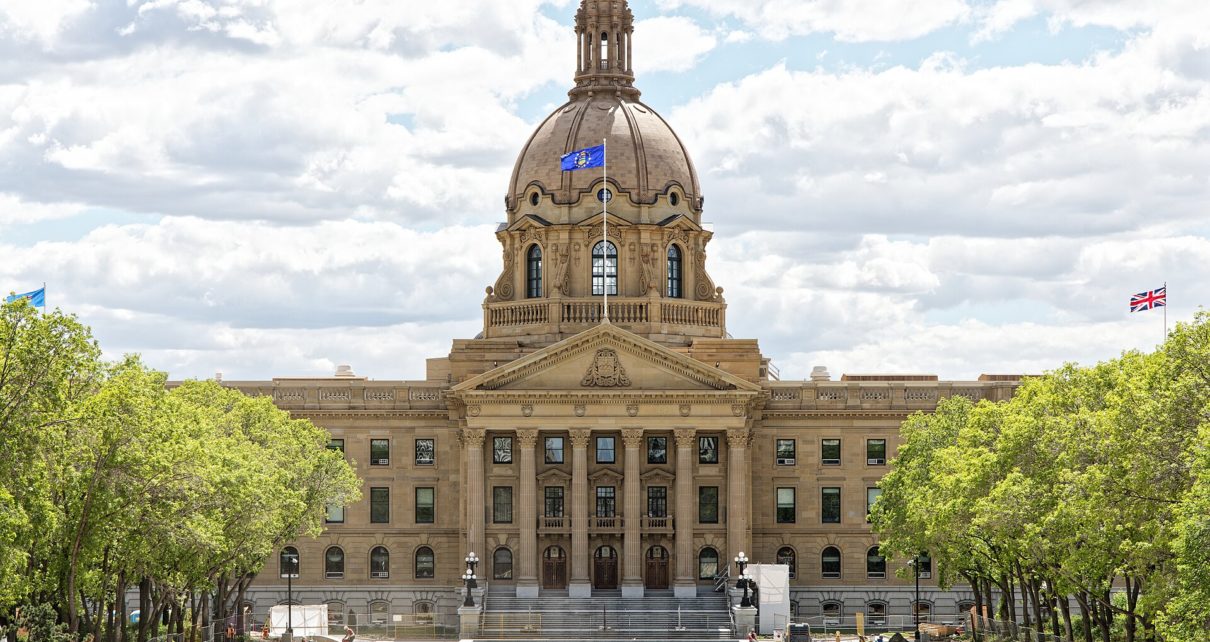
Photo: “Alberta Legislature Building” by Benjamin Miller is licensed under Creative Commons CC0 1.0 Universal. https://commons.wikimedia.org/wiki/File:Alberta_Legislature_Building,_June_7,_2024.jpg