For millions of people, displacement poses a threat not due to war or persecution, but because the land beneath their feet is disappearing, crops can no longer grow, or floods return year after year. A 2020 report by ActionAid and Climate Action Network South Asia estimates that climate-related disasters could displace nearly 63 million people across five South Asian countries by 2050, including 45 million people in India alone. As climate change reshapes where people can safely live and work, climate-driven migration is emerging as one of the defining humanitarian and security challenges of the 21st century.
Climate-driven displacement poses an emerging strategic challenge for NATO and Canada because unmanaged migration, regional instability, and humanitarian crises can intensify security pressures across the transatlantic alliance. NATO’s strategic assessments, including the Brussels Summit Communiqué and the Climate Change and Security Action Plan, identify climate change as a “threat multiplier” that exacerbates conflict, fragility, and global insecurity. However, a critical disconnect remains; while fragile states experience the majority of climate-related disasters, the international legal framework still provides no formal status for those displaced by environmental collapse. This legal gap increases the likelihood of unmanaged migration flows, political instability, and resource competition – conditions that directly affect NATO’s long-term security and crisis management priorities. At the core of this disconnect is a refugee protection system designed for a different era.
How can a 20th century framework, conceived in the aftermath of WWII as a response to state-based persecution within a clearly defined Westphalian order, adequately address the realities of 21st century displacement? The evidence suggests it cannot. According to the latest UNHCR report, global displacement has reached 121 million people, including 30.5 million recognized refugees.
Yet, the global rules-based order remains anchored in the 1951 Refugee Convention, which defines protection narrowly in terms of persecution based on race, religion, nationality, or political opinion. It contains no legal recognition for individuals displaced by environmental degradation or climate-induced collapse. As a result, those fleeing uninhabitable conditions such as drought, sea-level rise, or ecosystem collapse are often categorized as ‘economic migrants,’ despite the involuntary nature of their displacement. This legal classification gap limits access to international protection mechanisms and increases the risk of return to unsafe or uninhabitable environments, exposing a structural limitation in the current protection regime.
This disconnect between legal frameworks and contemporary displacement trends has direct strategic implications for NATO and Canada. Without reform or adaptation, climate-driven migration pressures are likely to intensify political polarization, strain border management systems, and increase the frequency of humanitarian crises affecting member states. In this sense, the legal invisibility of climate-displaced populations is both a humanitarian issue and also a growing security vulnerability for the transatlantic alliance.
The burden of hosting the world’s displaced populations falls disproportionately on developing countries. The UNHCR Report describes how low- and middle-income countries host 71% of all refugees, while the Least Developed Countries alone provide asylum to one quarter of the global total. As climate change drives increasing levels of displacement, these states may face growing competition over scarce resources, mounting pressure on public services, and heightened social tensions. In countries where political and economic conditions are already fragile, climate-related stress can contribute to instability and exacerbate existing conflicts, as illustrated by the case of Syria.
Between 2006 and 2010, Syria experienced one of the worst droughts in its recorded history, severely damaging agricultural livelihoods which led to widespread rural-to-urban migration. According to the UN, nearly 800,000 people lost their livelihoods during this period. This migration placed additional pressure on already strained urban centres, where rising unemployment, overcrowding, and inequality contributed to growing public dissatisfaction. While climate change did not directly cause the Syrian Civil War, many researchers argue that the prolonged drought acted as a threat multiplier, worsening existing vulnerabilities and increasing the likelihood of unrest in a country already facing significant political and economic challenges.
As such, addressing the challenges posed by climate migration necessitates a security-oriented shift in policy. While legislative reform of refugee law primarily falls under the jurisdiction of the international system, NATO can play a supporting role by integrating climate-related displacement into Alliance security planning, resilience strategies, and crisis prevention frameworks. NATO’s role in climate displacement must be to enhance preparedness, coordination, and logistical capacity, ensuring that large-scale relocations triggered by climate disasters occur in a controlled and stable manner rather than evolving into security crises.
One of the most effective ways to address climate-related migration is to reduce its root causes by strengthening resilience in vulnerable communities. Investing in climate-adaptive infrastructure such as flood defences, drought-resistant agriculture, and sustainable land and water management can help communities withstand environmental shocks and remain in their homes.
Evidence from India highlights this approach. Research by the Centre for Science and Environment (CSE) shows that villages with investments in water harvesting and ecological restoration experienced reduced migration and, in some cases, even reverse migration. Programmes such as the Mahatma Gandhi National Rural Employment Guarantee Act (MGNREGA) have further demonstrated how ecological infrastructure and guaranteed rural employment can strengthen local livelihoods and reduce climate-driven displacement.
Planned relocation is another proactive strategy that NATO can support by helping member and partner states prepare for large-scale climate displacement before crises occur. Rather than responding after disasters force uncontrolled migration, NATO can contribute to coordinated planning, risk assessments, and logistical preparedness that enables safer and more orderly relocation of vulnerable populations. The situation in Kiribati illustrates why this matters; faced with rising sea levels projected by the Intergovernmental Panel on Climate Change to approach nearly one metre by 2100, the country has begun long-term planning for relocation, including purchasing land in Fiji as a potential future home for its population.
Within this context, NATO can also integrate climate risk data into broader security planning. This includes monitoring drought, food insecurity, and water stress, as well as identifying potential displacement hotspots before they escalate into humanitarian or security crises. By sharing intelligence with member states and coordinating preparedness efforts, NATO can help ensure that relocation and migration linked to climate change are managed in a planned and orderly way rather than occurring reactively in the aftermath of disaster.
Concluding Remarks
The international community is currently addressing a 21st-century displacement crisis with a 20th-century framework. As climate change accelerates instability, forced migration, and regional fragility, existing systems of response are increasingly insufficient. Addressing climate-driven displacement therefore requires both prevention and preparedness.
Strengthening resilience in vulnerable regions through climate-adaptive infrastructure, sustainable land and water management, and community-based development can reduce the need for forced migration in the first place.
At the same time, stronger international frameworks are needed to protect those already displaced by climate impacts. This includes legal recognition of climate-displaced populations and expanded safe migration pathways.
As seen in cases such as Syria, climate-driven displacement does not occur in isolation; it interacts with governance fragility, resource scarcity, and conflict dynamics, contributing to instability across entire regions and posing a threat to global security that demands a coordinated international response. In an era of accelerating environmental change, adaptation is no longer optional; it has become a prerequisite for security.
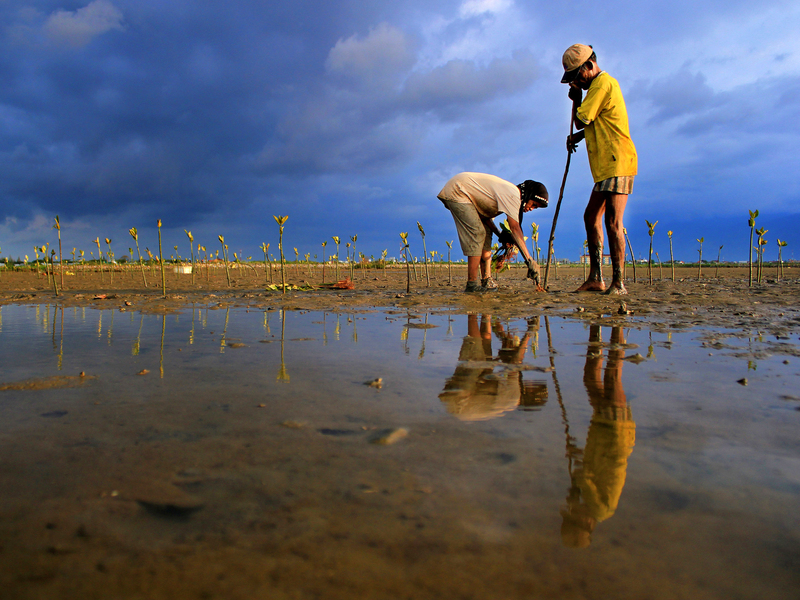
Image credit: Mangrove Forest Reforestation (2015) by Irwandi wancaleu via Wikipedia Commons. Licensed under CC-BY-SA-4.0
Disclaimer: Any views or opinions expressed in articles are solely those of the author and do not necessarily represent the views of the NATO Association of Canada.